

Greetings all
Like it or not, Australia is inextricably enmeshed in the continuing global economic and political strife emanating from the Strait of Hormuz. No surprise really then that Naval matters – past, present and future – remain front of mind and feature again in this MMHN Update.
Contents
1. Australian Defence Strategy
2. RAN – Changes in Command
3. Strait of Hormuz Negotiations – Australia
4. RAN – Japanese Frigates Contract
5. AUKUS Production Issues – US and UK
6. RAN – KAKADU Fleet Review
7. Suez Canal – Strait of Hormuz
8. Gallipoli Strait – History Informs the Present ME Conflict
9. Dire Straits – Seafarers at Risk
10. News of HMVS Cerberus Wreck, Half Moon Bay
11. The Polly Woodside site in Better Days
12. Ocean Energy Untapped
13. Who’s Who in State Government 2026
14. Maritime Heritage Legislation – key to protection
15. Historic document: Journal of Midshipman J.J. Cody
16. National Marine Science Strategy
17. Maritime Skills and Careers
18. Antarctica – 19th Century
19. The Dan Ships – Antarctic Heritage
20. Central Pier, Victoria Harbour – DV fails again
21. Port of Darwin – China
1. Australian Defence Strategy
The 2026 National Defence Strategy (NDS) refers to $53 billion over the next decade – three percent of GDP. Academic Peter Layton, Strategic Studies, Griffith University writes (The Conversation 16/4), ‘the planned allocations for operating and crewing the Australian Defence Force’s (ADF) current ships, aircraft and vehicles is unlikely to be enough. Disappointingly, though, compared to the huge spends on traditional crewed warships, submarines and armoured vehicles, there hasn’t been much allocated to these systems or the AI wave of the future.’
Reference to implementing the 2024 ADF Strategy does not inspire confidence particularly as Minister Richard Marles claims the 2026 Strategy reflects ‘a clear-eyed assessment of a more dangerous and uncertain world.’ However, attention to the ‘new’ warfare weapons currently being waged elsewhere is heartening. E.g. ADF investment in autonomous uncrewed systems (drones in the air and water), such as the Air Force’s Ghost Bat and the RAN’s Ghost Shark and Speartooth components are manufactured in Australia.
The NDS does note the investments Defence has made in recent years to improve fuel security to remediate shortfalls. It has done trials on low-carbon, sustainable aviation fuels, but there are no plans yet to produce these on a large-scale for military use. ‘So far, it seems Defence is just nibbling at the edges of fuel security and resilience.’
See: 2026 National Defence Strategy
Also: The Conversation – New National Defence Strategy
Ghost Bat; Ghost Shark; Speartooth
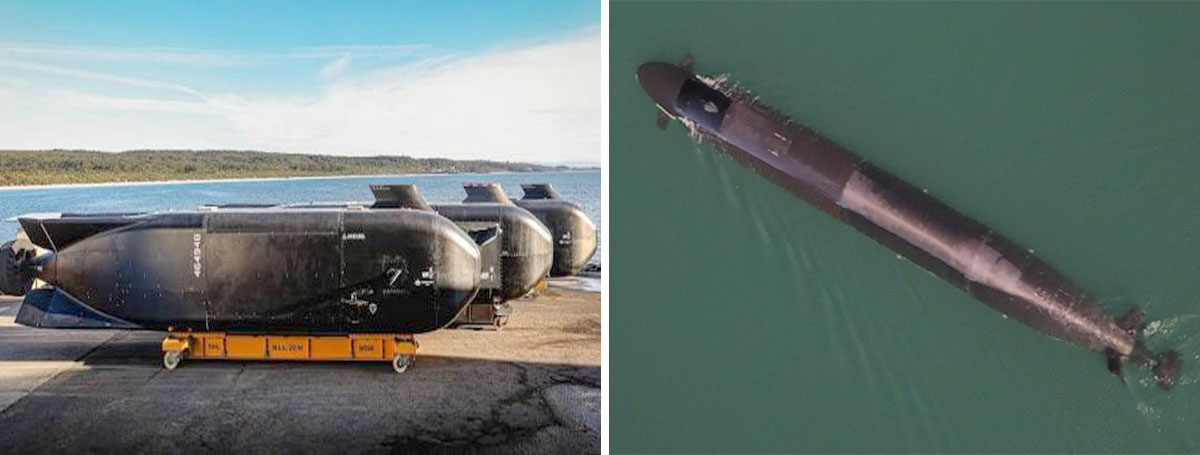
Images: Ghost Shark and Speartooth Credit: from manufacturers websites
2. RAN – Changes in Command
MMHN notes two major RAN promotions will occur in July 2026.
Chief of the Navy, Vice Admiral Mark Hammond AO RAN will be appointed as the Chief of the Defence Force. Deputy Chief of Navy, Rear Admiral Matthew Buckley AM CSC will be promoted to Chief of Navy. Reflecting, perhaps, the growing recognition that Australia is an island nation ‘girt by sea’ and, as always, our nation’s security and prosperity are heavily reliant upon our maritime capability. MMHN offers congratulations and sincere best wishes to both men in these uncertain times.
See: About Navy Leaders
3. Strait of Hormuz Negotiations – Australia
The tortuous Middle East Conflict continues, defying all intelligent analysis. MMHN’s focus remains on the Australian context. Matthew Knott and Michael Koziol reports (The Age 15/4) that Defence Industry Minister, Pat Conroy stated that Australia will ‘most definitely’ participate in a summit with France and Britain, aimed at forming a global coalition to reopen the Strait of Hormuz after a permanent ceasefire is in place. Given that Israel, US or Iran will not take part and at least 15 US warships are currently attempting to blockade the Strait and Iranian ports, it is difficult to feel optimistic.
See: Australia joins Strait of Hormuz talks – without the US
Also: ABC News – Federal Politics Blog
4. RAN – Japanese Frigates Contract
RAN has selected the upgraded Japanese Mogami-class frigate, built by Mitsubishi Heavy Industries (MHI), as the preferred platform for the future fleet of general-purpose frigates. The upgraded Mogami-class can be delivered fast, is larger and more lethal, and has lower crewing requirements than the Anzac-class frigates. The first three frigates will be operational by 2034.
The general purpose Mogami-class frigates will replace the Anzac-class frigates and be equipped for undersea warfare and local air defence. They will be built offshore by Mitsubishi Heavy Industries. Subject to the right conditions, the remaining frigates will be built at the Henderson Defence Precinct in Western Australia.
Australia and Japan signed an historic contract mid-April in Melbourne. This will be Japan’s first ever warship export project. Both Japan’s Defence Minister, Shinjiro Koizumi and his Australian counterpart, Richard Marles, attended a signing ceremony aboard the Mogami-class frigate JS Kumano, docked off Station Pier, alongside HMAS Brisbane. Soon after the event Japan announced its biggest overhaul of defence export rules in decades.
MMHN was delighted to accept RAN’s invitation to join the celebration marking this historic contract. A wonderful evening with insightful speeches, musical entertainment and a sake ceremony known in Japan as Kagami Biraki. This traditional Japanese ritual is performed to bring good fortune, safety, and prosperity to a new vessel and its crew. Wooden mallets are used to break open a large, decorated barrel of sake (sakadaru) then distributed among the attendees to share in the joy and good fortune.
See: Mogami-class Frigate
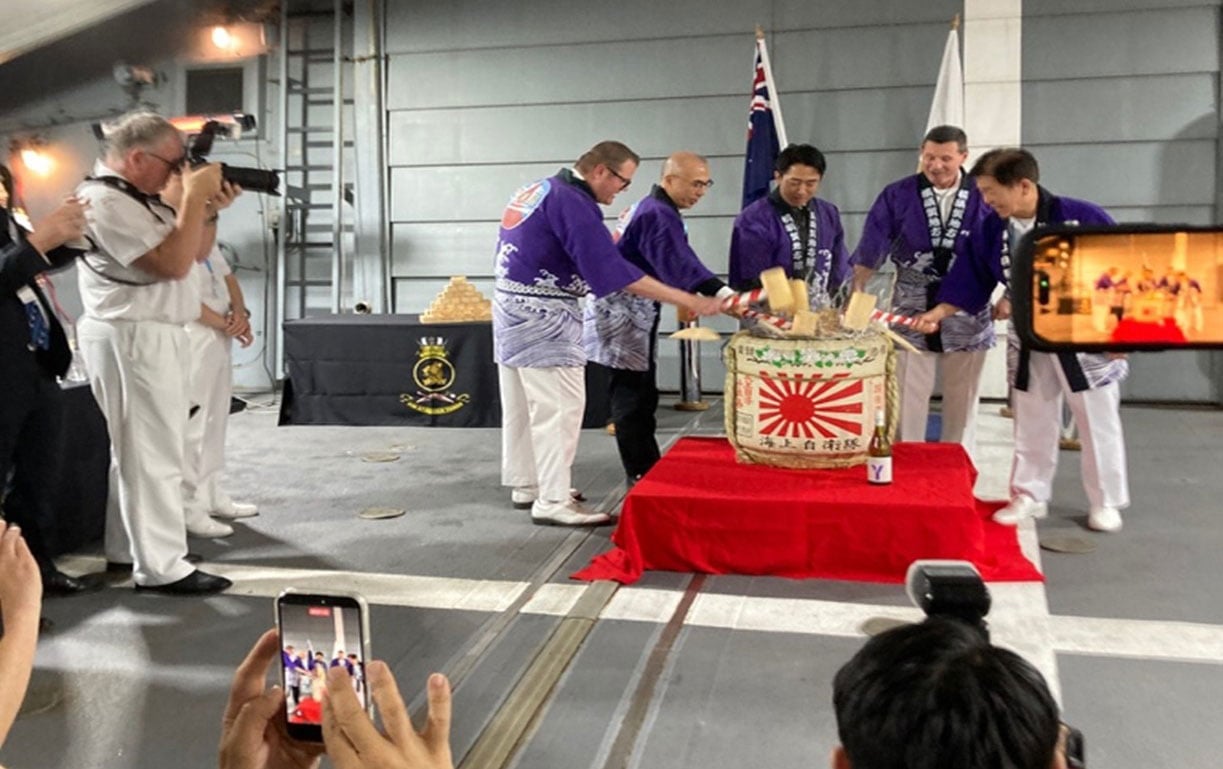
Image: Kagami Biraki ceremony aboard the HMAS Brisbane. Credit: Jackie Watts
5. AUKUS Production Issues – US and UK
Vice Admiral Robert Gaucher says the Trump administration remains committed to the AUKUS alliance. Michael Koziol (SMH 22/4) reports that, ‘the US Navy’s priority is the next-generation Columbia-class of nuclear-powered submarines, rather than the Virginia-class vessels.’ Gaucher has conceded that the production rate for Virginia-class submarines is still well below that required to meet the needs of both the US Navy and the deal to sell at least three vessels to Australia via the AUKUS defence pact.
Journalists Riley Stuart and Elias Clure report that British politicians have cast doubt on the UK’s ability to develop and deliver nuclear submarines promised as part of the AUKUS defence pact. The House of Commons Defence Committee on Tuesday released the findings of its year-long review into the trilateral partnership. While the report was broadly supportive of AUKUS, it also ‘laid bare the scale of the endeavour that will be required to deliver it.’
See: US says Virginia class ships not priority
Also: Britain launches AUKUS parliamentary inquiry
Listen: Shortcomings in UK’s delivery of AUKUS
6. RAN – KAKADU Fleet Review
2026 marks 125 years since the foundation of the RAN. Vice Admiral Hammond said, ‘125 years of naval service commenced in March of 1901 with the establishment of the Commonwealth Naval Force. In 1911, we were conferred with the title ‘Royal Australian Navy’ from His Majesty the King, and then in 1913 we witnessed the arrival of the first fleet unit here in Sydney Harbour.’
2026 is the first time RAN brought the Kakadu Fleet Review to Sydney Harbour. Throughout the anniversary year a number of activities will take place to mark this historic milestone, including a fleet review; a naval tradition where a reviewing officer on board the reviewing ship inspects the massed ships of the navy, typically when the battle fleet was mobilised for war. Since the 19th century, fleet reviews have been held for commemorative events and celebrations, including inviting other national navies to participate by sending vessels. The Kakadu Fleet Review involved the largest gathering of international warships on Sydney Harbour for more than a decade with up to 30 ships from 19 countries assembled in a display of international sea power.
The Fleet Review is hosted by RAN every 2 years. This year HMAS Leeuwin was the Reviewing Ship, with the Governor General and other dignitaries onboard as they passed each ship and RAN’s submarine HMAS Dechaineux. The sailors lined the decks to give three cheers. Notably the sail-past included vessels from the Heritage Fleet in Sydney, plus impressive RAN helicopters and RAAF jet flypasts.
The Naval Historical Society of Australia issued a Special Edition on 31 March of the Naval Historical Review, which provides excellent images of the ships preparing in Jervis Bay and assembling in Sydney.
See: 125th Anniversary
Watch: KAKADU Fleet Review
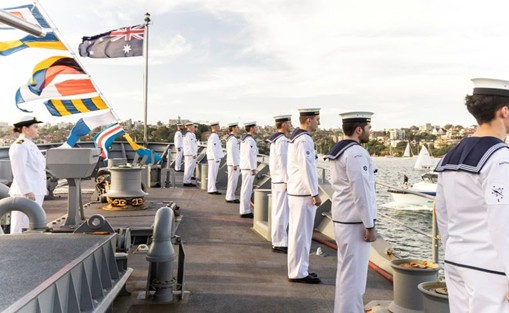
Image: NSW Government, Kakadu 2026 fleet review
7. Suez Canal – Strait of Hormuz
An interesting comparative historical analysis. Academic Leon Goldsmith (The Conversation 14/4) describes the current US blockade as ‘the latest and most combustible phase of a broader regional conflict with global impacts and long, complex roots.’ He likens the global oil and gas trade acts as a collective ‘coronary artery’ upon which we are all utterly reliant. He discerns useful socio/political comparisons between the 1956 Suez Crisis which marked the ‘eclipse of the old British Empire’, and the 2026 Strait of Hormuz Crisis may in future be remembered as a ‘turning point for the US-led global order’.
See: Strait of Hormuz Blockade
8. Gallipoli Strait – History Informs the Present ME Conflict
According to Prof. Meighen McCrae, Strategic Defence Studies, ANU, ‘Gallipoli was about controlling sea routes,’ (The Conversation18/4). By early 1915, Europe’s most powerful states, including Britain and its Empire, had been at war for months, with no end in sight. Delivering a steady stream of munitions and other critical war materials was deemed critical to keeping Russia, ally to Britain and France, engaged in the fight. The only realistic route for re-supply passed through the ‘choke point’ a narrow Strait of Gallipoli or the Dardanelles (61 km long, 1.2 to 6.5 km wide) and regrettably, under Ottoman/Turkish control. Is this beginning to sound familiar in 2026?
As historian Jörn Leonhard wrote in his book, ‘Pandora’s Box, A History of the First World War’, ‘when sailing in open water, naval forces are safe from most land-based weapons.’ However, when they are constrained in limited waters, such as maritime choke points, they become extremely vulnerable to attack from land, as well as from sea mines. An expensive warship can be damaged or destroyed by much cheaper land-based artillery. And ‘with just one minelayer, the Turkish navy had successfully sealed the mouth of the Dardanelles.’
Though outnumbered, Turkish forces held superior positions and proved a formidable opponent. In a nutshell MacCrae proposes 4 lessons from Gallipoli which are relevant today:
1. Beware of the allure of the dominant personality.
2. Don’t fall into the trap of underestimating your enemy.
3. Mission creep.
4. War is costly in terms of human life (in 2026 particularly for Iranians).
See: Gallipoli has 4 lessons for the Strait of Hormuz crisis
Also: Jörn Leonhard
9. Dire Straits – Seafarers at Risk
An estimated 20,000 sailors are currently at risk in the Persian Gulf. The ABC captured and compiled interviews and first-hand accounts from sailors stranded in the Persian Gulf and under threat of drone attacks, missiles, and exploding boats and reveal an increasingly dire humanitarian crisis unfolding. Since the start of the Middle East conflict, the narrow Strait itself has been alarmingly empty, while in the Persian Gulf, some 2,000 ships remain trapped. Seafarers on these stranded ships are facing their own battle to survive. ‘Our shipping company has no advice. We just have to endure’. In texts to Seamen’s Union of India (SUI), one sailor pleaded to be saved. ‘Many are facing shortages of food, water and bunker,’ he said.
See: ABC News – Sailors trapped by blockade plead for help
10. News of HMVS Cerberus Wreck, Half Moon Bay
Easy to have missed exciting news of the HMVS Cerberus in the Local Government pages (of all places!). After depressing media coverage over so many years a wonderfully optimistic headline appeared ‘Full steam ahead for Cerberus preservation.’ There has been action!
October 13, 2004: Victorian Minister Delahunty through Heritage Victoria provided an $80,000 Heritage Grant to the Friends of the Cerberus to remove four, 18-tonne guns to reduce structural load on the collapsing hull.
April 30, 2012: The Age reported, ‘protected under the Victorian Heritage Act, the Cerberus has been sinking since its hull collapsed in 1993′. In 2008, then Heritage Minister Peter Garrett pledged $500,000 to the National Trust to advance a project to stabilise the wreck. Hopes of raising the wreck of colonial naval ship HMVS Cerberus have been scuttled with the government deeming a plan to build a stabilising platform too dangerous.
July 31 2018: The Age reported, ‘pouring 4,000 tonnes of concrete into the hull will ruin the Cerberus wreck’ which would have been an amusing headline if it wasn’t so serious a problem. This council proposal to stabilize the vessel was considered ‘heritage vandalism’ by conservationists and the Friends of the Cerberus group because it was viewed as irreversible that it would accelerate, rather than prevent, the ship’s destruction. The Friends of Cerberus website revealed that no concrete was inside. The extremely heavy armour was all that was required to make the vessel sink.
May 20, 2010: The Age reported, ‘Heritage Victoria divers found the badly decomposed corpse inside the wreck, about 2pm as they surveyed the half-submerged ship off Black Rock. The wreck is off-limits to the public’. Question; was this incident the trigger for the public safety fixation or the structural collapse in 1993?
April 24, 2026: The Age reported, ‘the wreck is now owned by Bayside Council who seemed to have acquired the $500,000 (plus interest) from the National Trust and are calling for experts to help.’ MMHN has been in contact with the newly appointed Bayside Project Officer and has offered whatever assistance the Network can provide. The Project Scope includes to evaluate the existing condition of the wreck, develop a program for safety and conservation monitoring and works and provide guidance in the future management of this significant heritage site.
Without question HMVS Cerberus is a most significant vessel – and whatever can be salvaged off it, should be.
See: History of the Cerebus – Wikipedia
11. The Polly Woodside site in Better Days
MMHN thanks member Tim Bracher for this fascinating image of the Polly Woodside site before it became overwhelmed by the construction of the Plenary Building, which literally consumed or encased the magnificent Duke and Orrs Dock Engine Room. It is preserved behind glass windows but inaccessible to the public most of the time.
We would all agree with Tim’s observation, ‘funny to remember how it was, but a lot more “authentic” in those days.’ The signage on the glass needs a refresh. Note the immense buoy which is also lost to the public tucked in behind the wooden fence enclosing the Polly.
The Engine Room is periodically inspected by an expert group of Australian engineering conservationists who volunteer for the Engineering Heritage Australia (EHA)
See: Engineering Heritage Australia
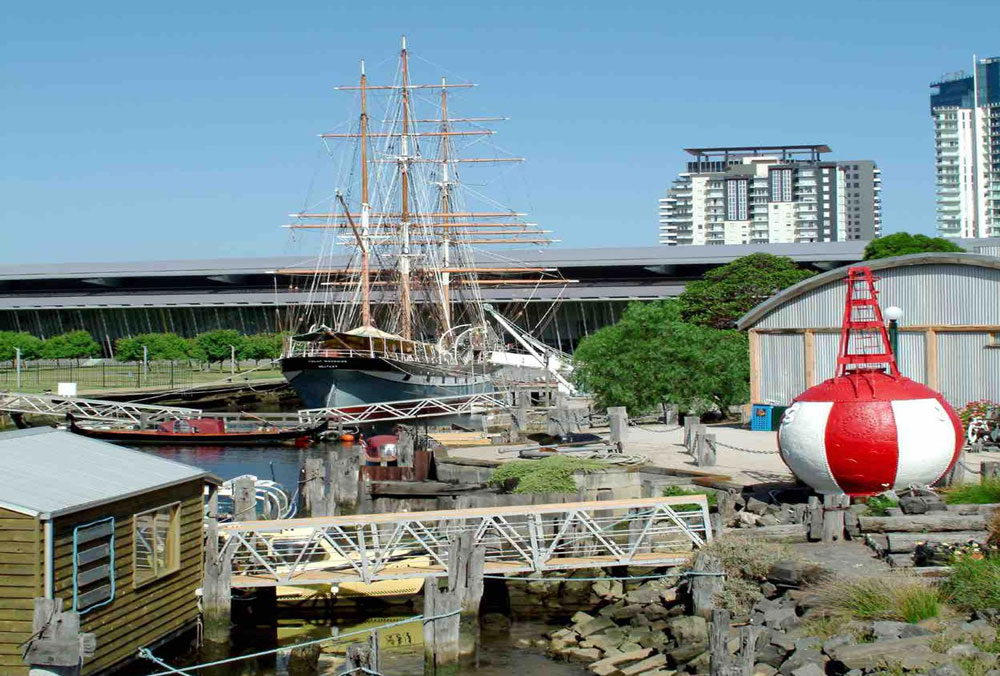
Image: MMHN member Tim Bracher
12. Ocean Energy Untapped
Is Australia, like many island nations, ignoring renewable energy lurking around our vast coastline? Interesting similarities exist between the current 2026 oil shock with the oil shocks of the 1970s. Both triggered by conflict in the Middle East. Both resulted in global energy prices soaring. Both exposed the vulnerability of modern economies to fuel supply.
NZ Academic Prof. Craig Stevens, University of Auckland observes (The Conversation April 10), surprising global apathy in relation to alternative energy in harnessing wave power, remaining untapped. He refers to the earlier work of Stephen Salter at the University of Edinburgh who recognised that a tremendous amount of wave energy, is constantly cycling within oceans. He developed a promising method of turning wave energy into electricity using a pear-shaped device dubbed the ‘nodding duck’ to efficiently harness energy carried in passing waves. Sadly, focus drifted away from the Salter project. Fortunately, research and development into related approaches to ‘blue’ energy from tides, winds, depths and differences in heat and salt has continued.
Greater recognition that burning fossil fuels is accelerating global warming has added impetus to the search for viable alternative energy sources. Certain places around the globe are continually swept by waves, and the passages between islands amplifies tidal flows. Wind energy, on and off shore is well-developed around the globe. Focus on tidal energy is growing as evidenced by technologies designed to convert ocean wave motion into electricity.
See: NZ is surrounded by ocean energy. Just what would it take to tap it?
Also: Stephen Salter
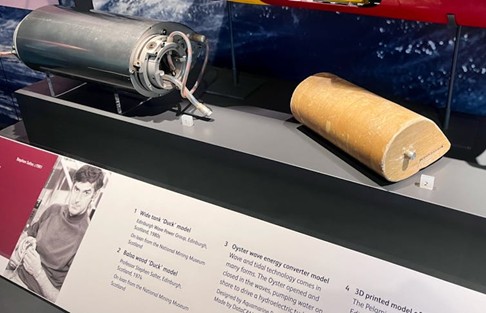
Image: Models of the Stephen Salter’s Duck displayed at the National Museum of Scotland. CC BY-NC-SA
13. Who’s Who in State Government 2026
A reminder that advocacy is crucial to MMHN’s work. Knowing who’s who really matters. Recent ministerial changes likely to be relevant to MMHN and other maritime stakeholders are listed below.
Please let MMHN know if you would like to suggest any other relevant contacts or advocacy on related maritime heritage projects.
Minister Enver Erdogan, responsible for Outdoor Recreation (Boating) & Environment (Parks Victoria piers, litter, rivers, Tourism, MMHN Maritime Experience Centre Project, Maritime heritage assets)
Minister Harriet Shing responsible for Water (Melbourne Water, waterways, Victoria Harbour, litter, rivers)
Minister Sonia Kilkenny retains Attorney General now responsible for Planning and Finance (MMHN Maritime Experience Centre Project, Station Pier Cruise Terminal)
Minister Colin Brooks retains Industry and Advanced Manufacturing, and now responsibility for Defence Industry and TAFE (Shipbuilding, Docklands Secondary School, Maritime Skills, heritage/maritime curriculum)
Minister Jaclyn Symes responsibility for Development Victoria and Precincts (Docklands Precinct, Station Pier Precinct, MMHN Maritime Experience Centre Project)
Minister Ben Carroll retains Education (Maritime Skills, History/Heritage in Curriculum)
Minister Lilly Ambrosio retains Energy and Resources (Offshore Wind power, Blue Economy)
Minister Steve Dimopoulos retains Economic Growth and Jobs,
Sport and Major Events (Blue Economy, Boating/Sailing, Fishing, Water Sport)
Minister Melissa Horne retains Ports and Freight (Commercial piers, freight terminals, Blue Economy)
Minister Michaela Settle responsible for Regional Development (Blue Economy, Wind Farms)
Minister Natalie Suleyman responsible for Tourism (MMHN Maritime Experience Centre Project, Ferries, Station Pier Cruise Terminal)
Minister Gabrielle Williams responsible for Transport Infrastructure, Public and Active Transport (Ferries)
Minister Vicki Ward responsible for (Maritime Museums, Maritime art, MMHN Maritime Experience Centre Project, Station Pier Cruise Terminal, Immigration Museum, Polly Woodside)
14. Maritime Heritage Legislation – key to protection
Given the disregard for land-based or built-form maritime heritage infrastructure, let alone the sad saga of the Cerberus, it is difficult to accept, that Australia is widely recognized as having one of the strongest and most comprehensive underwater maritime heritage protection legislations in the world, particularly regarding underwater cultural heritage.
The Underwater Cultural Heritage Act 2018 provides protection for underwater cultural heritage, including shipwrecks, aircraft, and associated artifacts that have been underwater for 75 years or more. It covers heritage in coastal waters (0–3 nm) and Commonwealth waters (3–200 nm), protecting roughly 8,000 submerged sites.
Australia’s legislative framework is closely aligned with the UNESCO 2001 Convention on the Protection of the Underwater Cultural Heritage, often viewed as a benchmark for international standards. Indigenous Heritage Protection, State-level laws, such as those in Western Australia, specifically protect maritime archaeological sites.
Additionally, Traditional Use of Marine Resources Agreements (TUMRAs) protect Indigenous cultural heritage within the Great Barrier Reef.
Victoria takes its underwater maritime heritage seriously. There are around 660 shipwrecks along the Victorian coastline, but only about 300 have been found. Three more emerged over the violent storms of summer 2025. Funding allocations do not seem to align with the significance of this heritage.
See: Heritage Victoria – Maritime Heritage Listings
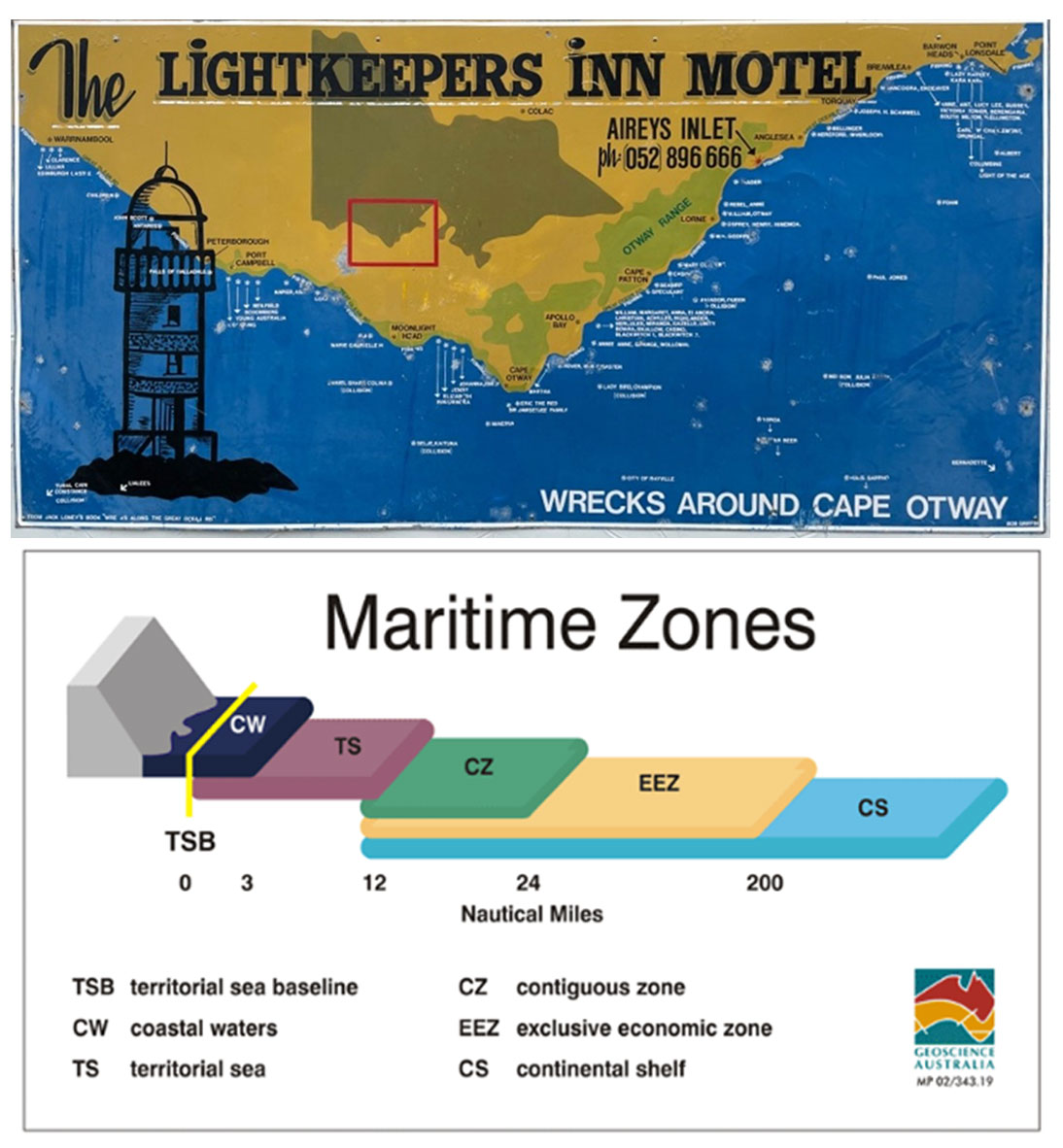
Images: MMHN & Geoscience Australia
15. Historic document: Journal of Midshipman J.J. Cody
Rare items of maritime history are to be found within the extraordinarily diverse rich Monash Memorial Defence Library collection located in Victoria Barracks. MMHN Board member Michael O’Brien manages this remarkable library and from time to time provides us with fascinating material including The Journal of Midshipman J.J. Cody.
The journals were kept by young officers as part of their training and were regularly checked by their supervising officer and the captain of the ship they were assigned to. The purpose of the journals was to train midshipmen in observation, expression and orderliness, and they were required to record their observations about all matters of interest of importance in the work that was carried out, on their stations, in their fleet, or in their ship, and illustrate them with plans and sketches.
J.J. Cody joined the Royal Australian Naval College at Jervis Bay in 1928 and graduated in 1931 after the College had moved to Flinders Naval Depot. He served as a midshipman in HMAS Canberra (1932), HMS Royal Sovereign (1933) and HMS Anthony (1933-34) before his promotion. His eventual rank in the RAN was Lieutenant-Commander and he received a Mention in Despatches. His final and best sketch in the journal is of St Tropez Harbour (4th April 1934).
16. National Marine Science Strategy
Given that as an island national our future is inextricably linked to the ocean,
MMHN is delighted to see this important document, “National Marine Science Strategy 2026-2036: Building Blue Futures” was launched at Parliament House by Senator The Hon Murray Watt, Minister for the Environment and Water.
MMHN notes that Minister Watt is responsible for Heritage Preservation under the Environment Protection and Biodiversity Conservation Act. (The sole reference to heritage in federal legislation). MMHN regrettably observes that this aspect of his responsibility appears to be a peripheral interest. Science and Technology Australia hosted ‘Science Meets Parliament’, an annual event that brings together hundreds of scientists from across the country to engage directly with parliamentarians and policymakers. It was particularly encouraging to see strong representation from the marine science community, ensuring ocean priorities are part of national conversations.
The Ocean Business Leaders’ Summit in Cairns, 11 to 12 June, creates a clear opportunity for Australia and the broader Asia-Pacific region to engage with the Blue Economy.
The Summit is invitation only, so to register your interest please email: kate.pickard@oceandecadeaustralia.org
See: National Marine Science Strategy 2026
Also: Ocean Business Leaders’ Summit
17. Maritime Skills and Careers
MMHN congratulates Offshore and Specialist Ships Australia (OSSA) and Boating Industry Association of Victoria (BIAV) for their efforts. Encouraging news that the maritime skills development is going very well!
The boating industry needs apprentices, qualified and experienced workers. To address this, BIAV have appointed Eva Pasquet as the Boating Careers Coordinator to address this issue. The need for a Boating Careers program is clear.
The OSSA Scholarship Fund awarded its first Bursary designed to encourage and support mature age marine engineers. The bursary provides a weekly grant, as well as assistance with requisite pre-sea safety training.
OSSA has an impressive program of engagement and outreach thus far in 2026:
Expos – Trade & Tech Fit Career Expo, MCEC; Ballarat Careers & Futures; Southwest Careers Expo; Oellen Careers Expo; Warrnambool Careers Day; Bairnsdale Career Expo; Australian Maritime College (Launceston); Perth Careers Expo
Schools Engagement – Ballarat Grammar School, Highvale Secondary College, Hampton Park Secondary College, Werribee Secondary College, Caulfield Grammar,
The Schools Maritime Careers Program in NSW
See: Boating careers
Also: OSSA Scholarship Fund
18. Antarctica – 19th Century
We are fortunate indeed to have such an erudite Antarctic scholar, Andrew McConville, Librarian Digital Access at the State Library of Victoria. You may wish to listen to Andrew’s podcasts called the Black & White series on Antarctic themes, made for the Herald Sun.
Listen: The hapless heroic Columbus of the South
Also: Melbourne Scientists Epic Antarctic Adventure
Also: Scholarly book – Australia and Early Antarctic Exploration
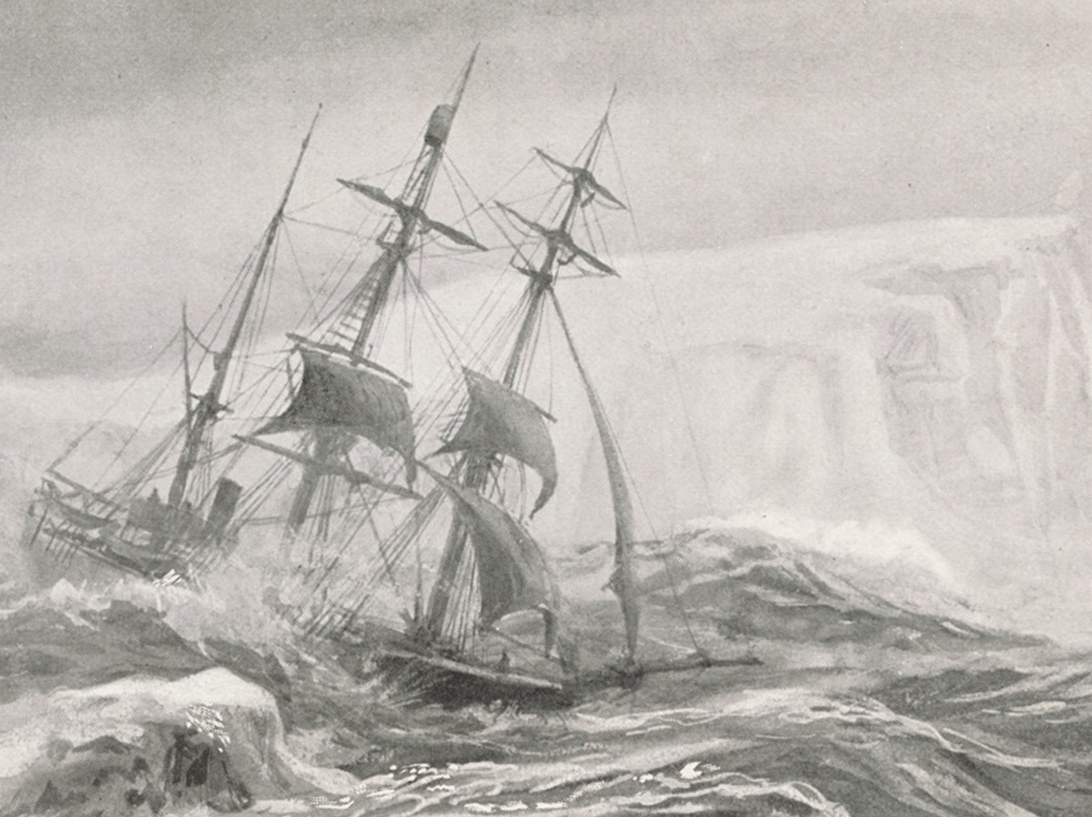
Image: From the book, ‘The cruise of the Antarctic to the South Polar regions’ by Henrik Johan Bull (1896).
19. The Dan Ships – Antarctic Heritage
At last, the Dan Ships Lauritzen Plaque has been installed on Northbank on the Birrarung/Yarra River, adjacent to Seafarers Bridge. Seven years after the proposal to mark this significant Antarctic maritime heritage of Melbourne by ANARE/OSSA member Ray McMahon, we are delighted to report success. Antarctic expeditions are not for the faint-hearted. Similarly, it seems the protracted bureaucratic struggle to ensure it is appropriately commemorated is also not for the faint-hearted! Well done all those who have successfully achieved this Antarctic commemoration in the public realm in a city not known for celebrating its rich cultural heritage.
20. Central Pier, Victoria Harbour – DV fails again
Development Victoria’s (DV) apathy in relation to maritime heritage in Docklands Precinct has long been a source of frustration. DV failures are well-documented; the eviction of the Heritage Fleet, the protracted neglect and eventual demolition of Central Pier and the neglect of wharves beneath Collins Wharf which may prohibit public access throughout 2026.
The sudden appearance of a cluster of white floating structures in the former footprint of Central Pier suggests that this pattern is continuing. Those who genuinely understand the social and economic value of heritage assets are aghast at DVs latest action and expenditure in Victoria Harbour which reaches a new low in heritage preservation terms. Heritage Victoria granted DV a Permit to demolish Central Pier. A key Permit condition required DV to reference or acknowledge the heritage significance of Central Pier permanently in the public realm.
MMHN was appalled to observe seemingly hundreds of conical white plastic buoys, floating and bobbing about on tethers roughly where Central Pier used to be. Regrettably this extensive installation entitled ‘Echo’ designed to echo the outline of the Central Pier is the result of a peculiar quirk in the HV Permit Process which enabled DV to officially lodge a Permit Variation to the initial more appropriate referencing concept for Central Pier approved by HV. Sadly, HV could not rule on the merit of this Permit Variation, no matter how silly.
MMHN has been assured by DV that this weird and wasteful installation was merely a temporary measure! Imagine the cost! Imagine the nuisance to recreational boating! Imagine the white plastic cones breaking loose, fragmenting and heading off goodness knows where? Surely an all-time-low in DV’s decision-making and expenditure without informing the community or stakeholder. This is not an acceptable way for a State Agency to manage one of Melbourne’s most prominent waterways precinct.
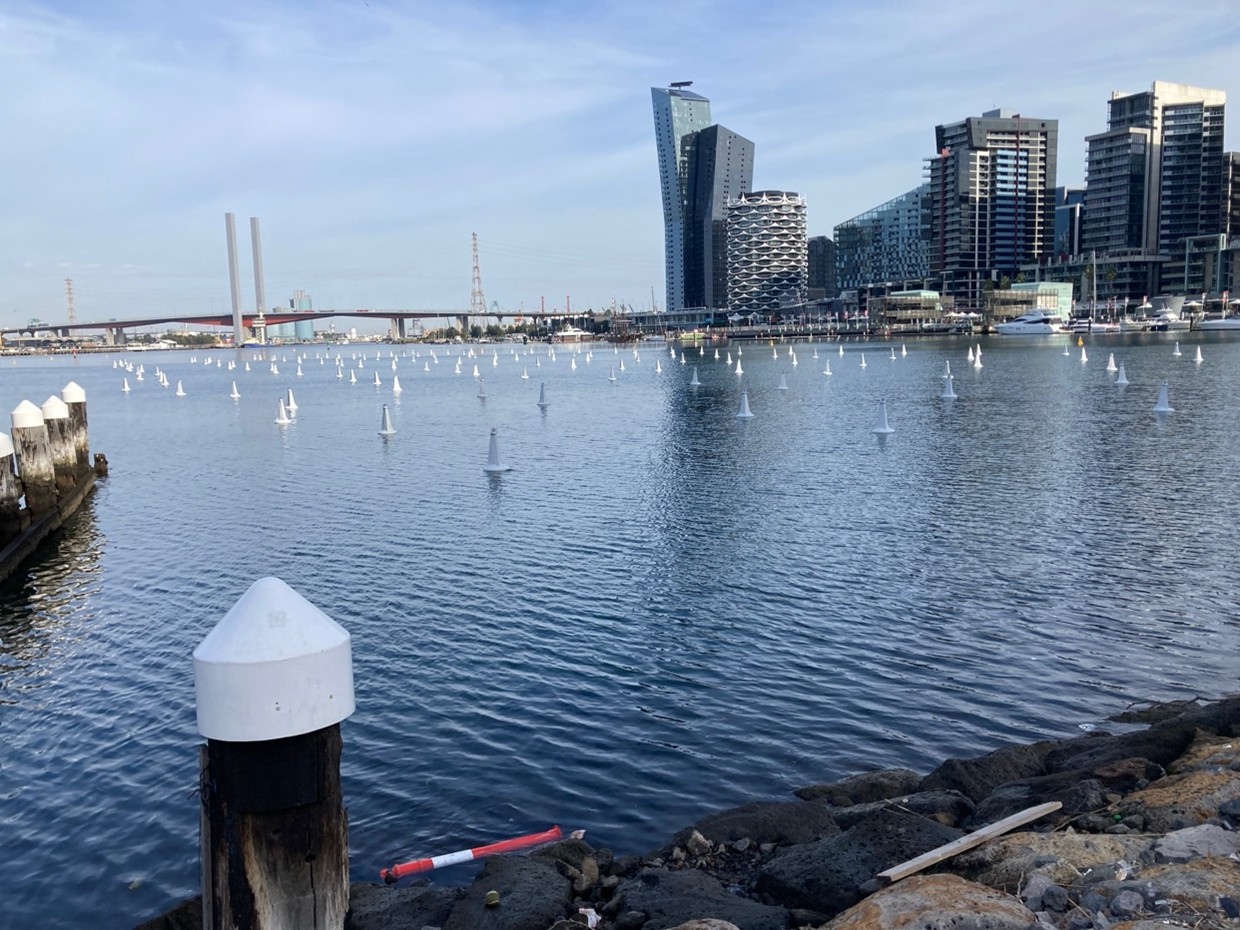
Image: Jackie Watts
21. Port of Darwin – China
Matthew Knott reports (Age 28/1) on the emerging tension or potential retaliation in relation to ownership of the Port of Darwin. Chinese ambassador Xiao Qian stated, ‘we will see’, hinting perhaps it was a mere coincidence that China had decided to conduct live fire exercises in the Tasman Sea while circumnavigating the Australian continent in 2025 and left the door open to similar future visits by the Chinese navy.
Ambassador Xiao Qian continued saying that Chinese firm Landbridge, which bought a 99-year lease for Darwin Port in 2015, had invested significantly in the facility and made it profitable, raising ethical concerns about Australia’s bid to return it to Australian ownership. ‘When you’re losing money, you lease it to a foreign company and when it starts making money you want to take it back. That’s not the way to do business.’
See: Beijing hints at retaliation over Port of Darwin lease
Until next time,
Jackie
Dr Jackie Watts OAM
Chair,
Melbourne Maritime Heritage Network