

Greetings all
Season’s Greetings from MMHN to all maritime stakeholders!
On reflection, our relationship with the oceans of the world makes it abundantly clear that if you are human, then you are absolutely a maritime stakeholder.
Contents
1. Blue Machine: Seeing Ourselves as Citizens of an Ocean World
2. Rethinking the Global Map: An Old-World Ocean Map Goes Viral
3. Australian Maritime Welfare Society (AMWS)
4. Station Pier
5. Ocean Wave Energy in Australia – Invitation
6. Aquaculture – Salmon Fishing Impact
7. Royal Australian Navy’s HMAS in Samoa
8. Marvellous to see people enjoying Station Pier – Ports Victoria
9. Port of Melbourne: The 2055 Port Development Strategy (PDS)
10. Speaking of Ports, Who Knew About Portunus?
11. Polly Woodside 2003: 20 years of overdevelopment
12. Sea Shepherd and Greenpeace
13. Back to the Future: Ferries for Melbourne
14. Birrarung Yarra River: Artists, Writers and the River – Invitation
15. Sydney Cruise Terminal – New Proposal
16. Fishermans Bend – Heritage Industrial Assets
17. Global Ocean Emergency Services – Undersea Cables
18. Timor Leste – New Undersea Cable
19. Maritime Museums of Victoria (MMV)
20. Maritime ‘Big Builds’ in Docklands Precinct in the past and a ‘Big Build’ now proposed by MMHN
21. RAN Patrol-Boat Gift to Tuvalu
22. HMNZS Manawanui – Monitoring Continues
23. Princes Bridge Restoration Works
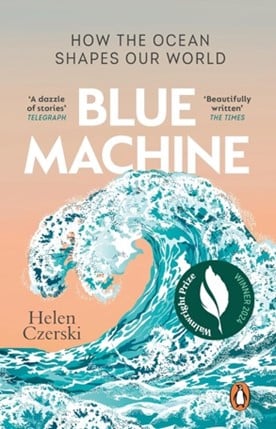
1. Blue Machine: Seeing Ourselves as Citizens of an Ocean World
MMHN highly recommends this excellent presentation from the recent International Congress of Maritime Museums (ICMM), entitled Blue Machine: Seeing Ourselves as Citizens of an Ocean World. Dr Helen Czerski, a scientist with Greenwich Museum, says “Blue Machine presents a fresh perspective on what it means to be a citizen of an ocean planet, an understanding which is crucial to our future”.
See: Blue Machine: Seeing Ourselves as Citizens of an Ocean World
2. Rethinking the Global Map: An Old-World Ocean Map Goes Viral
In September and October of 2018, three maps went viral on social media and the web. All of them had the same perspective, featured oceans as the focus, and presented the oceans as one body of water. The maps were based on the so-called ‘Spilhaus Projection’ and centred on Antarctica. Though it has recently gained some popularity online, this projection is not new. Many articles recognise Athelstan F. Spilhaus, a South African American geophysicist and oceanographer, as the author of this projection back in 1942.
The earliest publication of information about the Spilhaus Projection was a 1979 article in the Smithsonian Journal by Athelstan Spilhaus, entitled See the Oceans, Slice up the Land.
“In collaboration with geodesists Robert Hanson and Erwin Schmid, who helped me with the equations and programmed the computers which drew the astonishing maps which changes our understanding of the way to see the word. It’s complex, fascinating and demonstrates that new techniques challenge historic perspectives of the world as we ‘see’ it.”
To investigate further, see:
https://storymaps.arcgis.com/stories/756bcae18d304a1eac140f19f4d5cb3d
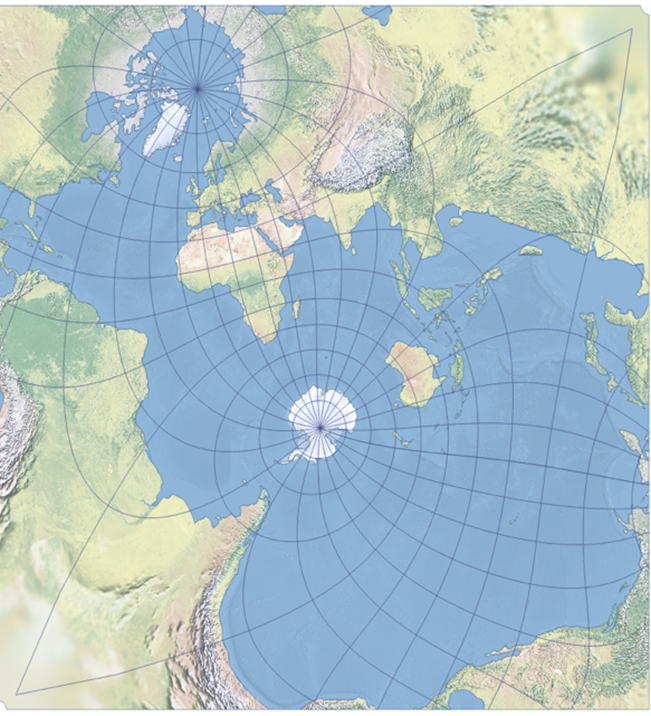
Image: Storymaps website
3. Australian Maritime Welfare Society (AMWS)
MMHN completely concurs and is grateful for these important observations from the Chair of the AMWS, David Parmeter in Honouring Sacrifice: The Vital Role of Merchant Navy Memorials in Preserving Maritime History (November 2024):
“At AMWS we often refer to the outstanding work performed by our fraternal organisation, the Merchant Navy War Memorial Fund (MNWMF) in honouring the memory of Australian Merchant Navy Mariners who gave their lives in the service of their country in World Wars I and II. The importance of this was emphasised for me during a recent holiday in the United Kingdom. In London, there is the Tower Hill Memorial to British merchant seafarers. It is an impressive and moving monument that records the names of the 12,000 First World War and 24,000 Second World War merchant seafarers who have no known grave, their bodies lost or buried at sea. This has particular significance for my family, as my father-in-law Robert served as a teenage deck boy on the MV Justitia that was torpedoed in the North Atlantic in 1940. Robert was one of the lucky ones who survived, but the names of his eleven shipmates who perished are recorded on the Memorial. After the war, Robert settled in New Zealand with his family and rarely spoke of his experiences.
While Tower Hill is a National Memorial, it is not the only one. In Liverpool, there is a Merchant Navy Memorial on the Merseyside waterfront, which recognises the significant role played by seafarers from that port in both World Wars.
Locally there is the Merchant Navy Memorial and Columbarium at Rookwood in Sydney and the national Merchant Navy Memorial on the shores of Lake Burley Griffin in Canberra. All AMWS members are encouraged to support the work of MNWMF in ensuring that the Australian merchant Navy A title emblazoned in battle and honour in freedom is recognised as an important part of Australian Maritime History and Social Culture.”
A reminder that MMHN has a reciprocal relationship with Sydney ASWS.
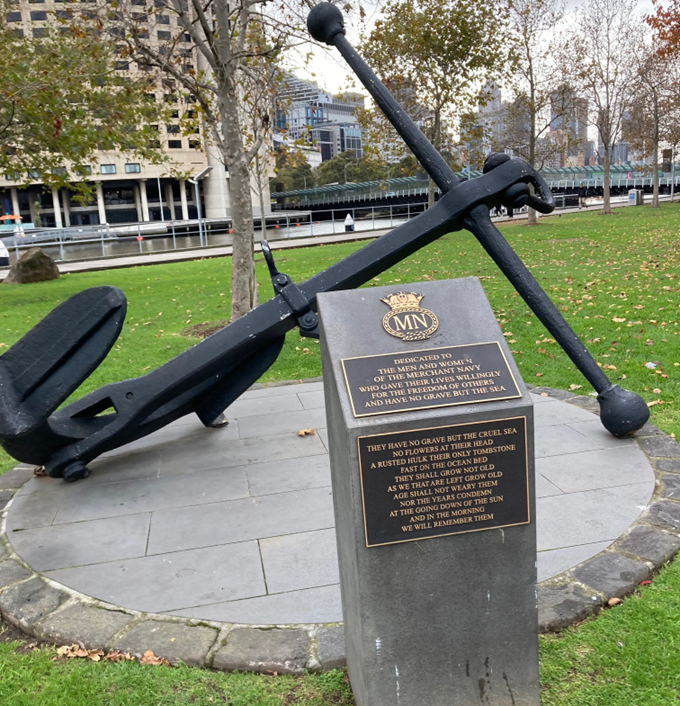
Image: MMHN Merchant Seafarers Memorial, South Bank Maritime Precinct
4. Station Pier
Dare we hope for progress at last? A commitment of $70 Million over 4 years? Nina Taylor MP (Port Melbourne) released this video.
See: https://youtu.be/rF396g3tDCc?si=GxZaIWH3mAT3I-yO
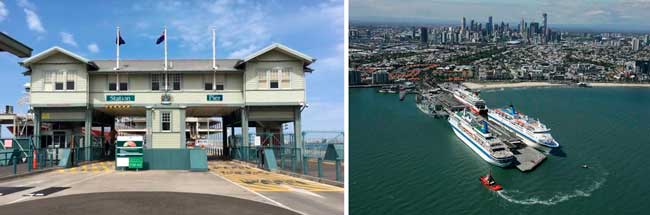
Image: Only Melbourne website
5. Ocean Wave Energy in Australia – Invitation
When: 3:30pm, Tuesday 3rd of December 2024
New energy will be the focus of this webinar, which will present the status, opportunities and challenges of wave energy in Australia. Experts will discuss this comprehensive project report, the aim of which is to investigate wave energy potential in Australia through a thorough examination of international trends, domestic resources, market dynamics, integration potentials, environmental considerations, regulatory frameworks, and social acceptance factors.
For the full report, follow this link to the project page.
6. Aquaculture – Salmon Fishing Impact
The ABC reports that the Federal Government will fund an oxygenation trial in Macquarie Harbour, Tasmania to help save the Maugean skate, a prehistoric fish whose last known habitat is shared with salmon farming operations in Macquarie Harbour (12th Nov 2024). Declining water quality and low dissolved oxygen levels, partly caused by salmon farming in the harbour, have led scientists to warn that the skate faces extinction. A request has been made for a review of the 2012 decision to allow more salmon farms into the harbour. No decision on that yet. The salmon industry support thousands of jobs across Tasmania.
Full article: https://www.abc.net.au/news/2024-11-12/tas-albanese-maugean-skate-funding-pledge/104588238
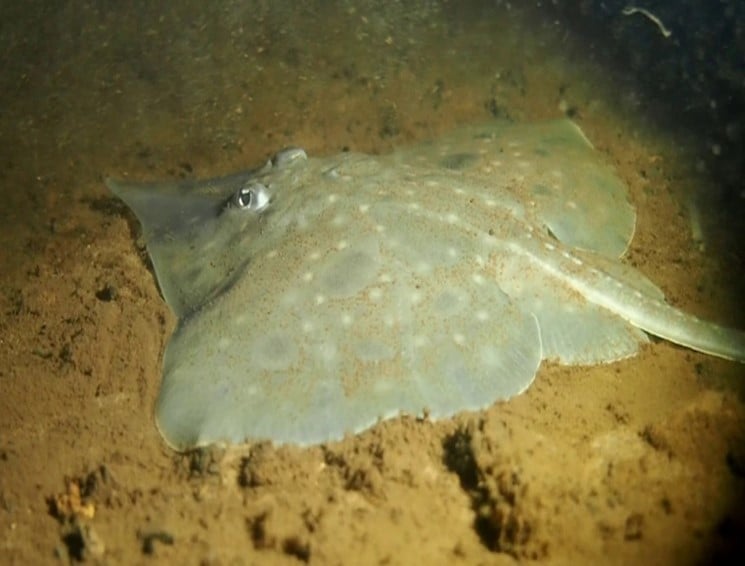
Image: Jane Ruckert, ABC website
7. Royal Australian Navy’s HMAS Choules in Samoa
A topical reminder that historically, national navies have been about much more than war service. The RAN presence at the recent Commonwealth Heads of Government Meeting in Samoa is evidence of this. At Samoa’s request, Combined Joint Task Force (CJTF) 1117 deployed ships from Australia, New Zealand and the UK, comprising RAN HMAS Choules, ADV Reliant, RNZN HMNZS Canterbury, and the Royal Navy’s HMS Tamar. The CHOGM is a biennial meeting hosted by different Commonwealth countries on a rotating basis. Given the political tensions in the Pacific, the event was an opportunity for the RAN to lend support to maritime security tasks, bringing much experience to operations on Samoan Guardian-class patrol boat, Nafanua III. On the lighter side, the Olympic team from the Samoa Weightlifting Federation visited the HMAS Choules to train, while the RAN Jazz Band and the Republic of Fiji Military Forces Rock Band combined to perform a free public concert at Friendship Park.
See: https://www.samoaobserver.ws/category/samoa/110021
Also: https://www.defence.gov.au/news-events/news/2024-11-22/all-aboard-hmas-choules
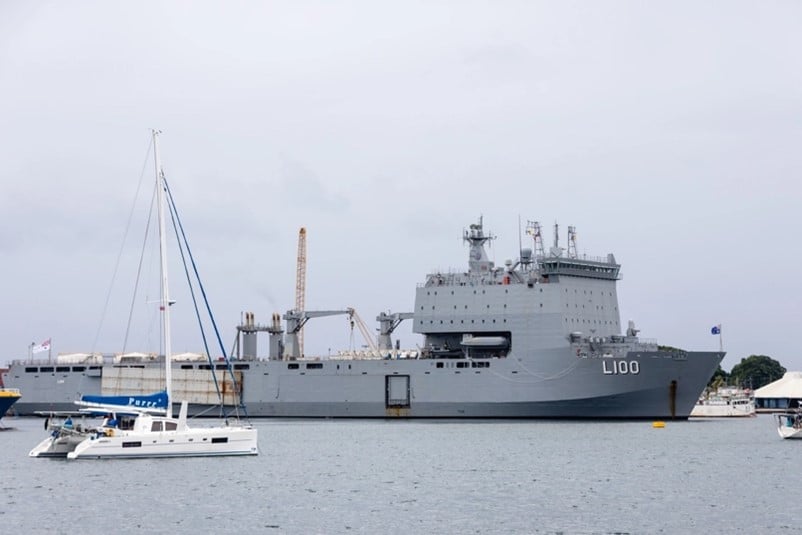
Image: Samoa Observer website
8. Port Welshpool & District Maritime Museum – Invitation
MMHN is delighted to alert you to the Sea Days Festival at the Port Welshpool Museum.
When: 10am – 4pm on Saturday 4th and Sunday 5th January, 2025.
You are invited to visit the newly renovated museum and soak up the wealth of fishing industry history and the fascinating past of Port Welshpool as it was.
Guest speakers:
Saturday, 11am: John Woolley
John will entertain you with history and stories of the oil and gas industry from its beginnings in Corner Inlet and Bass Strait.
9aturday, 1.30 pm: Cheryl Glowrey
Cheryl Glowrey, a local historian and author, will share the intriguing story of how Wilsons Promontory became a National Park and Port Welshpool’s involvement in its development.
A not-to-be-missed opportunity for maritime enthusiasts.
Note: The ever-popular Devonshire Teas will be available.
For more info: https://ptwelshpoolmuseum.wixsite.com/pwmuseum
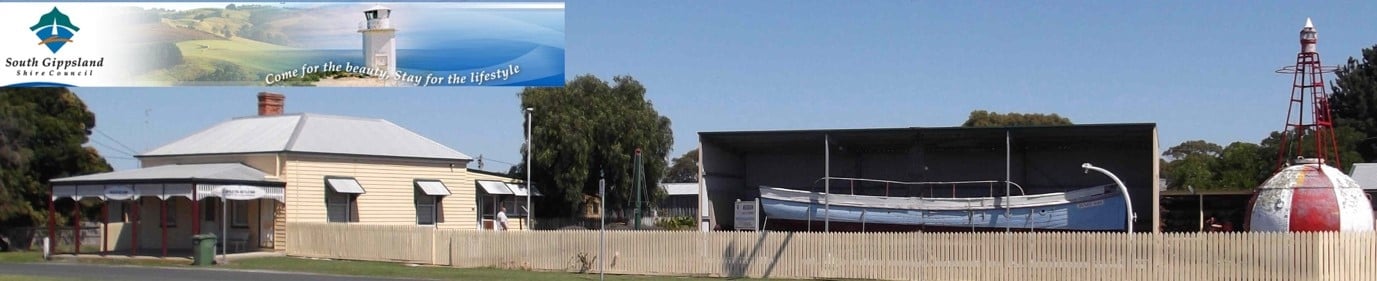
Image: Port Welshpool Museum website
9. Port of Melbourne: The 2055 Port Development Strategy (PDS)
In November, MMHN was invited to participate in a Zoom ‘Community Workshop’ consultation, designed to elicit comment in preparation for next the Port of Melbourne Port Plan. A draft will be released early in 2025. The numbers are impressive.
See: https://www.portofmelbourne.com/about-us/factsandfigures/
All Victorian ports are legislatively required to have a PDS under the Port Management Act 1995 (Vic) and to review their PDS every five years. The Port of Melbourne has reviewed its 2050 PDS and is planning the development of its 2055 PDS, which will be completed by December 2025. The PoM’s 30-year plan, titled 2050 Port Development Strategy, was published in 2020. It provides a roadmap for the future development of the port and outlines ten key projects to improve port capacity and respond to the needs of a growing Victoria.
10. Speaking of Ports, Who Knew About Portunus?
MMHN is delighted to receive news from an MMHN member, reporting from Rome:
The Temple of Portunus was dedicated to the ancient Roman god, Portunus. Known as the God of ports, keys, doors, and livestock, his name is derived from portus, meaning ‘harbor’ or ‘gateway to the sea’ (or river in this instance). Situated on the banks of Rome’s oldest port on the river Tiber (Portus Tiberinus), and probably dating from the 1st century BC, the Temple of Portunus (Tempio di Portuno) sits close by an ancient cattle market and watches over cattle barges as they enter the city. Maritime heritage enthusiasts are well aware that Melbourne was also once a burgeoning riverport, which shifted further and further away from the centre of the city for various reasons. Did this also happen in the riverport of Portus Tiberinus? Today, the port of Civitavecchia (built at the command of emperor Trajan between 103AD – 110AD), sits just north of the Italian capital city. Known in ancient times as the Port of Rome and Centumcellae, it owes its name to the presence of a hundred clefts (cento anfratti) inside the dock, used for collecting goods in natural ‘vaults’.
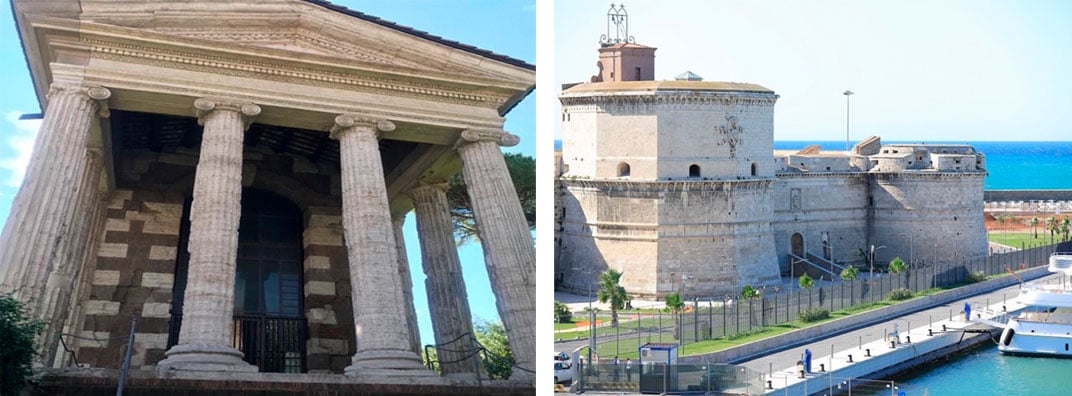
Images: Temple of Portunus and Civitavecchia, Wikipedia
11. Polly Woodside 2003: 20 years of overdevelopment
What a difference 20 years of over-development makes in how the marvellous ‘Polly’ is presented in the public realm. MMHN thanks Yarra Business Association for sharing the recent discovery of this image.
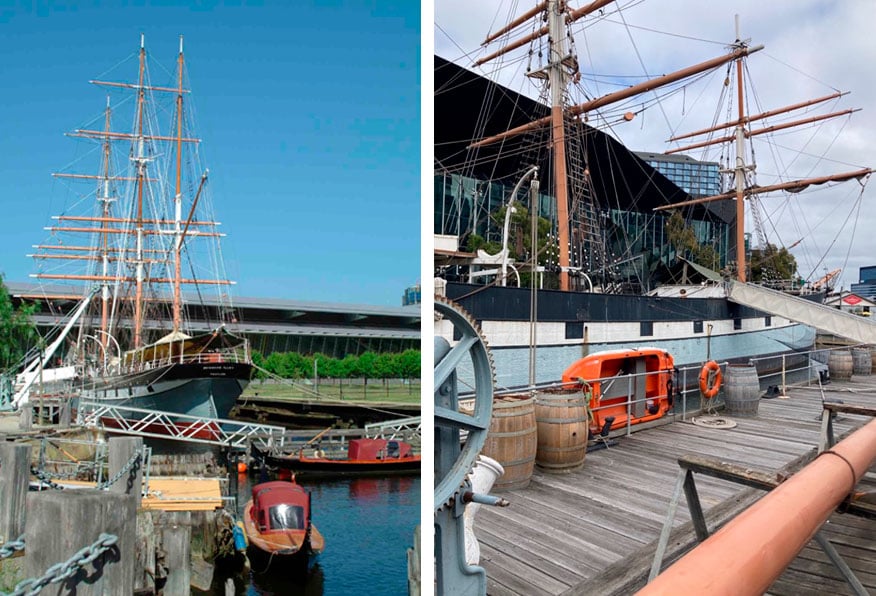
Image: The Polly Woodside, 2003 and 2023.
12. Sea Shepherd and Greenpeace
There has been little media coverage of Greenpeace action of late. And no wonder.
On the 14th of November, the ABC reported that the Sea Shepherd and Greenpeace co-founder, Paul Watson, had been detained since July amid a push by Japan to extradite him on charges dating back more than a decade. Dismayed supporters report that the detention period has now been extended in Greenland for another 3 weeks, for the 5th time. Supporters fear that extradition to Japan would risk life imprisonment. A reminder that Watson led high-profile confrontations against Japanese whaling ships as they slaughtered hundreds of whales each year for “scientific purposes” in the Antarctic Ocean. The complex question arises; is whaling legal in Greenland?
The East Greenland large whale hunt focuses on a single species, the common Minke whale. The Greenland hunt is an Inuit ‘collective hunt’ that is only permitted for the taking of this species. There are no vessels that are authorised to mount a harpoon cannon in East Greenland.
See: https://www.abc.net.au/news/2024-11-14/sea-shepherd-paul-watson-detention
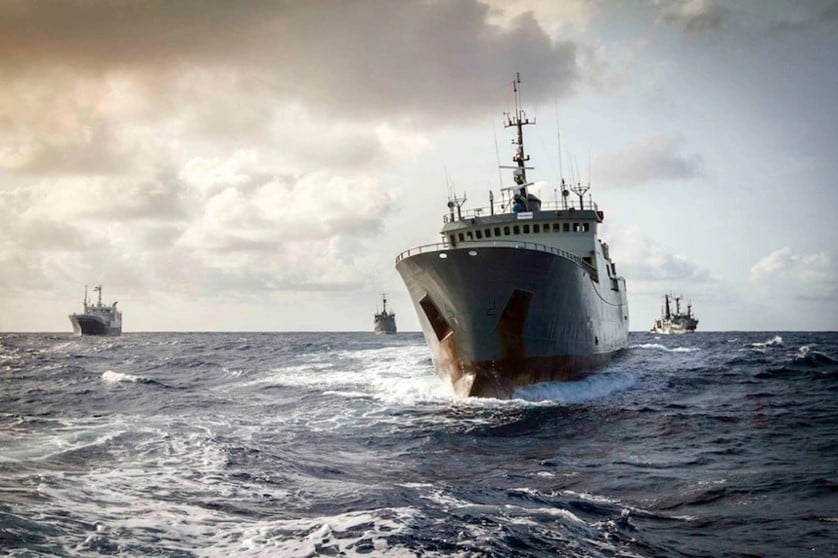
Image: ABC News
13. Back to the Future: Ferries for Melbourne
MMHN is a staunch advocate for expansion of ferry services in Melbourne, for both recreational and public transport purposes. Given road congestion, it is, as they say, ‘a no-brainer’ to use our waterways. Ferry operators would be encouraged if ferry services received the same level of public subsidy as buses and trams. MMHN recommends that you have a look at this YouTube video (see link below) which makes the key point that in the 19th century, as a large, expanding city on a navigable river leading to a vast bay, the port city of Melbourne was well-served by punts and ferries. Until private car ownership became widespread, enthusiasm for river punts and ferries continued well into the 20th century. Indeed, between 2004 to 2008, Parks Victoria operated a successful public ferry service, the Yarra River Shuttle Service, providing 6 stops on the Birrarung/Yarra River between Southbank and Harbour Esplanade in the Docklands. The City of Melbourne collaborated with Parks Victoria to fund this ferry service which regrettably stopped when government funding ceased, not because the demand had diminished.
See: https://www.youtube.com/watch?v=FMoMnpuhiXc&t=50s
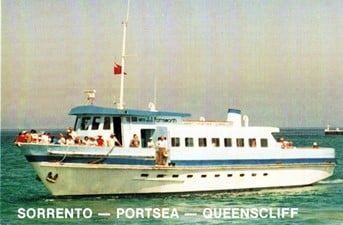
Image: Marcus Wong of Waking up in Geelong website
14. Birrarung Yarra River: Artists, Writers and the River – Invitation
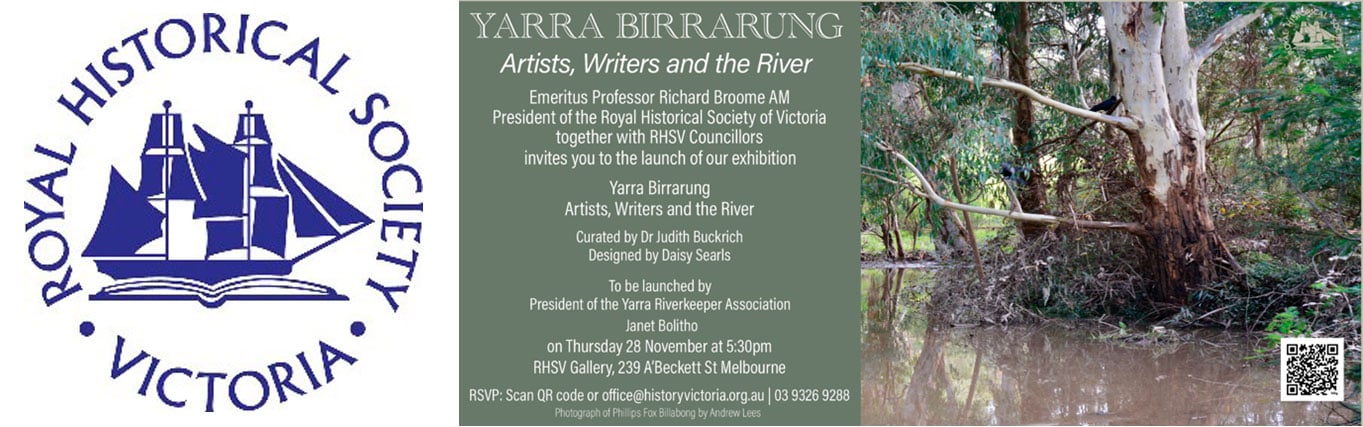
You may wish to see an excellent exhibition at the Royal Historical Society of Victoria Gallery.
When: Open until July 2025
It is curated by historian Dr Judith Buckrich and designed by Daisy Searl. The exhibition coincides with the launch of Dr Buckrich’s new book, Yarra Birrarung: Artists, Writers and the River, an illustrated history of life on the Yarra. MMHN Member and President of the Yarra River Keepers Association, Janet Bolitho, said at the launch, “Through the lens of artists and writers, the book explores how life has flourished on the river, including recreation, industry and land use, as well as infrastructure, natural history and social history. Despite much despoiling, our river remains the vital artery of the city and beyond to the Yarra Ranges. Just as it was the fulcrum of Wurundjeri life, it continues to inspire and fulfil our lives. From the Heidelberg School to the MCG, the river has been a centre of Australian arts and culture for decades.”
15. Sydney Cruise Terminal – New Proposal
Botany Bay has been ‘floated’ as a surprise location for a newly proposed Sydney cruise terminal. A bold vision for an artificial island to become Sydney’s newest cruise terminal has been outlined with the location also hosting super yachts and private jets.
See: New Sydney Cruise Terminal
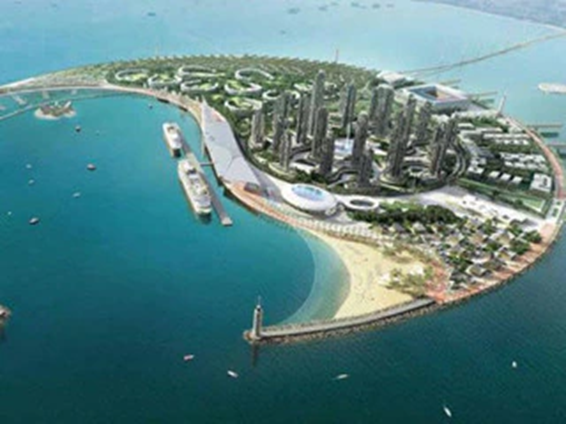
Image: Herald Sun website
16. Fishermans Bend – Heritage Industrial Assets
MMHN is pleased to note reference at this forum to the value of heritage assets. Indeed, in discussing the future business of Fisherman’s Bend, there is acknowledgement of the loss of “[maritime] industrial docklands”. However, a key learning from Docklands was that, in hindsight, more effort could have been made to retain and integrate more of the area’s original gritty, industrial character into newer, contemporary development, noting the success of these approaches more recently, both locally (e.g. Collingwood and Cremorne) and overseas. Melbourne University are putting significant investment into advanced facilities that will foster industry partnerships and research, driving innovation and becoming a magnet for talent, skills development and investment. It was exciting to hear about the globally unique research infrastructure in areas such as fluid dynamics (aero and hydro), power and propulsion (energy test cells), and large-scale prototyping and materials testing. Notably, from the maritime perspective, this proposed MU research approach includes:
- Wind, wave and current ocean facility
- Deep manoeuvring and directional wave basin
- Power, propulsion and energy lab
See: https://www.development.vic.gov.au/projects/fishermans-bend-innovation-precinct?page=overview
17. Global Ocean Emergency Services – Undersea Cables
National vulnerability around undersea communication cables must be acknowledged. MMHN recommends this gripping account of submarine forces we still encounter, The Newfoundland Tsunami of November 18, 1929: An Examination of the Twenty-eight Deaths of the “South Coast Disaster”.
This ‘wake-up call’ from the BBC, describes the stunning geological and hydrological effects of an earthquake that struck the south of Newfoundland, Canada in 1929. Residents at the time noticed only minor damage from the earthquake itself, but “out at sea, an unseen force was moving”. Shortly afterwards, “a 13m-high (43ft) tsunami made landfall on the Burin Peninsula. In total, 28 people lost their lives as a result of drowning or injuries caused by the wave.”
The earthquake was devastating enough in its own right, but the BBC article goes on to explain that it also triggered a submarine landslide – called a turbidity current – which flowed at speeds of 50-70 knots (57-80mph) and travelled more than 1,000km (621 miles) away from the earthquake’s epicentre on the Laurentian Continental Slope. Far away and almost simultaneously, it smashed the transatlantic subsea cables (cutting-edge technology of the day), snapping 12 cables in 28 places. In a mysterious ripple effect, another 16 cables were snapped over the next 13 hours, some over 500km (311 miles) away from the epicentre. Questions arose. If a volcanic eruption had been the cause, why the delay? Why the vast distance? Had they all been snapped by the quake itself, the cables would have all broken at the same time. Scientists began to wonder. Why did they break one after the other? It is worth remembering that deep-sea cable ‘emergency services’ keep the internet that we are all totally dependent upon running. If a fault or threat is found, then a specialist repair ship is dispatched. All these vessels are strategically placed around the world to be 10-12 days from base to port. William Park writes for the BBC:
“There are 1.4 million km (870,000 miles) of telecommunication cables on the seafloor, covering every ocean on the planet. Laid end to end, these cables would span the diameter of the Sun, and are responsible for the transfer of 99% of all digital data. But for something so important, they are surprisingly slender – often little more than 2cm in diameter, or about the width of a hosepipe. In the article, Park quotes Mike Clare, the International Cable Protection Committee’s marine environmental advisor who researches the impacts of extreme events on submarine systems. ‘There are 150 to 200 instances of damage to the global network each year. So if we look at that against 1.4 million km, that’s not very many, and for the most part, when this damage happens, it can be repaired relatively quickly,’ says Clare. When cables break, and they do (by nature or assault), it could spell disaster for a whole country’s internet. Cables lie in depths of 200-300m but in some places in the Northeast Atlantic, they reach depths of 1,500m. ‘Only 10-20% of faults worldwide relate to natural hazards, and more frequently relate to cables wearing thin in places where currents cause them to rub against rocks, causing what are called shunt faults’.”
In a sense, the technology monitors itself and inadvertently provides new information. Cablers laying the first transatlantic cables in the 19th century noticed that the Atlantic Ocean gets shallower in the middle, inadvertently discovering the Mid-Atlantic Ridge. “Today, cables can be used as ‘acoustic sensors’ to detect whales, ships, storms and earthquakes in the ocean.” Another discovery involves the way climate change may manifest, for example, as inland floods. In West Africa, such floods are causing an increase in canyon-flushing in the Congo River, dumping large volumes of sediment to flow out of the river mouth into the Atlantic to potentially impact on the cables. Such estuaries are now avoided by cable layers.
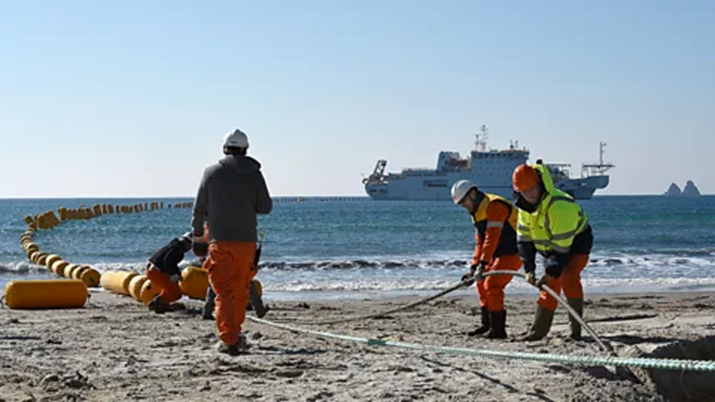
Image: BBC website
18. Timor Leste – New Undersea Cable
A submarine cable soon to arrive promises faster and more affordable internet access. At present, only 44.3% of the Timor-Leste population have internet connectivity to a service which is not only slow and unreliable but also prohibitively expensive. The Timorese Government has prioritised the submarine cable as a critical component of its broader broadband strategy. In May 2022, an agreement was formalised between Timor-Leste and Australia to build a submarine cable, with expectations that it would be operational by April, 2025. The Timor-Leste Government also has a new legal framework for e-commerce and electronic signatures and bans unsolicited commercial messages. Businesses must ensure their websites are compliant, implement secure payment systems, and train staff on the new requirements.
See: https://www.lowyinstitute.org/the-interpreter/cable-connect-timor-leste
19. Maritime Museums of Victoria (MMV)
You may enjoy and be inspired by this excellent collaborative promotional video by the 18 members of the MMV, highlighting each museum in turn. Perhaps try to visit some of these during the holiday season.
See: MMV YouTube Channel
20. Maritime ‘Big Builds’ in Docklands Precinct in the past and a ‘Big Build’ now proposed by MMHN
You may wish to see the latest MMHN Docklands Column. The harbour’s growth, by way of a series of historic ‘Big Builds’, to use today’s terminology, continues to underpin the prosperity of Victoria to this day. Take a moment to consider: Why does the Melbourne Maritime Heritage Network (MMHN) so strongly advocate for due recognition of maritime heritage ‘Big Builds’ located in the Docklands precinct? The answer, in brief: Maritime trade drove important investment in port infrastructure. The Docklands precinct has been crucial in the evolution of the port since colonial settlement. Major ports world-wide evolve over time, but what makes the port of Melbourne evolution unique? The answer lies in the extraordinary speed at which the port developed, shaped by a number of factors that arose during what was a transformative period in global maritime history.
Read on: https://www.docklandsnews.com.au/big-builds-past-docklands-maritime-big-builds-and-a-big-build-mmhn/
21. RAN Patrol-Boat Gift to Tuvalu
Australia has handed over a new Guardian-class patrol boat – the HMTSS Te Mataili III – to Prime Minister of Tuvalu, Feleti Teo, in a ceremony at Fleet Base West in Western Australia. The delivery of the vessel follows the elevation of the security partnership between Australia and Tuvalu under the recently enacted Falepili Union*.
HMTSS Te Mataili III is the 21st vessel delivered under the Pacific Maritime Security Program. The vessel will strengthen Tuvalu’s capability to protect its critical maritime resources.
See: https://www.contactairlandandsea.com/2024/10/18/tuvalu-receives-patrol-boat-gift-from-australia/
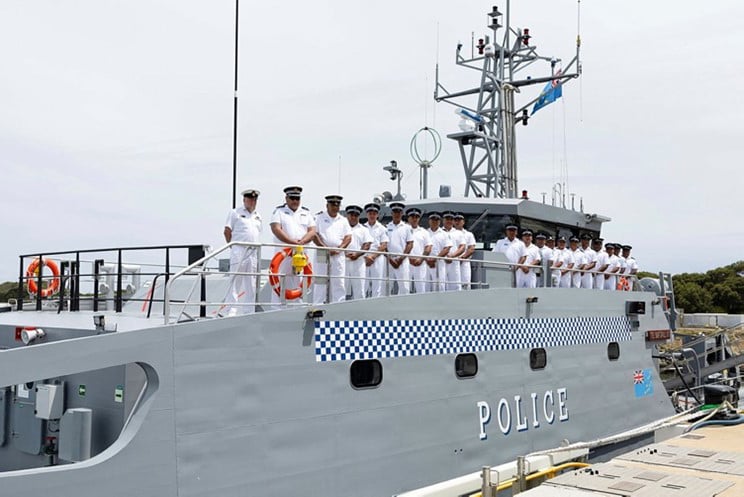
Image: ABIS Photographer, Connor Morrison
22. HMNZS Manawanui – Monitoring Continues
The New Zealand Defence Force issued an update to the media today, sending us the first official photos of HMNZS Manawanui in her current resting place.
Ongoing monitoring of the sunken ship – the first Royal New Zealand Navy commissioned ship lost since WWII – is being conducted under Operation Resolution. NZDF continued to conduct daily beach surveys, together with local authorities in Samoa, and had not found any evidence of pollution or fuel affecting the shoreline.
See: https://www.nzdf.mil.nz/media-centre/news/hmnzs-manawanui-assessment-and-monitoring-continues/
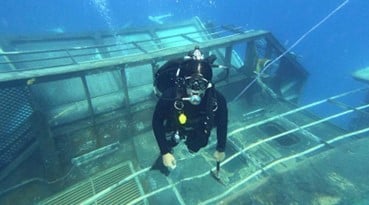
Image: A Royal New Zealand Navy diver examines the wreck of HMNZS Manawanui. New Zealand Defence Force
23. Princes Bridge Restoration Works
MMHN is, of course, delighted to note the City of Melbourne restoration work on Princes Bridge, a key maritime heritage infrastructure asset right in the middle of the state capital city, is progressing. Staged works commenced in March of 2024 and are predicted to take 3 years. While we are thankful for such investment and note efforts are being made to minimise disruption to the community, the extensive hoardings are questionable from the heritage perspective. Elsewhere in the developed world, restoration works on heritage assets are respectfully shrouded in images reflecting what lies beneath. Not only are the hoarding garish but even the City of Melbourne Restoration Notice is shabby.
See: https://www.southbanklocalnews.com.au/restoration-of-135-yea…
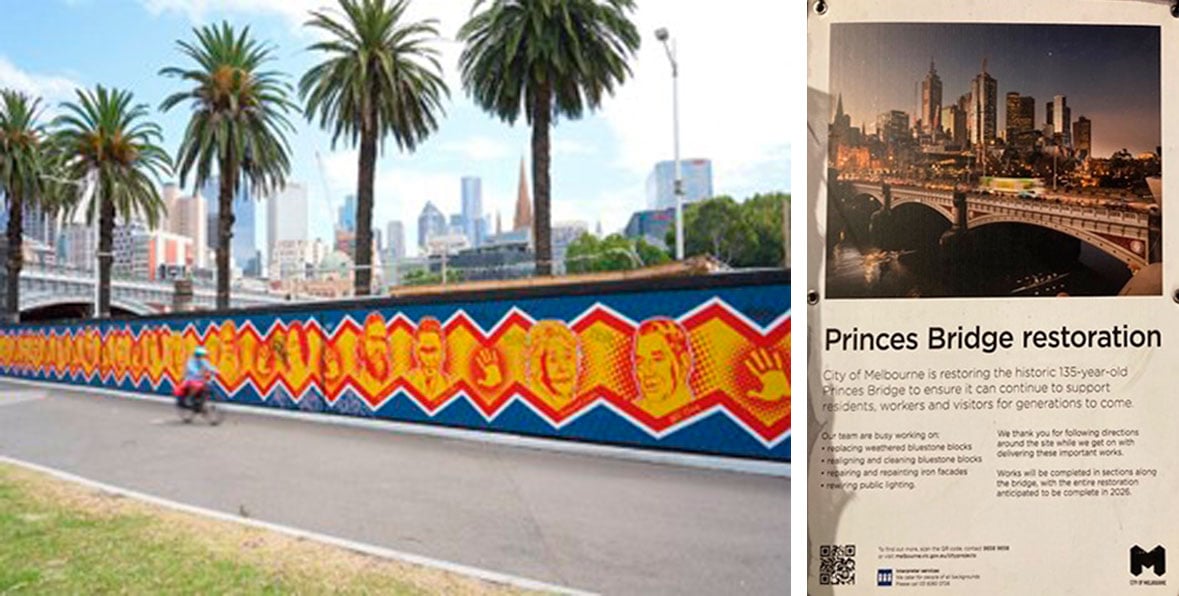
Images: MMHN
Membership 2024
If you have enjoyed the MMHN Updates in 2024, we invite you to please consider joining MMHN so that together we can continue to staunchly support due recognition of the unique maritime heritage of the Docklands precinct.
Register online at: https://mmhn.org.au/membership/
Best wishes, see you in the New Year!
Jackie
Dr Jackie Watts OAM
Chair,
Melbourne Maritime Heritage Network