

Greetings all
Melbourne is both a ‘port’ city and a ‘sport ‘city. Pardon the pun. The Paris Olympics Games remind us that there is generally an historical basis for the water sports, in fact like many sports, there is an historical or survival element.. But 2024 you may want to Olympics sailing competitions are to be held from at Marseille Marina; rowing, kayaking and canoeing including a new kayak-cross will be held at Vaires-sur-Marne Nautical Stadium.
See: https://olympics.com/en/news/
However, the historical or survival element in relation of several new ‘sports’ such as breakdancing, beach volleyball or skateboarding is somewhat hard to fathom?
Contents
1. Historical basis for water sports in a port city
2. Two Invitations
3. Pirates by any other name…
4. World War II Shipwrecks
5. Estonia– Maritime Heritage
6. Antarctica – Out of Sight, Out of Mind?
7. West Australia – Exemplar Heritage State
8. Matthew Flinders Reburied
9. Seafaring in Danger, even in Port
10. Australian Maritime Safety Authority (AMSA)
11. Stella Maris Seafarers Centre
12. Save Beaconsfield Reservoir / Cerberus Base Campaign
13. Royal Australian Navy
14. Port of Geelong
15. Ocean Energy Politics
16. Williamstown Shipyard
17. Electric Boats on Sydney Harbour
18. Port of Abu Dhabi
19. Robur Tea Warehouse
20. Floating Pier Proposal in Docklands Precinct
21. Port Phillip Sea Pilots (PPSP) – Flinders
22. OSSA Training – Critical Supply Chains and Australian Maritime Training
23. Apollo Bay Harbour development
24. Nautical Lingo
1. Historical basis for water sports in a port city
Whether sailing or rowing or canoeing or punting, expertise on the water has shaped early Melbourne. As an island nation, our bountiful inland waterways and surrounding oceans enabled indigenous people to thrive. Europeans came by sea. Exploration took great navigational and sailing skills. Colonial settlement in the 19th century in a city which spanned a river meant that water transportation was crucial. Rowing became not only a profitable commercial activity in Melbourne. but was also an immensely popular recreational pastime. Amateur rowing blossomed in Victoria more than in any other state and many rowing clubs were established. This enthusiasm for rowing led, some say, to the first amateur competitive river race in Australia being held on the Birrarung/Yarra on 2nd August 1840 – a mere 5 years after European settlement began on the banks of the river in Melbourne. Burgeoning Maritime Trade, initially on the river wharves on both sides of the river, and later the Coode Scheme including to widen and straighten the river and the excavation Victoria Harbour became basis of the port of Melbourne’s prosperity. Today, the port, is further downstream beyond the Bolte Bridge yet maritime trade is still driving Victoria’s prosperity.
2. Two Invitations
Girt by Sea: Finding Security in Australia’s Maritime Domains
Quaint language perhaps but a hot topic.
When: Wednesday July 31st at 12.15pm
Where: Via Zoom from the Lowy Institute Sydney
MMHN alerts maritime enthusiasts to a forthcoming Lowy Institute seminar looking into the question, ‘What do the maritime security challenges close to Australia mean for the country’s future’? The seminar will feature Hervé Lemahieu (Director of Research at the Lowy Institute) in conversation with Professor Rebecca Strating (La Trobe University), and Professor Joanne Wallis (University of Adelaide) about their new book, Girt by Sea: Reimagining Australia’s Security. The book looks at six maritime domains central to the country’s national interests and offers an alternative vision for how Australia should understand its strategic challenges.
Access the event live from Sydney: https://portal.lowyinstitute.org/
Note: If you have tech trouble with this link call Lowy on 02 8238 9000
All At Sea – Books with a Maritime Flavour
MMHN is delighted to collaborate for the first time with The Melbourne Athenaeum Library and Rare Books Melbourne.
When: Tuesday 13th August 6.30pm – 7.30pm
Where: The Melbourne Athenaeum Library
Level 1, 118 Collins Street, Melbourne CBD
Aptly titled, All At Sea will be an amusing exploration of literature with a strong maritime setting, chosen and presented by renowned Melbourne book collector, Professor Chris Browne, from his extensive library. From the beginnings of the novel in the 17th century until the present day, the sea has provided a compelling backdrop for storytelling. Be they tales of adventure and derring-do, romance, philosophy, historical, political or geographical drama, the allure of the sea is strong. Follow life from The Water Babies to The Old Man and the Sea. Explore the exploits of well-known heroes such as Hornblower, Aubrey, and Kydd, discover forgotten names like Frank Mildmay, Jack Saunders, and Peter Simple, and meet the unforgettable villains Hook, Queeg, and Long John Silver. Join us in the world of Night Plunderers and Game Lumpers, Lightermen and Scuffle-Hunters. We invite maritime enthusiasts to come aboard.
For catering purposes, please booking here: https://www.trybooking.com/CTMZH
3. Pirates by any other name…
Privateers, Corsairs, Picaroons, Buccaneers, Freebooters, Raiders, Blackbirder, Sea Rovers, Mutineers, and Marionets. Night Plunderers, Game Lumpers, Lightermen and Snuffle-Hunters.
Piracy is a constant element in maritime empire, maritime trade and global politics. Defined historically, a person who commits an act of robbery or violence upon a ship and its crew or on coastal regions by ship is considered a pirate. During the Roman Empire (circa 100 BC), Cicero wrote that “pirates and banditti infested the sea and the coasts of Sicily”. Opportunistic seafaring robbers seem to have been a constant presence throughout maritime history. Sometimes sovereigns or delegated authorities issued commissions or a ‘letter of marque’ to legitimize robbery at sea, especially during wartime. Pirate motivation and methodologies have changed over the centuries, but the targets have primarily been other ships and seafarers. Current and disparate examples include those with an economic motivation. For example, the ‘Petro-Piracy’ of the Gulf of Guinea, in which oil-rich states form 6000 kilometres of coastline, from Senegal to Nigeria in West Africa to Angola in Southern Africa. Not to mention the Somali pirates operating the Gulf of Aden, the Guardafui Channel and the Somali Sea. New methodologies seem to have emerged, motivated by regional politics. For example, Yemen’s Houthi’s recent strategy of mounting missile attacks on international shipping passing through the Red Sea. Whatever the differences, motivations or methodology, two elements remain consistent – seafarers are vulnerable and can find themselves in extreme danger.
Dr Richard Blakemore is an Associate Professor at the University of Reading, as well as a consultant for the National Maritime Museum and the Deutsches Schifffahrts Museum and a Trustee of the British Commission for Maritime History. He has written a new book of interest for pirate afficionados, titled Enemies of All: The Rise and Fall of the Pirates.
Further reading:
The Conversation: Pirates and Politicians
http://english.news/Houthi
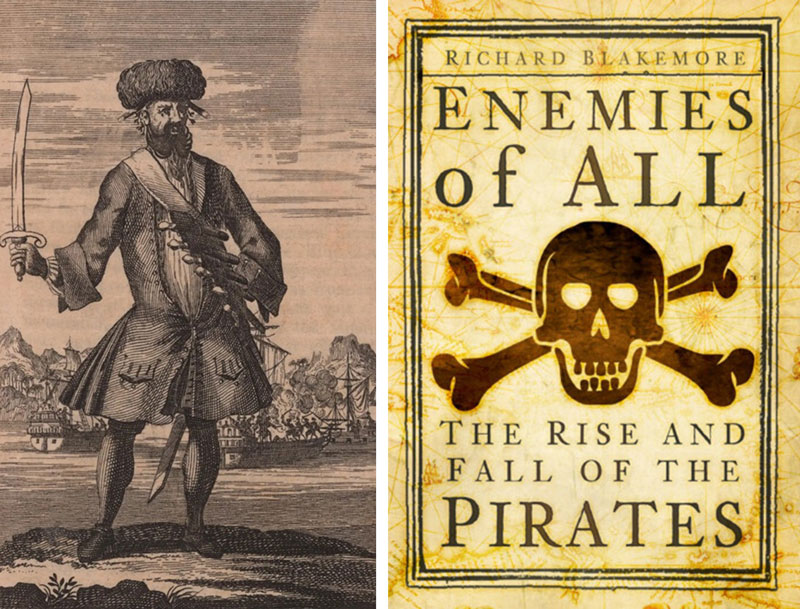
Image (left): The Conversation – Blackbeard, the Pirate by Benjamin Cole.
Source: Wikimedia Commons.
4. World War II Shipwrecks
World War II shipwrecks are scattered all around Australia, but six have been identified as a serious environmental threat. ABC News reporter Liz Gwynn wrote on the 7th of July that while World War II shipwrecks are scattered around Australia, “some of them are close to tourist towns and have the potential to leak toxic materials into sensitive marine areas.”
The wrecks include three US vessels – the Lexington, Neosho, and Sims – which rest at the bottom of the Coral Sea Marine Park off the East Coast; a vessel called MV Limerick, 18 kilometres east of Ballina in NSW; and two wrecks off Victoria’s coast near Apollo Bay and Wilsons Promontory. The condition of such ships, like all wrecks, will change and degenerate over time. Exactly who has responsibility or liability for such wrecks is not clear cut. According to the Dept of Climate Change, Energy & Environment and Water, all shipwrecks and their associated relics that occurred 75 or more years ago are protected under the Underwater Cultural Heritage Act 2018, regardless of whether their precise location is known.
See: ABC News – Australian WWII Shipwrecks
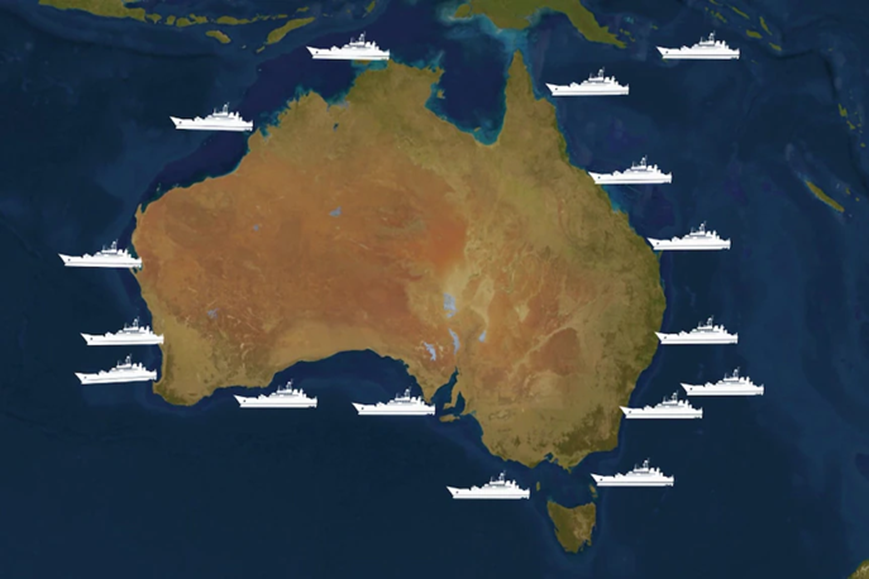
Image: Map, ABC News
5. Estonia – Maritime Heritage
MMHN Board members travel widely and often! Dr Greg Harper has been travelling in the Baltic states. Greg reports from Estonia:
Estonia has a rich seafaring heritage. In the capital city, Tallinn, Paks Margareeta (aka Fat Margaret), is an iconic early 16th century historic maritime tower that has played a significant role in the rich maritime history of Tallinn. Originally built as a defensive tower to protect the city from naval attacks, Fat Margaret now houses an extensive maritime museum encompassing exhibits on naval history, shipbuilding, and an impressive collection of maritime artifacts including ship models, navigational instruments, and historical documents. A highlight for Greg was an exhibit built around the remains of a ‘cog’; a medieval, single-masted, square-rigged sailing ship used for trade among the Hanseatic ports. Discovered in 2015, the ‘cog’ is preserved and mounted cleverly within the tower of Fat Margaret, surrounded by digitally enhanced stories which convey a sense of the economy and social milieu in which the cog and her crew were operating. In the Baltic Sea region between the 13th and 17th centuries (at a time when the Hanseatic League connected large trade cities in from Northern Germany, the Netherlands, Livonia, and Scandinavia), cogs could operate as cargo vessels or as warships and were ideally suited for Hanseatic trade. They were bulbous, single-masted vessels with a square sail, stern rudder, and a flat bottom that allowed passage through shallow waters. Cogs were also capable of carrying a relatively large amount of cargo with a very small crew. Very few medieval wooden sailing cogs are preserved. More modern times feature augmented reality. For example, a WWII event not well known to many in Australia is the Soviet evacuation of Tallinn in August 1941. Also known variously as the Juminda Mine Battle, the Tallinn Disaster, and the Dunkirk of Estonia. Soviet forces had occupied Estonia in June of 1940, and a large part of the Red Banner Baltic Fleet was bottled up in Tallinn harbour when Germany advanced. This evacuation event involved 165 ships, 28,000 evacuees and 66,000 tons of equipment. A total of 84 vessels were sunk or damaged irreparably. At least 12,400 people are thought to have drowned and under the post-war Stalinist regime, the event was downplayed. The Museum offers visitors audio and written options in three languages.
See: https://meremuuseum.ee/paksmargareeta
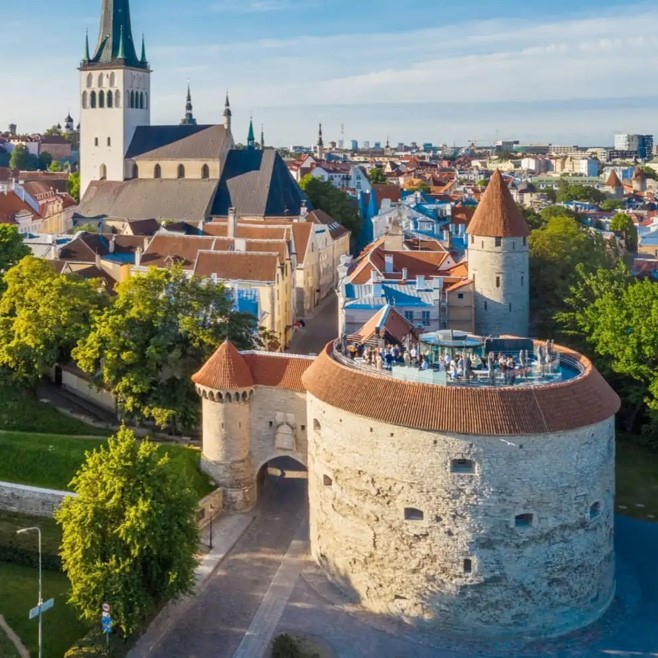
Image: Paks Margareeta Website
6. Antarctica – Out of Sight, Out of Mind?
Simply inexcusable! Wilkes Base was originally built by the USA in 1957, but the 33-hectare site was transferred to Australia in 1959 and now stands 3km north of Casey Base. The station operated for a further 10 years, before it was permanently closed in 1969.
Still on Wilkes Base are thousands of fuel drums, asbestos-riddled buildings and other waste, largely buried beneath the Antarctic ice and snow. Recently a French inspection team raised concerns, saying the mess poses a “clear risk” to the environment. Fortunately, use of drones has eliminated any possibility of an ‘out of sight, out of mind’ approach. The Australian Antarctic Division has been using drone-mounted, ground-penetrating radar to determine the best option for cleaning up the site in the coming years”. Such comments do not convey the requisite sense of urgency. MMHN would argue that it is shameful that ANARE has not addressed this vexing situation already. No doubt, the next step is acquiring adequate funding to deploy AI-enabled robots to clean up what should be a pristine space on our planet. A place for which Australia is responsible.
See: ABC News – Abandoned Antarctica Wilkes Station
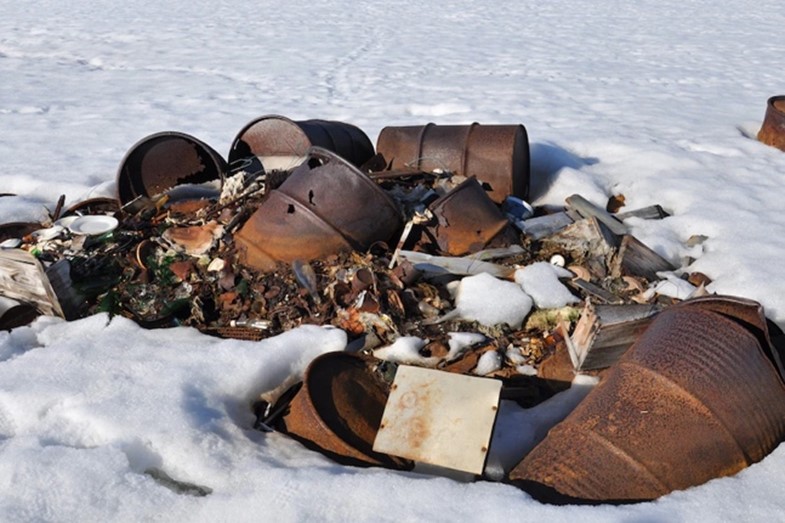
Image: The Conversation
An ANARE veteran shares his recollections with MMHN, describing this situation as “disgraceful” – a consequence of the Station being distanced from Antarctic operations in recent years. Decades ago, Barry Jones (then Science Minister) sent Stephen Murray-Smith to investigate the scandalous rebuilding program. Stephen went on to write a great book about it, called Sitting on Penguins.
There is dark irony in the French drawing attention to the appalling Wilkes situation, given the environmental disaster that they created in1994. New Scientist (July, 1994) reported “France has abandoned plans to repair a controversial airstrip in Antarctica. The 1100-metre runway near the Dumont d’Urville base was badly damaged in January by a violent wave, which washed part of it into the sea. Plans were to flatten three islands to build the runway at a cost of 110 million francs (about £12.5million). Critics have always maintained that landing large transport aircraft on the strip would disturb the penguin population and could disrupt breeding. French biologists say construction of the airstrip destroyed up to 35 per cent of the breeding sites of five seabird species, including Adelie penguins, petrels and Antarctic skuas by flat…”
See: https://www.newscientist.com/article/mg14319340-500-peace-and-quiet-for-penguins/
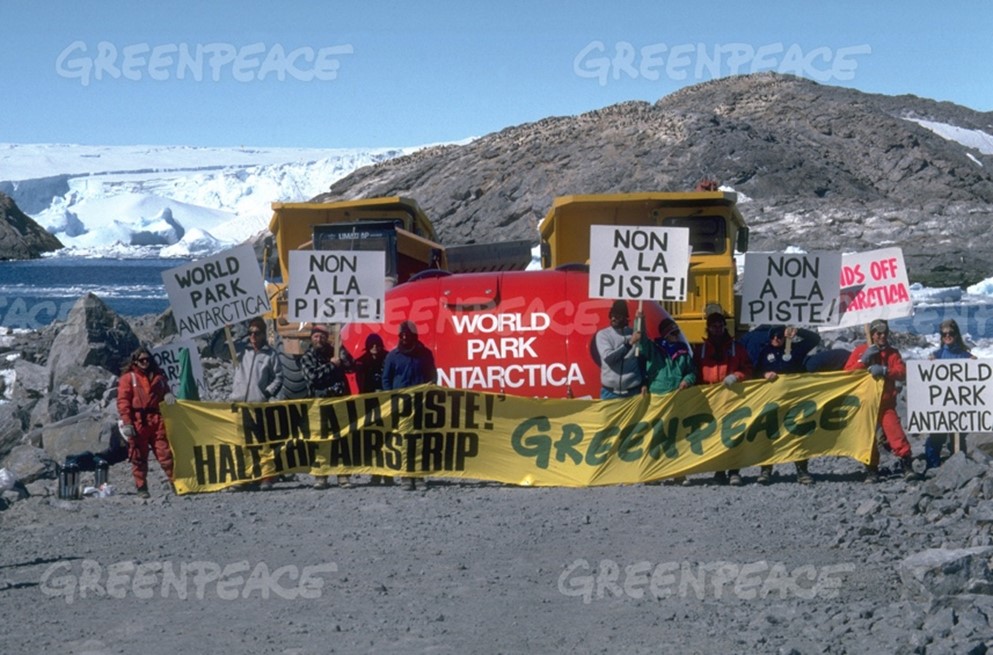
Image: Greenpeace blockade of airstrip site at French base Dumont D’Urville, Antarctica, 1991
7. West Australia – Exemplar Heritage State
MMHN, at once vigorously applauding heritage support in WA, is incensed that no such funding source derived from a State Lottery is available here in Victoria.
The WA 2024-25 Heritage Grants Program offers funding assistance for the conservation, future planning, and promotion of heritage places. This involves two primary funding streams: State Heritage Grants and Community Heritage Grants. Grants of up to $50,000 are offered for conservation works projects and up to $16,000 for documentation projects, on a dollar-for-dollar basis. Eligible major conservation project funding of up to $100,000 is available if one or more of the additional criteria are met.
See: https://dreamstate.lotterywest.wa.gov.au/article/247-celebrating-perths-heritage
8. Matthew Flinders Reburied
Archaeologists currently working on the HS2 project in Euston discovered the remains of Captain Matthew Flinders. In the 1790s, the Royal Navy explorer, navigator, hydrographer, scientist and master navigator led the first circumnavigation of Australia, confirming that it was, in fact, an island and even contributed to popularising the name ‘Australia’ itself. Flinders died in 1814 and was buried in the St James burial ground. Following the expansion of Euston station westwards into part of the burial ground in the 1840s, his headstone was removed, and it was thought that his remains had been lost. For a long time, there was an urban myth that Captain Flinders was buried under platform 15. Helen Wass, Head of Heritage at Euston HS2, explains the impact of the discovery:
“The discovery of the remains of Captain Matthew Flinders’ is an incredible opportunity for us to learn more about the life and remarkable achievements of this British navigator, hydrographer and scientist. Captain Matthew Flinders put Australia on the map due to his tenacity and expertise as a navigator and explorer. Given the number of human remains’ at St. James’s, we weren’t confident that we were going to find him. We were very lucky that Captain Flinders had a breastplate made of lead meaning it would not have corroded. We’ll now be able to study his skeleton to see whether life at sea left its mark and what more we can learn about him. This discovery is particularly exciting for me as an archaeologist working on the site as Captain Matthew Flinders was the grandfather of renowned Sir William Matthew Flinders Petrie, commonly known as the ‘Father of Archaeology’.
During the late 1790s, Flinders sailed to Australia and established himself as a first-class navigator, an excellent cartographer and a man of determination. In 1798 Flinders, John Thistle and George Bass sailed around Tasmania and proved it to be an island. The passage was later named Bass Strait and one of the islands Flinders Island. John Thistle had an island named after him at Cape Catastrophe where he drowned. Finally on 9th of May 1802, Matthew Flinders reached Port Jackson, Sydney. While at Port Jackson, he obtained seven convicts to replace the crew members drowned in South Australia. He left Sydney in July and charted the east coast of Australia, went through Torres Strait and continued the charting of the Gulf of Carpentaria. Here, he lost one of his crew in a fight with the local Aborigines. By now, his ship was in a very poor and sorry state, but he continued west and south. He eventually returned to Sydney after a full year at sea, on 9th of June 1803, having circumnavigated Terra Australis Incognita, the Unknown South Land.”
See: HS2 News: The final voyage of Captain Matthew Flinders
and: BBC News: Matthew Flinders’ remains to be reburied in Lincolnshire
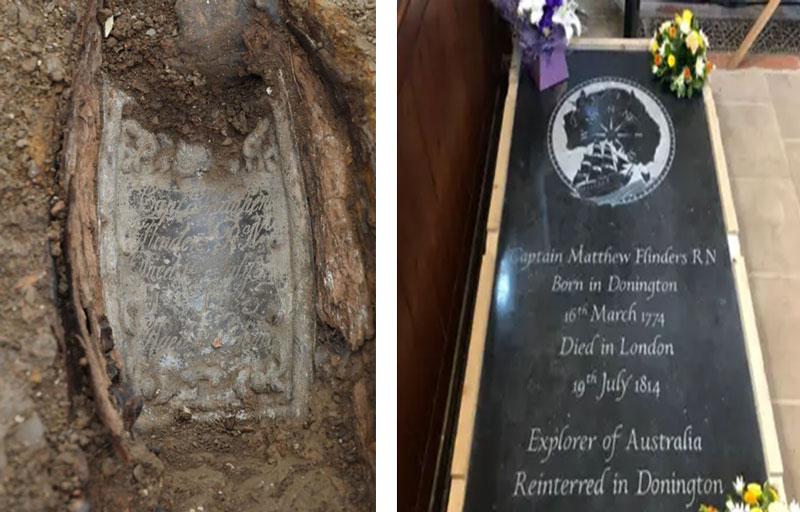
Image: The Flinders breast plate and new Commemorative plaque
9. Seafaring in Danger, even in Port
Sad report for World Cargo News (19th June, 2024) of a seafarer who died during commercial operations in the Port of Melbourne MIRRAT’s Webb Dock West terminal on the vessel PCTC Grande Baltimora. Ship owners, Grimaldi Group, confirmed the death of a 34-year-old Filipino crew member. A thorough investigation is underway, and the company is providing close support to the deceased’s family and assisting the crew on board. The vessel was detained in port for several days while AMSA conducted investigations. MMHN understand that when such a tragedy occurs in Port, the entire the ship’s crew is changed, and a new crew taken on board.
See: https://media.amsa.gov.au/media-release/amsa-shines-light-seafarer-worker-conditions-new-report
and: https://www.worldcargonews.com/news/2024/06/fatal-incident-aboard-grimaldi-pctc/
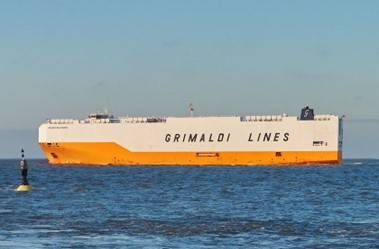
Image: PCTC Grande Baltimora, World Bargo
10. Australian Maritime Safety Authority (AMSA)
AMSA reports on good seafarer welfare news—which could be better! A reminder that MLC is an International Labour Organization treaty that has been ratified by 104 member states, including Australia. Complaints about breaches against the Maritime Labour Convention (MLC) on ships decreased in 2023, compared to the previous year. AMSA inspects shipping in Australian waters to ensure that vessels are MLC compliant. There has been 18% decrease in complaints to AMSA about breaches to the MLC (214 complaints in 2023 from 261 in 2020). Of the 214 complaints received in 2023, breaches of employment conditions were the most common (for example: wages, hours worked and hours of rest while at sea). Fatigue obviously increases danger. Most complaints made to AMSA are submitted by seafarers themselves. This indicates that seafarers are aware of, and trust, Australia’s reputation as a nation that takes seafarer welfare matters seriously. Most complaints (75) came from WA and bulk carriers registered the highest complaint rate (58.9%). During 2023, AMSA Port State Control inspections resulted in 11 detentions. AMSA notes that still much work to do.
“Severe underpayment, decrepit living conditions and difficulties returning to their home country are some of the abuses seafarers endure from poor employers… Seafarers are the backbone of the global economy, and when they are in an unacceptable working and living condition, they often suffer in silence.”
11. Stella Maris Seafarers Centre
Chair of Stella Maris Seafarers Centre, Ray Collins, reminded us that “Without seafarers, we would not have most of the items we rely on for daily living”. They work tirelessly to bring products into our ports that sustain us and our economy. Two Sea Sundays are scheduled for 2024: June 26th and July 28th. Stella Maris is the official maritime welfare agency of the Catholic Church, which operates Stella Maris Centres in more than 300 ports across the world. The connection between to Christianity and seafaring dates back to the fishermen-disciples of Christ over 2000 years ago.

12. Save Beaconsfield Reservoir / Cerberus Base Campaign
MMHN commends the Save the Beaconsfield Reservoir Action Group (SBRAG) for their work in relation to preserving maritime heritage infrastructure assets in Victoria. Such community-based efforts take not only immense effort on the part of volunteers but also considerable fundraising to hire professional heritage expertise. In late 2023, SBRAG nominated for heritage listing based on its unique role in the Victoria’s Naval heritage. The significance of the Beaconsfield Reservoir within the Mornington Peninsula Water Supply Scheme (MPWSS) lay in its purpose as a reliable source of potable water, necessary to establish and expand Flinders Naval Base, later known as HMAS Cerberus. There are no comparable water schemes in Victoria designed and established to specifically enhance Australian and Victorian Naval defence capability.
The MPWSS, the HMAS Cerberus Naval Base and their unique roles in the maritime heritage of Victoria and Australia are irrefutable. Documentary evidence indicates that in 1912, Prime Minister Andrew Fisher officially requested the construction of the MPWSS to enable this crucial coastal defence and training base for the Navy. Concerns escalated at the outbreak of WWI in 1914. Without access to a water source, the Naval Base would have been reliant on water being shipped in or brought overland. HMAS Cerberus remains operational and continues to serve the nation as the sole Victorian Naval Base. Unfortunately, HV deemed that the MPWSS was not of sufficient state heritage significance and refused the heritage listing. SBRAG rejected this decision, noting that the explanation clearly failed to acknowledge both the extent of the remaining water infrastructure and the unique maritime significance of the MPWSS. SBRAG applied to the Heritage Council for a review of the refusal. This was granted and the $300+ fee was waived. SBRAG and MMHN anxiously await the final decision.
For further information, email info@mmhn.org.au to access a 2006 publication by Mr. Clarrie Talbot which comprehensively covers the topic.
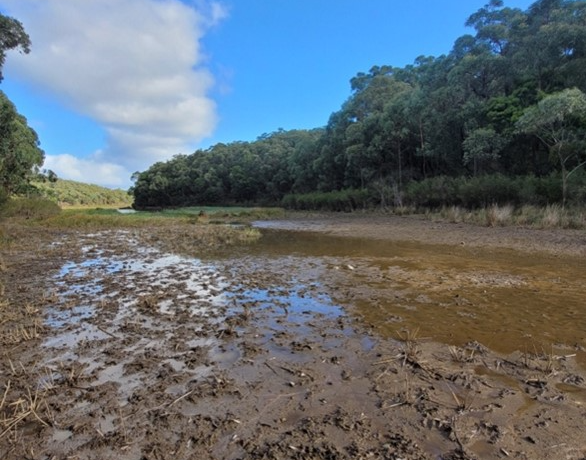
Image: SBRG – Melbourne Water appears to be draining the system, disregarding heritage considerations and the submission in progress.
13. Royal Australian Navy
MMHN recommends several recent YouTube videos offering real insight into work aboard:
- HMAS Yarra: https://www.youtube.com/watch?v=vW3oNOLizbs
- HMAS Collins: https://www.youtube.com/watch?v=j1j-3HhAVYs
- HMAS Dechaineux: https://www.youtube.com/watch?v=1D_4VDsuits
14. Port of Geelong
For over 150 years, the Port of Geelong has been an integral part of the Victorian maritime economy. MMHN recommends you look at Custodians of the Bay, a Brief History of Geelong Port for some insight. While Geelong Port manages wharf and land-side infrastructure, Ports is responsible for channel management and commercial navigation of commercial waters in and around Geelong. Geelong Port is privately owned by Stonepeak and Spirit Super. The port offers 15 berths over two primary precincts: Corio Quay and Lascelles Wharf. However, changes are afoot! At the port 7km from the Geelong CBD, Alcoa has announced an EOI for mixed-use development for its 515ha site at Point Henry. In 2014, after more than 50 years of operating an aluminium smelter and rolling mill at this location, Alcoa decided to close operations. Decommissioning and environmental remediation is preparing the site for eventual redevelopment. Areas within the site are being set aside for conservation, including wetlands and a native grassland.
The EOI closes on August 19th 2024, and is being managed by KPMG, who can be contacted via au-fmalcoapthenry@kpmg.com.au
MMHN encourage maritime enthusiasts to share their views on the future of the Port of Geelong.
See: https://engage.geelongport.com.au/
and: https://www.theurbandeveloper.com/
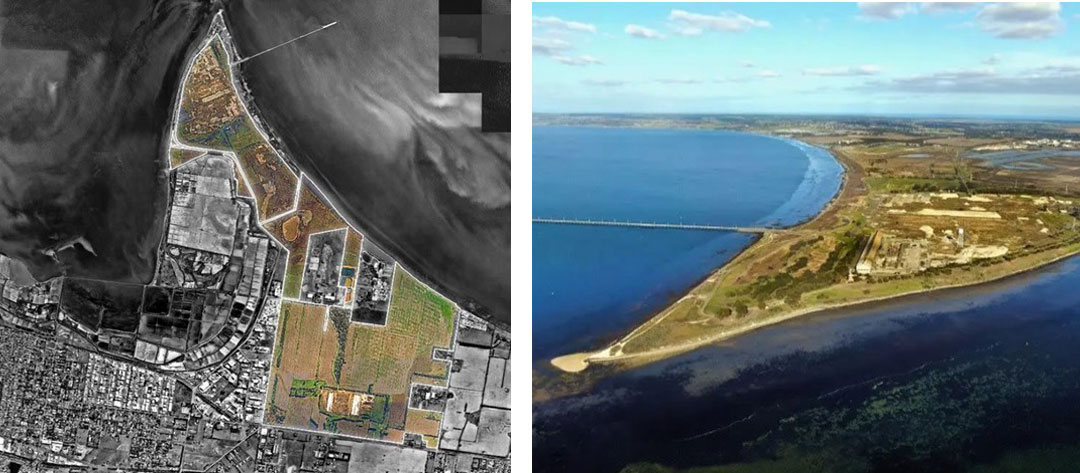
Images: Port of Geelong Website
15. Ocean Energy Politics
MMHN follows closely the development of State and Federal policy when it comes to offshore energy off the Victorian Coast. This new maritime industry will require serious re-thinking in relation to maritime skills and vessels. Professor Mark Kenny of the Australian Studies Institute, Australian National University, recently reflected on the sector’s implications for the next Federal election.
See: The Conversation: Climate and Energy – a federal election flashpoint
16. Williamstown Shipyard
Given the heritage-listed Alfred Graving Dock on the waterfront at Williamstown is an irrefutably significant maritime infrastructure asset for Victoria, MMHN can merely watch on high alert – and hope.
See: SMH – Williamstown Shipyard for sale
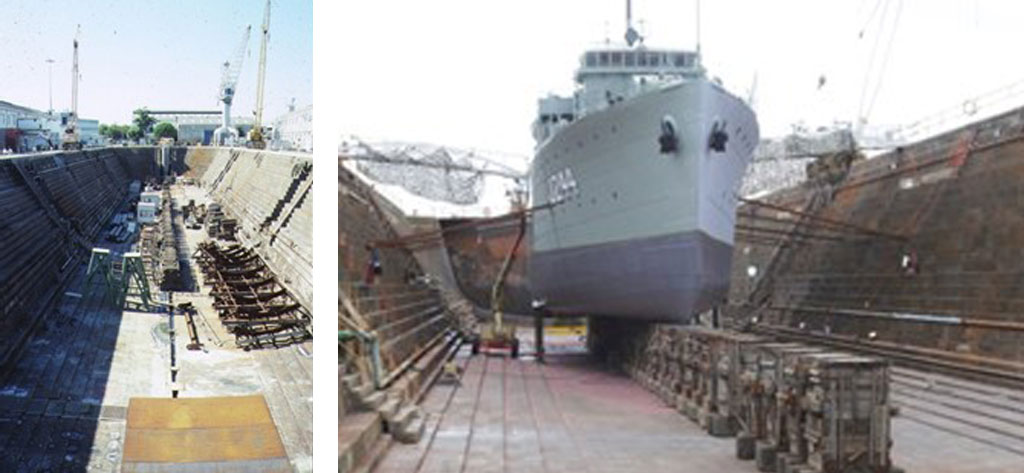
Images: National Trust
17. Electric Boats on Sydney Harbour
Is Sydney Harbour about to go electric? Amber Shultz (The Sydney Morning Herald, 16th June) reports “The future of Sydney Harbour could be noise-free, pollution-free and wake-free if electric boats are embraced – but there’s a catch. Electric boats are quieter, smoother and cheaper to run and service than boats petrol or diesel engines. With no risk of fuel spill and zero emissions, they’re cleaner to run, too. However, the industry is in its infancy, and there’s a trade-off between passenger capacity and battery size, with most electric boats only able to run for a few hours without recharging.”
See: SMH: Sydney Harbour is about to be carpeted with electric boats.
Electric boats are already for hire on the Birrarung/Yarra, which presents a less hazardous location should power run out, than bobbing around in the Sydney Harbour swell. Locally owned and operated, Melbourne Boat Hire is Melbourne’s premium, eco-friendly, electric self-drive boat hire and boat tour operator on the iconic Yarra River in Melbourne.
See: Melbourne Boat Hire
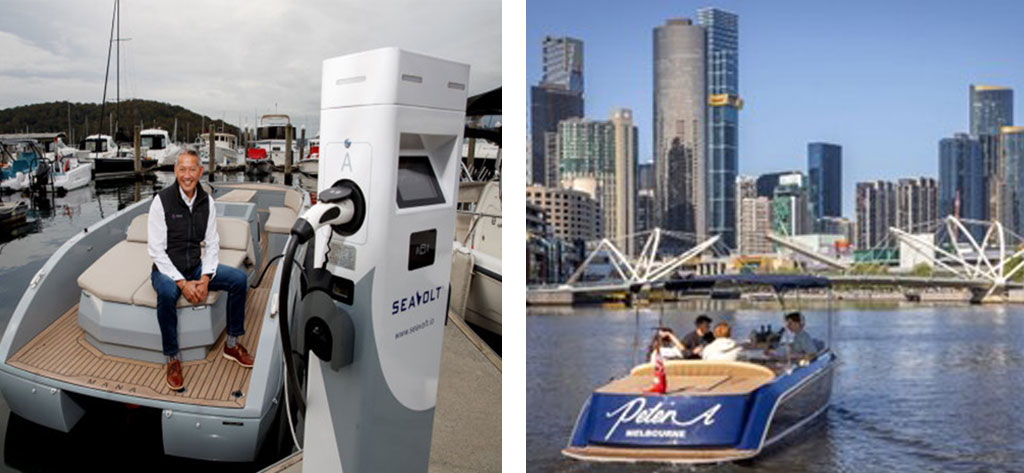
Images: Sydney charging station, SMH & Melbourne Boat Hire from their website
18. Port of Abu Dhabi
MMHN has a keen interest in the way in which this Port is managed. Former MMHN member, Dr. Haya D’Aghlas, returned to Melbourne briefly in July. In a meeting hosted by the Port of Melbourne, Haya discussed her role as the Director of Strategy and Regulations – Maritime Sector at Abu Dhabi Ports Group. Topics covered included:
- Abu Dhabi Maritime Overview,
- Public Water Transport Strategy
- Aspiration: Abu Dhabi as a Leading Maritime City
- Maritime Hub: Abu Dhabi
Quite clearly, Abu Dhabi competes in a world far apart from Victoria. For example with an annual budget allocated in the billions, not millions! Abu Dhabi is committed to rising in the World Shipping port rankings, whereas Victorian ports do not appear to compete.
See: https://www.worldshipping.org/top-50-ports
The commercial port of Abu Dhabi is managed and funded separately from the public port of Abu Dhabi. There are more than 200 islands off the port and a public water transport network is expanding. There is a great interest in managing jet-skis and attracting superyachts.
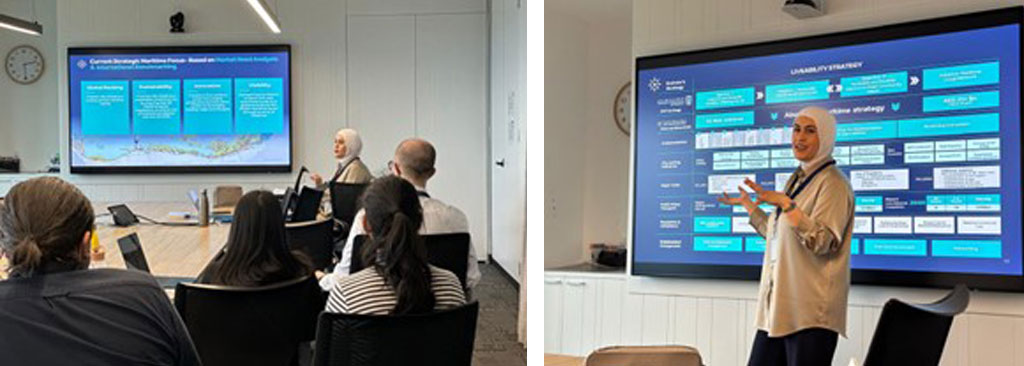
Images: Port of Melbourne
19. Robur Tea Warehouse
This immensely significant example of maritime trade infrastructure has repelled innumerable appropriate development plans. Over the years, plan after plan attempted to compromise the heritage value of this unique 135-year-old, historic Robur Tea House in Southbank. Meanwhile, the value of the real estate kept escalating.
Has the most recent one addressed this vexing matter? See the image below. After a 3-year planning process, Norwegian architects Snohetta have gained heritage approval for the redevelopment of the site. Along with the heritage listed warehouse, the location features a complex of seven integrated buildings, ranging in height from 3 to 30 storeys.
The six-storey Robur Tea House was once the tallest building outside Melbourne’s CBD. Land values continue to drive development – but at what cost?
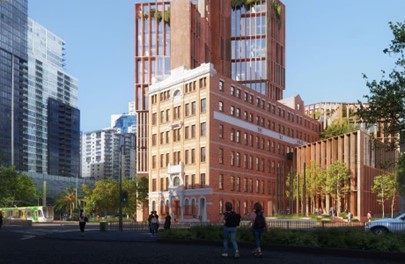
Image: Urban Developer
20. Floating Pier Proposal in Docklands Precinct
MMHN is nothing if not nimble! An opportunity arose this month for MMHN and relevant stakeholders to gain further insight into an exciting and utterly do-able method for achieving ‘permanent activation’ in the Docklands Precinct. We were delighted to welcome Jim Gandy, designer and engineer of the immensely successful Brooke St floating pier in Hobart, who agreed to share his insights and expertise about replicating the project in Melbourne. MMHN is grateful to Matthew Chun, AFL Executive General Manager – Finance, Clubs and Infrastructure, who kindly agreed to host this fortuitous meeting
A reminder that a primary MMHN Objective is a Maritime Experience Centre (MEC) atop a new floating Central Pier, capable of delivering social, cultural and economic benefit not only to Docklands, but to Victoria as a whole. Maritime matters – past, present and future – remain the basis of our prosperity. This is an exciting concept on a number of levels for the Docklands Precinct. Also, a first for Victoria.
See: https://mmhn.org.au/maritime-experience-centre/
Jim Gandy has generously allowed MMHN to take further advantage of his presentation to inform government agencies as well as the wider community. An invitation to view it will be issued in due course.
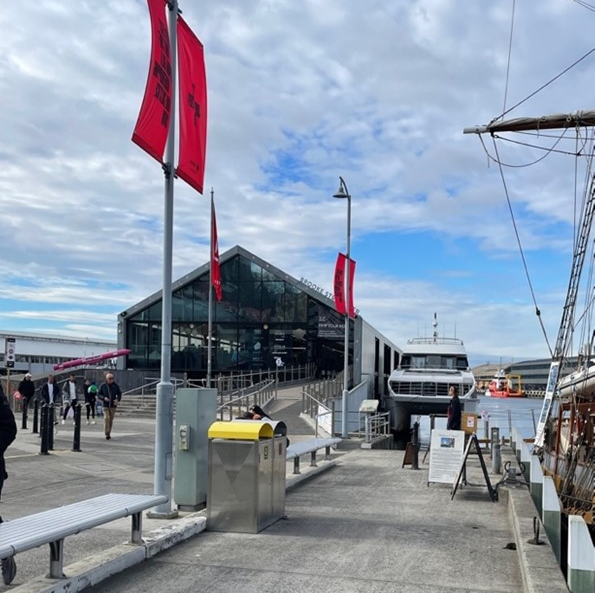
Image: Brookes St Pier, Ash Raftis, MMHN Board member
21. Port Phillip Sea Pilots (PPSP) – Flinders
MMHN is pleased to see new informational signs at the Flinders Cargo Shed at Flinders Jetty. Western Port has been operating since the 1800s and since the 1960s, trade from the port has included steel and hydrocarbons – and it still does. In 1972, a new tanker port was established at Westernport and a PPSP Pilot boat is now permanently moored there.
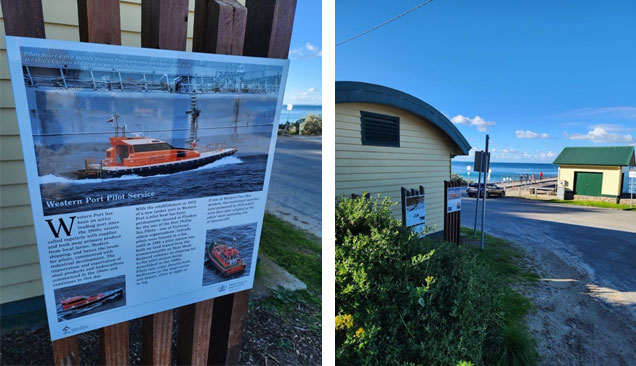
Images: Port Phillip Sea Pilots (PPSP)
22. OSSA Training – Critical Supply Chains and Australian Maritime Training Requirements
Recently OSSA was invited to put forward a paper to the AEP (Australian Energy Producers) conference held in Perth, outlining the necessity for a strong maritime presence to support the nations international logistics. OSSA continues to push for a stronger Australian fleet and with it, greater training opportunities for seafarers through:
- Direct approaches to Federal and State governments.
- Expanding OSSA involvement with presentations to schools in Queensland, NSW, Victoria and SA.
- OSSA will promote the OSSA Schools Program in WA in October at the Fremantle Maritime Day.
- Development of a bursary to support cadets going into the sea industry.
23. Apollo Bay Harbour development
Apollo Bay is to be redeveloped. MMHN is generally apprehensive when announcements such as this are made about significant maritime heritage sites. The Great Ocean Road Coasts and Parks Authority has announced Antarctica Architects as consultants for the Apollo Bay Harbour redevelopment. A Precinct Plan is being developed. A new promenade, commercial space extending the Apollo Bay Fisherman’s Cooperative building, relocating the Port Operations Depot, and improving pedestrian and transport networks within the precinct are included in the proposal. The Federal Government has provided $12.61 million in funding for the project through the $500 million Geelong City Deal. A community reference group is to be set up this month—stay tuned.
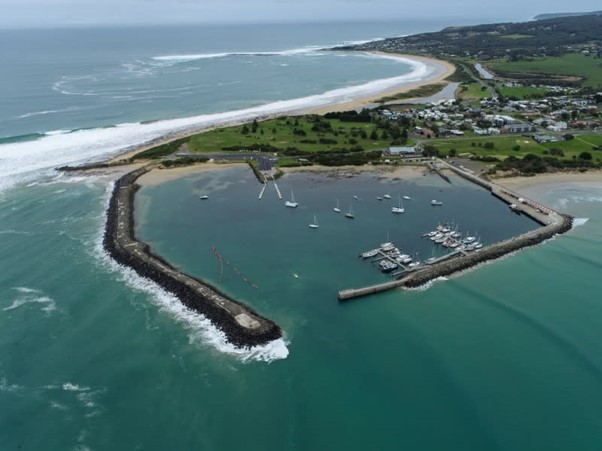
Image: Parks Victoria
24. Nautical Lingo
In these dark, windy days of winter, nautical language continue to amuse. Oddly enough, ‘shiver me timbers’ is not relevant at all in the frigid temperatures of this past month but refers only to the wooden frame of a ship. And as for a ‘snuffle hunter’? Again, contrary to what you might first think, this is not about the on-set of a yet another winter flu, but refers to a type of porter or manual labourer formerly employed at a port.
Until next time,
Jackie
Dr Jackie Watts OAM
Chair,
Melbourne Maritime Heritage Network