

Greetings all,
Global socio-political maritime turbulence continues, as does local unease in relation to the Heritage Fleet in Victoria Harbour Docklands. But first, an invitation:
Invitation – HMAS Cerberus Base Open Day
When: 10:00am – 3:30pm, Sunday 6th April 2025
Where: HMAS Cerberus, Sheean Avenue, Somers VIC
This is a special day for maritime stakeholders. In addition to a daylong program of brief talks on a fascinating range of maritime topics, MMHN is delighted to report the eagerly anticipated ‘soft opening’ of the refurbished Cerberus Learning and Heritage Centre. Curator, Lawson Rennie, will share his insights into the Centre’s collection.
11:00 – Presentation: Australian Naval and Military Expeditionary Force 1914
12:30 – Official Reopening
13:00 – Presentation: Royal Australian Navy in the Korean War
14:00 – Presentation: Women in the Royal Australian Navy
15:00 – Presentation: N-Class Destroyers
See: https://www.navy.gov.au/community-engagement/events/2025-04-06/hmas-cerberus-open-day
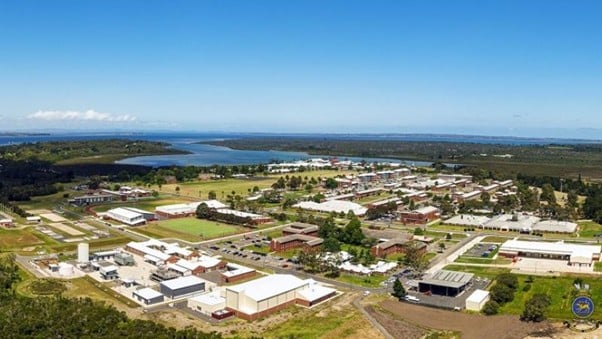
Image: Cerberus Base, RAN website.
Contents
1. International Maritime Heritage ‘Champion’
2. HMAS Arunta (II) – A Most Welcome Presence in Melbourne
3. Early Maritime Contact with India – La Trobe Society
4. The Lady Nelson Heritage Vessel
5. The Enterprize – Heritage Vessel
6. Heritage Fleet Eviction Looming: Tell Us What You Think
7. Contentious AUKUS Project – Potential Economic Upside For Australia
8. A Concern: Collins-class submarine HMAS Farncomb Refit Program
9. Queenscliff Maritime Bookshop: Reflections
10. Wooden Boat Festival 2025
11. Undersea Cable Damage – Alarm Bells Ring in Taiwan
12. Weird Collision in the North Sea
13. Huge US Military Fuel Tanks in Darwin Harbour
14. Port of Darwin Buy Back?
15. Heritage Vessel Wyuna Restoration
16. Maritime Skills – Finally Federal Investment
17. Seafarer’s Wage Theft
18. Fishing Matters – Yes, it Does
19. Drama Sailing Under the Bolte Bridge
20. Maritime Heritage Amnesia
1. International Maritime Heritage ‘Champion’
Good news! Soon after MMHN was established, Dr Kevin Fewster, a leading international figure in maritime and history museums and maritime heritage, agreed to become our first patron. Kevin is a former Director of Royal Museums Greenwich, the world’s largest and most visited maritime museum precinct, which includes the National Maritime Museum, the Royal Observatory, the Cutty Sark, Queen’s House, Caird Library and the Prince Philip Maritime Collections Centre. Kevin remains a major figure in the International Congress of Maritime Museums (ICMM).
The good news for Australian maritime heritage is that, on Kevin’s recent return to live in Sydney, the federal Minister for the Arts invited Kevin onto the Board of the Australian National Maritime Museums (ANMM). MMHN, ANMM and Australia at large are fortunate indeed to benefit from the vast experience of this maritime heritage ‘champion’.
See: https://mmhn.org.au/about/
2. HMAS Arunta (II) – A Most Welcome Presence in Melbourne
Many will have observed the Anzac-class frigate HMAS Arunta (II) along our coast and in Port Phillip Bay recently. Some maritime enthusiasts were fortunate indeed to have visited the recent Open Day at Station Per. MMHN was offered the opportunity to take a tour of the ship led by the most impressive second-in-command, Lieutenant Commander Sarah Rhys-Jones. She is one of the 24% women in the RAN workforce. HMAS Arunta (II) was ‘on station’ to sound the horn at the start of the main fleet setting off for the Melbourne Osaka Cup. Chairman of the yacht race, George Shaw said, “The Australian Navy and the double-handed sailors in the Melbourne Osaka Cup yacht race share a mutual love and respect of the open ocean”.
The first HMAS Arunta was commissioned in 1942. During World War II, Arunta served with distinction in New Guinea and the Pacific from 1942 to 1944, at the Battle of Leyte Gulf in 1944, and Lingayen Gulf in 1945. Today’s frigates feature a ‘combined diesel or gas’ (CODOG) propulsion plant which enables the ship to sustain sprint speeds of greater than 27 knots with an operational range in excess of 6000 nautical miles at 18 knots. Navy’s multi-role MH-60R Seahawk helicopter can launch from the ship, providing enhanced anti-submarine and anti-surface warfare as well as search and rescue capabilities. Embarkation of a helicopter also provides the ship with the capability to deliver air-launched missiles and torpedoes.
See: Royal Australian Navy – HMAS Arunta II
Also: Sail World: HMAS Arunta to start the Melbourne Osaka Race
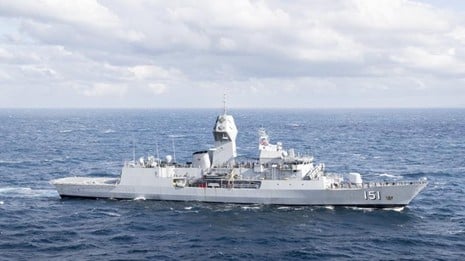
Image: The HMAS Arunta (II) via RAN Sea Power website.
3. Early Maritime Contact with India – La Trobe Society
The La Trobe Society in Melbourne looks closely at all matters relating to Governor La Trobe – a most influential pioneering administrator. In January 1839, Charles La Trobe was appointed lieutenant governor of Victoria. Recently, La Trobe Society enthusiasts looking after his restored cottage in Dallis Brooks, South Yarra were intrigued by his carved wooden bed. Clever volunteer researcher and historian, Tim Gatehouse, suggests that the bed may have been acquired by La Trobe during the six weeks spent in Sydney prior to taking up his post in Victoria! Gatehouse has compared the bed to other pieces of furniture imported to Sydney from India in the 1830s. This brought to mind the seldom acknowledged yet extensive colonial connection Australia has with India.
India and Australia had close commercial ties dating back to the 18th century, when India played a central role in nourishing the young colony. Trade with Australia came to be an important element in the operations of the East India Company in Bengal. The HMS Guardian (a 44-gun Roebuck-class fifth-rate two-decker of the Royal Navy) was converted to a supply ship, but was later wrecked enroute to Australia in 1789, carrying supplies for the new settlement at Sydney Cove. This rendered colonists close to starvation. The governor looked to Calcutta for help, dispatching the Atlantic to bring back all the food and stores it could carry. The Atlantic returned on a winter’s day that same year, with a cargo of rice, wheat and lentils. For the next 50 years, Australia’s most immediate and direct maritime links were with India rather than London. Bureaucrats, merchants, chaplains and judges moved between the two colonies. By 1840, a ship was leaving Sydney for India roughly every 4 days, and merchants in Calcutta grew rich from supplying the new colonial outpost. Not only was India an important source of food and provisions for Australia, but it also gave retired ‘colonials’ the opportunity to bring Anglo-Indian furniture, architectural styles and a taste for spicy food back to Australia. At the beginning of the 19th century, several British colonial families from India made a life for themselves in the new Australian colonies.
See: La Trobe Society – Newsletter No. 52
Also: High Commission of India – Historical Contacts
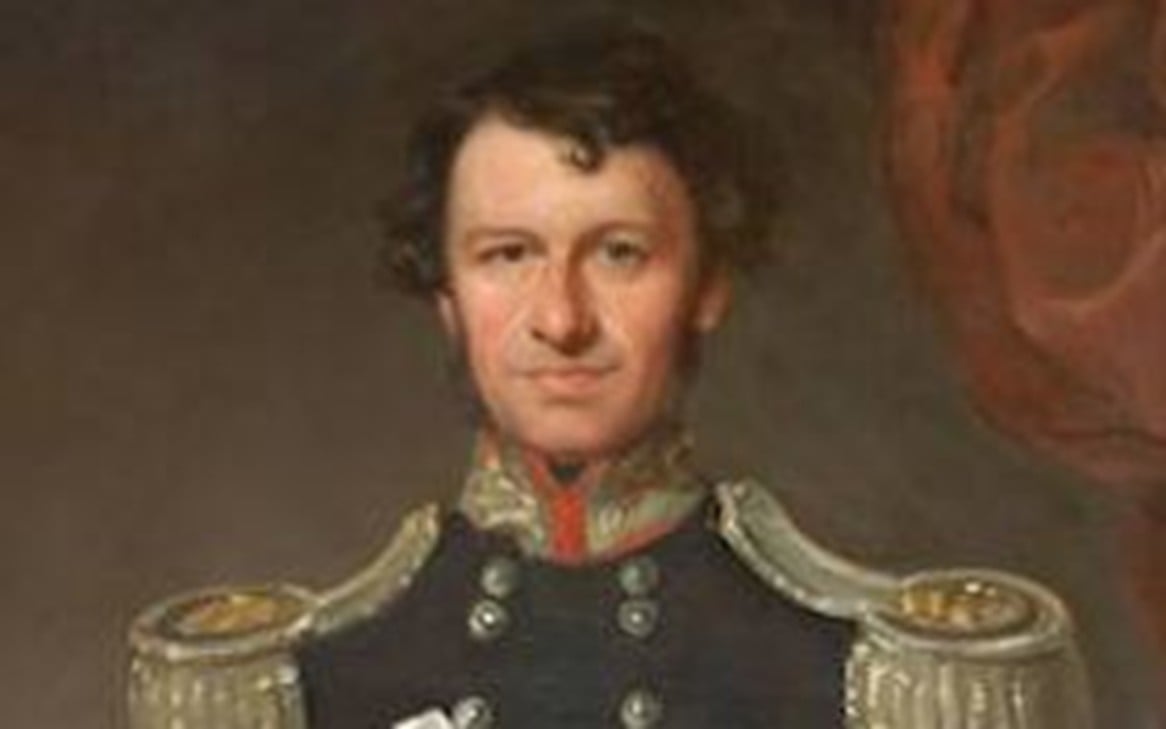
Image: Charles La Trobe via the La Trobe Society.
4. The Lady Nelson Heritage Vessel
The original Lady Nelson brig, built near London in 1798, was the first British colonial ship to enter Hobart’s port, bringing the first European settlers to Tasmania. The Lady Nelson also really important to Victoria as it was the first vessel to enter Port Phillip Bay and name it – in 1802 – and in 1801 had chartered Western Port.
This remarkably influential vessel leaves an extraordinary legacy. She transported an estimated 7,000 settlers, convicts, sailors and soldiers to Tasmania and even captured pirates. An immensely versatile vessel, the Lady Nelson embarked on journeys of exploration, establishing settlements and transporting cargo as well as people. She remained operational until 1825, when she was attacked and plundered by local islanders. Her crew were murdered, and the ship itself was destroyed by fire near Timor.
A locally built replica of the Lady Nelson was launched in 1988 for Australia’s bicentenary. This vessel, a tribute to the one that was so pivotal to the European settlement of Hobart and northern Tasmania, now sails the River Derwent. An estimated 15% to 20% of Tasmanian women today can trace their lineage back the passengers on the original Lady Nelson. So, when an all-female volunteer crew aged between 17 and 60 sailed the Lady Nelson upstream during the recent Wooden Boat Festival in Hobart to honour International Women’s Day 2025, it seemed fitting. The replica Lady Nelson is Tasmania’s answer to Victoria’s replica Enterprize, which maritime enthusiasts will recall sailed across Bass Strait into Port Phillip Bay in 1835.
See the video: ABC News – Lady Nelson Female Crew sail for IWD
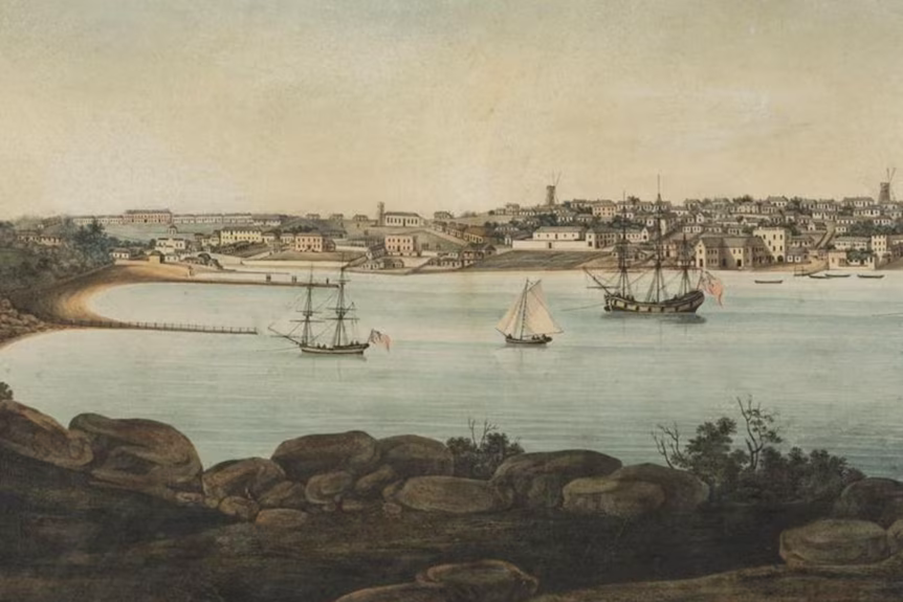
Image: Lady Nelson depicted in Sydney Cove via ABC (image supplied by the State Library of New South Wales).
5. The Enterprize – Heritage Vessel
Those operating this fully functional replica of the tall ship Enterprize, which was originally constructed in Hobart in 1830, take pride it the vessel’s historical accuracy. The replica Enterprize is an all-timber, carvel-planked, two-masted topsail schooner, single-decked and square-transomed, with crossing yards on her foremast. The original Enterprize was part of the coastal trading fleets of southern Australia. A familiar tale to most Victorians: John Pascoe Fawkner purchased the original vessel to cross Bass Strait in search of a suitable place to begin a new settlement in the Port Phillip District. They looked at Western Port Bay and then at the eastern side of Port Phillip, eventually finding the Yarra River, and after warping the ship upstream by hauling on ropes attached to the riverbank, they moored the Enterprize at the foot of present-day Williams Street in 1835. The replica Enterprize now operates not far from this very spot – on North Wharf, Victoria Harbour Docklands.
See: https://www1.enterprize.org.au
See: https://www1.enterprize.org.au/the-original-enterprize/
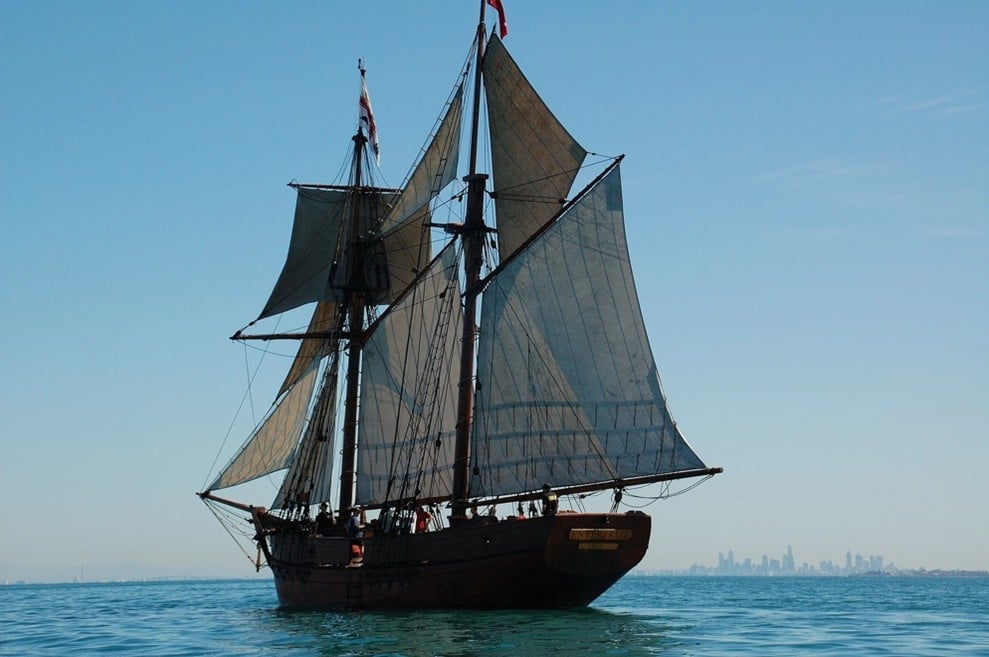
Image: The replica Enterprize via the Enterprize website.
6. Heritage Fleet Eviction Looming: Tell Us What You Think
A reminder that the core concern of MMHN is advocacy and the proactive support of maritime heritage in many forms. MMHN is therefore alarmed that Development Victoria (DV) has announced that it will evict heritage vessels from berths on North Wharf (Collins Wharf) in Victoria Harbour, Docklands Precinct. This has caused great distress amongst the many restoration volunteers that man the various vessels. DV responded by delaying the eviction for 6 months. This ‘reprieve’ offered by DV is simply inadequate for the vessels to either become, or remain, operational. The vessels require both on-water berths and shed space nearby for approximately two years. DV, the responsible authority, have provided no viable options for relocation of the heritage vessels. On the 25th of March 2025, MMHN hosted a community forum at Docklands Library so that representatives from heritage vessels Alma Doepel, Wattle and Enterprize, as well as community members, could meet to discuss the future of the Heritage Fleet in Victoria Harbour.
We heard of the skilled work over so many years done by the heritage vessel volunteers. We discussed the challenges posed by DV’s actions, potential relocation options, and the next steps towards developing a combined, coordinated response to the looming eviction. About 70 people attended the forum. Despite being invited, DV refused to attend. MMHN is coordinating a report summarizing comments arising at the forum and subsequent feedback from other stakeholders. This report will be sent to Development Victoria and the Minister for Precincts, the Hon. Harriet Shing.
You may wish to share your thoughts on this vexed matter. Please have your say by emailing info@mmhn.org.au
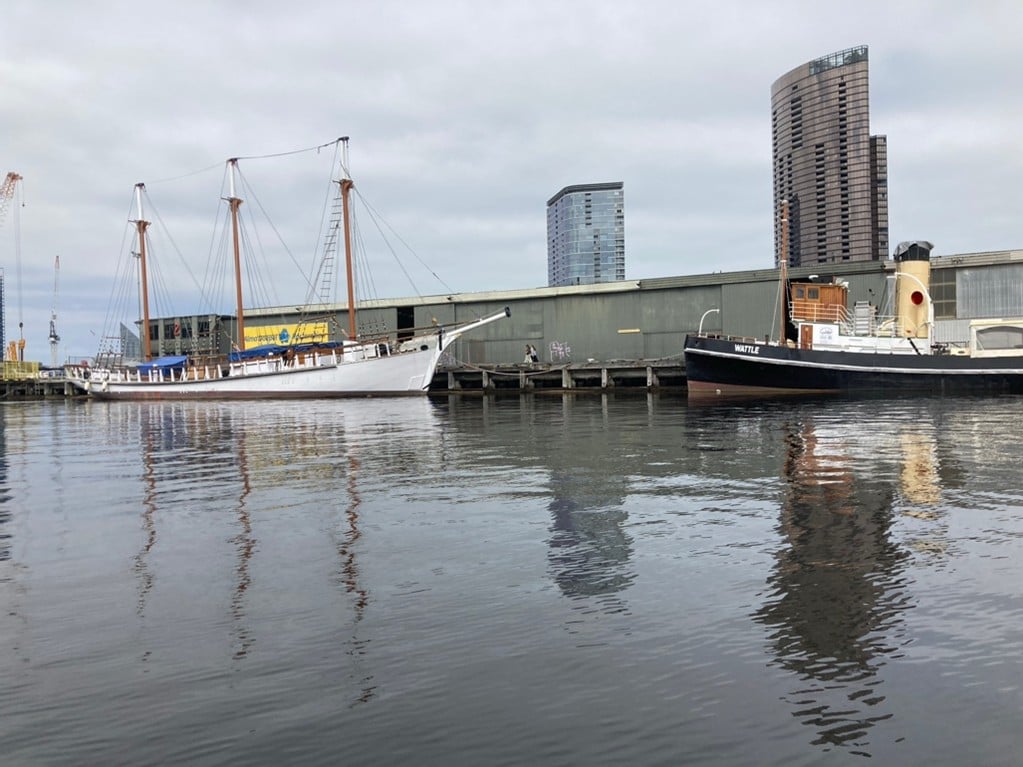
Image: The Alma Doepel and the Wattle in Victoria Harbour. Photo by Jackie Watts.
7. Contentious AUKUS Project – Potential Economic Upside For Australia
A March 17th report from journalist Andrew Tillett in the Australian Financial Review alerts us to the possibility that the contentious AUKUS project may result in cash flowing towards Australia:
“Big US defence contractors are bringing Australian businesses into the supply chain for nuclear-powered submarines, as industry pushes back against predictions that the AUKUS pact will fail.”
The US Navy is contracting the US firm Honeywell to steer “Australian companies through stringent quality and security checks to build parts for US-made Virginia-class submarines”.
The submarine builder, “Huntington Ingalls Industries is working to qualify what could end up being hundreds of Australian companies as suppliers to US shipyards. The US Navy Honeywell contract is a pilot program to ‘establish a trusted network of suppliers in Australia to securely transfer technology’. Virginia-class submarines require around one million components. Australian firms have already been assessed as having the capability of producing around 1,000 components”. The AUKUS plan allows “Australian companies to supply parts to help boost production rates and give firms experience for when Australia builds its own nuclear-powered submarines”. More than 300 Australian companies have expressed interest.
We shall see.
See: Australian Financial Review – AUKUS cash flows to Australian firms despite doubts
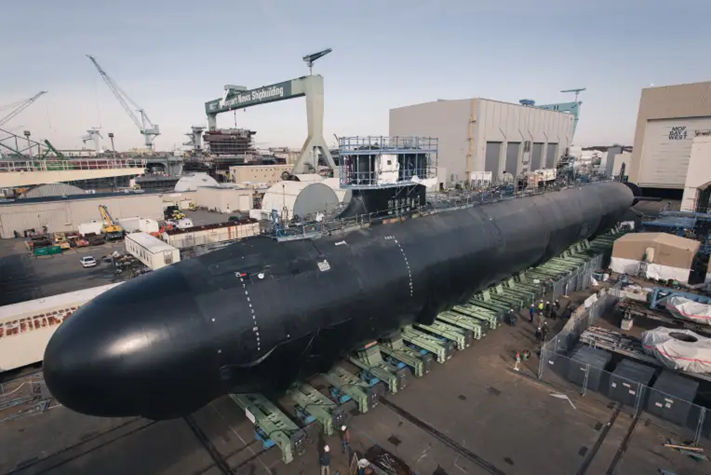
Image via ABC: Virginia class submarines under the AUKUS deal.
8. A Concern: Collins-class submarine HMAS Farncomb Refit Program
Also on the 17th of March, journalist Ben Packham of The Australian wrote that the ASC warned the Federal Government that a full upgrade of the HMAS Farncomb is in doubt. Commissioned on the 31st of January 1998, the submarine is having its main motor, diesel engines and generators serviced in place, rather than having new ones installed. Often, such refits are adjusted in response to what emerges as the works commence. But this change in plan has raised concerns about the HMAS Farncomb’s “potential capability gap” before new nuclear subs arrive.
See: The Australian – Secret Submarine Scandal
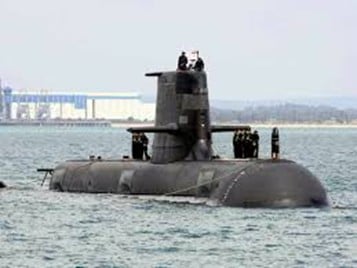
Image: Sea Power Centre, RAN.
9. Queenscliff Maritime Bookshop: Reflections
MMHN Member, Peter Ferrier (an octogenarian, former couta fisherman, diver, now owner of this maritime specialist, second-hand bookstore in the historic port of Queenscliff) bemoans, “the carving up of more or less the privatisation of once public space [in our port] into commercial operations where free berths are gone and overnight stays prohibitively expensive. Many veteran wooden boats were lost to the port as fees became too high”.
Peter actively supports the Queenscliff Maritime Museum and shares tales of his uncle, Lewis Ferrier, one of the last of Queenscliff’s professional fleet fisherman who was known to be a garrulous raconteur but could not swim. Peter fondly observed that the reason for this was because he could not keep his mouth closed! These days, Peter is “happy drifting and thinking in slack waters with gentle winds and no strong tides”.
Call into his book shop when you are down that way – Shop 2, 62 Hesse Street, Queenscliff, Victoria.
See: https://www.queenscliffvictoria.com.au/for-petes-sake/
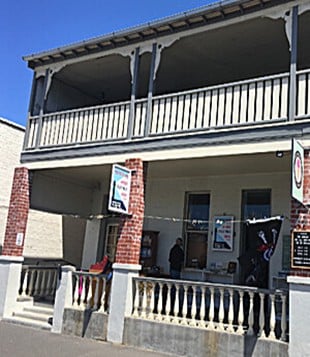
Image: Bookshop photo from For Pete’s Sake website.
10. Wooden Boat Festival 2025
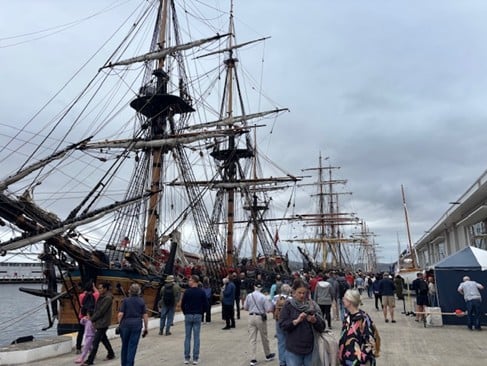
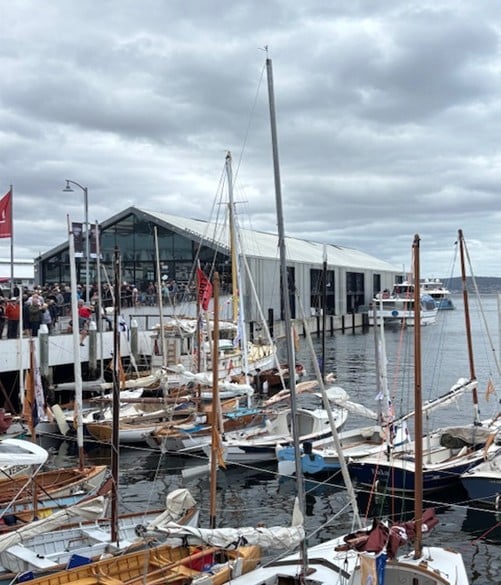
Images: Wooden Boat Festival by Martin Dixon.
11. Undersea Cable Damage – Alarm Bells Ring in Taiwan
On the 25th of February, the ABC reported that the Taiwan coast guard detained a China-linked cargo ship after a nearby undersea cable to the Penghu Islands in the sensitive Taiwan Strait was disconnected. Taiwan has reported 5 cases of sea cable malfunctions already in 2025, compared with 3 each in 2024 and 2023. Taiwan, has repeatedly complained about “grey zone” Chinese activities around the island that are designed to exert pressure on Taiwan without direct confrontation. Investigations continue to determine whether the cable damage was caused by intentional sabotage or a simple accident. There are now 15 submarine cables landing in 7 cable landing stations in Taiwan. The Penghu or Pescadores Islands are an archipelago of 90 islands and islets in the Taiwan Strait, about 50 kilometres (25 nautical miles) west of the main island.
See: ABC News – Taiwan detains China linked ship after cable incident
Also: https://www.submarinenetworks.com/en/stations/asia/taiwan
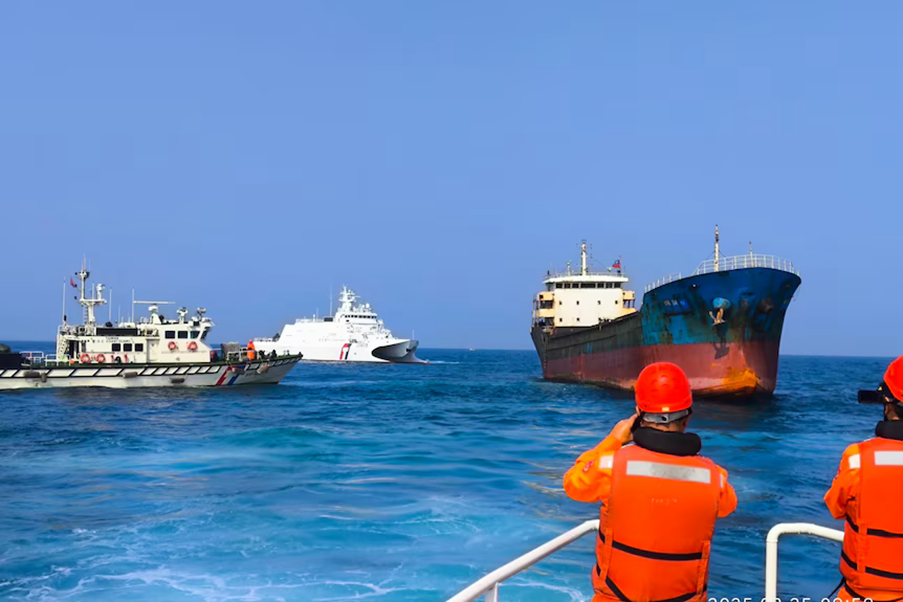
Image: The China-linked cargo ship detained by the Taiwanese coast guard via the ABC.
12. Weird Collision in the North Sea
Given the sophistication of navigation these days, it’s a shock to learn that a fuel tanker and a cargo ship (both large vessels) collided recently in the North Sea off the Port of Hull, resulting in a “massive fireball”. US-chartered oil tanker, Stena Immaculate, was anchored in daylight in the North Sea, about 13 miles off the coast, when it was struck by a container ship, the Solong.
The tanker was carrying 220,000 barrels of jet fuel in 16 segregated cargo tanks, according to the US maritime firm Crowley which manages the tanker.
“At least one cargo tank carrying Jet A-1 fuel was ruptured and leaked into the North Sea”. The cargo ship was German-owned with a Russian captain, who has since been arrested. Maritime traffic data showed the Solong travelled directly towards the Stena Immaculate without deviating until the collision. Central to understanding this bizarre collision is the recovery of voyage data recorders (VDRs) from both vessels. The marine equivalent of a plane’s “black box”, they reveal the vessel’s speed, depth under keel, radio communications, bridge audio and radar data. One theory is that the Stena Immaculate may have been “radar silent” for security reasons at the time, given its sensitive cargo. Seemingly under a military mission, it was unexpectedly anchored in an area where it is not common for ships to moor. Strange indeed.
In daylight, the tanker would have been visible on the screens of nearby vessels and visible to the naked eye from a distance. Another explanation is that the cargo ship’s autopilot function may have failed, and the vessel would have just sailed straight on. Both vessels have sustained significant damage in the impact of the collision and the subsequent fire. Environmental damage is a given: “It’s close to nesting season, so puffins, gannets, kittiwakes among others could be flying around the area and could be exposed to oil or petrol. Similarly, there are dolphins and seals. This is also a rich fishing environment, with the Grimsby fishing port nearby, and there could be economic consequences if fishing has to be stopped or scaled back.”
See: The Guardian – North Sea Ship Collision
Also: The Age – A massive fireball: fuel tanker and cargo ship collide
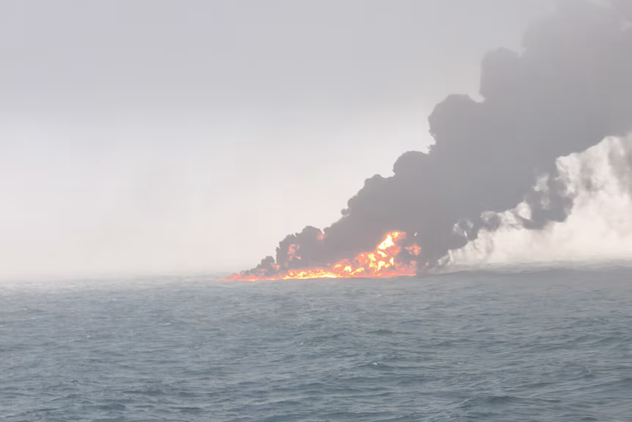
Image: Flames and smoke rise after a cargo ship struck an oil tanker off the north-eastern coast of England. (Photo supplied by Reuters, via ABC)
13. Huge US Military Fuel Tanks in Darwin Harbour
The ABC reporters, Jack Hislop and David O’Shea, report Project Caymus – 11 massive fuel tanks built to support US military activities in the Indo-Pacific – is under fire. Leaked correspondence revealed that the fuel tanks have been unlawfully constructed on Darwin Harbour, without a building permit, on land leased from the Land Development Corporation, an NT government agency. Designed to hold 300 million litres of military-grade jet fuel, the $270M facility commenced in 2021 as a pivotal project for US defence operations based out of Australia’s north. However, they are still not operational due to “water intrusion” in their leak detection system.
See: ABC News – Project Caymus Darwin fuel tanks
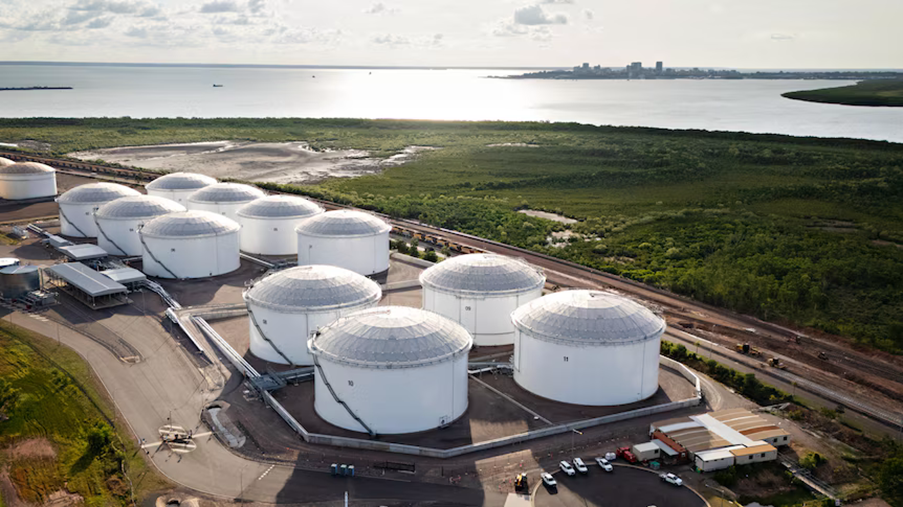
Image: The fuel tanks have been built at East Arm on Darwin Harbour.
(ABC News: Michael Franchi)
14. Port of Darwin Buy Back?
It is no surprise, perhaps, that talks on this matter are arising with the Chinese navy vessels circumnavigating Australia and a federal election date looming. There are multiple media reports that the Federal and NT Governments are in discussion about a deal to take back the Port of Darwin, which was leased to the Chinese operator Landbridge in 2015. The 99-year deal was reportedly worth $506M and signed by the then-NT Country Liberal Government. The Northern Territory Government began engaging with the Federal Government again on this matter in November of 2024 amid reports of potential financial difficulties at Landbridge. A public-private partnership model has been proposed, using federal funding. According to earlier reports, Landbridge would end the lease for $1.3B – almost $800M more than it paid 10 years ago. However, Landbridge is insisting that the port lease is not for sale.
See: 9 News – Port of Darwin potential buyback
Also: MSN News – Governments in discussion about Darwin Port
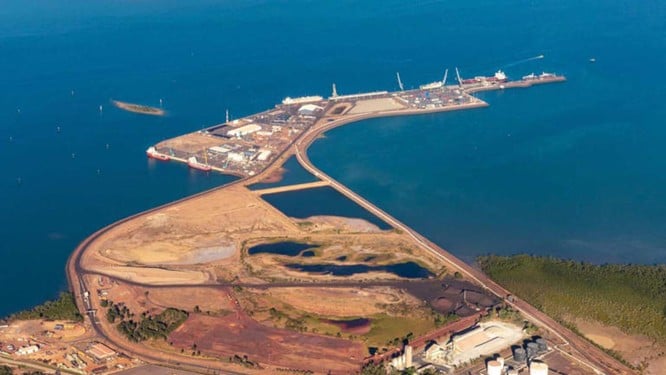
Image: the Port of Darwin via MSN.
15. Heritage Vessel Wyuna Restoration
Progress report on the Wyuna pilot cutter at Bell Bay in Tasmania, Australia.
“Tasports has removed the water supply reconnection that was arranged to enable pressure washing – working down from the upper deck. The scupper drains on the lower deck were an issue, drains from the upper deck were cut and rerouted directly overboard. The new Karcher [cleaner – 3200psi] blew the accumulated crap off the deck. Drain clean is a separate problem but Karcher produce a pipe cleaning kit connected to the pressure washer. The wash down went well, as you can see by the pictures.
Tasports provided a bin to clear up the build-up of steel offcut and other rubbish. We still await the crane we ordered to remove the lifeboat which disconnected from its davits and is held in place by straps and cordoned off as unsafe. Removal of the lifeboat is critical before any work in the immediate vicinity can proceed. All in all, we had a very successful trip and finally we feel like we are moving forward”.
MMHN thanks Max Bryant for this glimpse into a work session on the Wyuna.
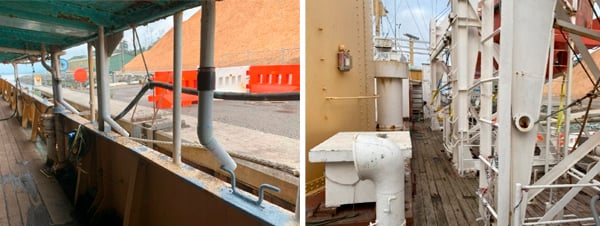
Images: New upper deck drain layout (left) and Looking good after a scrub (right).
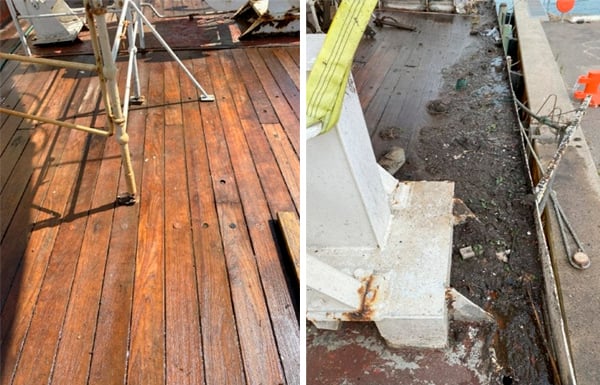
Images: Teak deck looking good (left) and Under the lifeboat in the no-go zone (right).
Photos by Max Bryant.
16. Maritime Skills – Finally Federal Investment
Great news and not a moment too soon. The Minister for Skills and Training, the Hon Andrew Giles, stated: “The maritime industry is so important to the Australian economy, so it is critical that we have the skilled seafarers to keep it afloat”.
A good start!
The Federal Government is investing $16.9M to support skills and training in the maritime industry. A new maritime skills and training initiative will give up to 20 trainee seafarers each year, for four years, access to berths to complete sea time required for international certification. Access to berths is a major stumbling block in ameliorating the skills deficit. This will support the government’s Maritime Strategic Fleet and the broader industry. An estimated $2.5M will also flow to the Transport and Logistics Jobs and Skills Council (JSC) to address training barriers, and ultimately Australia’s maritime skills deficit. This funding is progressing delivery of the recommendations made in the Strategic Fleet Task Force Final Report 2023. Ms Lynelle Briggs and Professor Nicholas Gaskell are to co-chair reviews of the Shipping Registration Act 1981 and the Coastal Trading (Revitalising Australian Shipping) Act 2012 to support the long-term sustainability of the industry. Minister Andrew Giles said: “We’ve recently established a Maritime Skills Network, bringing together government, industry and unions, to come up with solutions to challenges in the sector and this announcement will go a long way towards workforce shortage concerns”.
“This program will ensure a pipeline of trained Australian seafarers over the coming years that can fill critical functions such as harbour masters, marine pilots and regulatory roles protecting our environment and the safety of vessels operating in our waters.”
See the Strategic Fleet Taskforce Final Report 2023:
Infrastructure – Strategic Fleet Taskforce Report
Also: Minister for Infrastructure – Albanese Government backs maritime skills and training
17. Seafarer’s Wage Theft
MMHN commends all efforts to achieve wage justice for the immensely vulnerable seafarers in our waters. The Australian Maritime Safety Authority (AMSA) is collaborating with the Fair Work Ombudsman (FWO) to address wage theft aboard foreign-flagged vessels operating under the Coastal Trading Act. An updated Memorandum of Understanding between AMSA and FWO formalises their commitment to the Strategic Fleet Pilot Program, which will focus on compliance monitoring of foreign-flagged vessels operating in Australian waters. It aims to ensure adherence to Australian wage entitlements through joint ship visits across the South, East, and West regions of Australia. AMSA and FWO officers will gather critical evidence to support compliance with Australian workplace standards. This begs the question, what work at sea is covered?
See: AMSA and Fair Work Ombudsman Join Forces to Tackle Wage Theft
Also: Fair Work Ombudsman – Seagoing Industry Award
18. Fishing Matters – Yes, it Does
Fisheries Officers, also known as fishing inspectors, are responsible for ensuring compliance with fisheries and boating laws, protecting fisheries, and promoting responsible fishing and boating activities. On the 19th of March, journalist Michale Giles of the Sentinel Times in Gippsland reported, “that 27 fisheries officers in the Port Phillip Bay and Western Port Bay have been terminated, effective as early as April this year.” A spokesperson for the Minister for Outdoor Recreation, Steve Dimopoulos, said, “remaining officers will have an engagement and education role only.”
“But if there’s no one to enforce the law, the damage to the fish reserves could be quick and devastating,” says Alan Adamson, recreational fisherman and member of the Newhaven Yacht Squadron. Recreational fishermen fear that laws won’t be policed, and quotas ignored. Professional fishermen are equally concerned. General Manager of San Remo Fishermen’s Co-op, Wolfgang Platzer, fears this “change of focus” may jeopardize marine environments, recreational fishing and boating.
Eastern Victoria MP Melina Bath said, “there is enormous respect and cooperation between Western Port commercial operators and fisheries staff, and only last week this saw evidence collected on abalone poaching by divers in Western Port. We know that Victorians love fishing and boating.”
The change proposes the following:
- There will be no more Fisheries Officer positions in the state of Victoria.
- The current 73 Fisheries Officer positions throughout the state will be replaced with 36 Fisheries Engagement Officer positions, a 50% reduction, predominately focused on community engagement.
- Five Fisheries Stations will be closed around Port Phillip and Western Port Bay to be replaced by three new “community hubs”, providing education only.
- Only nine Engagement Officers will service this area, a reduction of 66% in critical staff.
- Several inland Fisheries Stations will be staffed by a single person, with several other regional stations being proposed as two person stations. This impacts worker safety and enforcement abilities.
There is some debate on the subject of abalone fishing. Some argue that compliance rates are high, yet data indicates 16% non-compliance in recreational abalone and 58% non-compliance in intertidal abalone (taken in waters less than 2 meters deep). Data also indicates 27% non-compliance in other intertidal offences (molluscs, etc), 56% non-compliance in marine national park offending, and 20% non-compliance in marine safety (boats and lifejackets). There has been a 50% decrease in boating-related deaths since Fisheries Officers have been enforcing the rules around boat safety. Under the proposed changes, a Major Fisheries Crime unit will be set up to target organised illegal fishing. This unit will be given additional resources so they can target those deliberately doing the wrong thing.
See: https://www.sgst.com.au/news/fisheries-fiasco
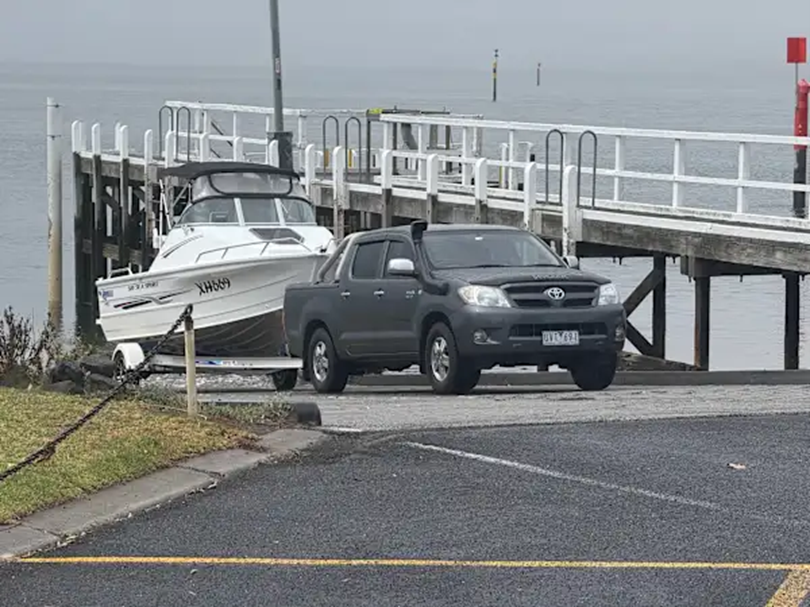
Image: Recreational fisherman via the Sentinel Times.
19. Drama Sailing Under the Bolte Bridge
What a marvellous thing to be in the right place at the right time? You may have noticed the mini-maxi yacht Alive at the Melbourne City Marina on New Quay, awaiting its scheduled start on the gruelling Melbourne to Osaka yacht race (M2O). Given that its mast is taller than the Bolte Bridge, entry into Victoria Harbour was not easy! Some docklanders may have watched the drama unfold under the careful scrutiny of the City of Melbourne Waterways Branch, who were nearby and ready to assist if necessary. As the yacht slowly approached the Bolte Bridge, a crew member sat atop the mast, effectively forcing the mast to bend sideways. No good – the mast was still too tall! The Alive circled back downstream, working on the next strategy to pass under the bridge. Plan B involved filling an enormous orange rubber bladder with water and hoisting it up the mast, tilting it further sideways before another attempt at passing under the bridge was made. The Waterways Branch boat tied a rope to the prow of the yacht and delicately (and successfully) towed Alive under the Bolte. Just.
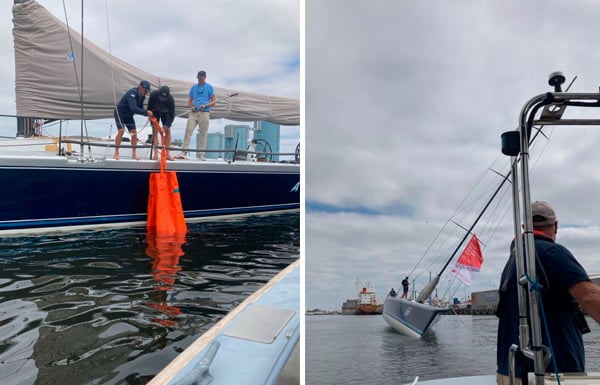
Images: Efforts to sail the Alive under the Bolte, photos by Jackie Watts.
20. Maritime Heritage Amnesia
In conclusion, a reminder that MMHN is delighted to hear about and/or promote any maritime matters. Do share your maritime news or views with us. Simply email info@mmhn.org.au
Until next time,
Jackie
Dr Jackie Watts OAM
Chair,
Melbourne Maritime Heritage Network
info@mmhn.org.au