

Greetings all
To open this month, MMHN offers an inspirational project for you to consider.
Contents
1. New Rotterdam Migration Museum
2. Re-Imagination of Station Pier
3. RAN review for King’s visit
4. What could happen with Central Pier?
5. 2024 Melbourne Boat Show – Maritime Heritage
6. Mexican Navy Visit: more inspiration
7. Marvellous to see people enjoying Station Pier – Ports Victoria
8. Maritime Art Matters
9. Marine Services – Bolte West Precinct
10. Amazon Wreck News – Astounding!
11. Tasmanian Ferries: Good news and less so
12. Defence Precincts – Henderson Shipyard in WA, and Osborne in SA
13. 50th Anniversary of the Maritime Museum of Tasmania
14. Tasmanian Maritime Heritage Network
15. Precarious Balance – Ships, dredging and flooding
16. Extended Marine Reserves – Excellent news
17. Experiential Learning – Voyage on the Cutty Sark
18. New Zealand navy ship runs aground, sinks off Samoa!
19. Gippsland Offshore Wind – November information Opportunities
20. Global impact of Maritime Union Action
21. Seaworks to open new gallery space
22. Vale Trevor Huggard AM
1. New Rotterdam Migration Museum
Rotterdam (a comparable port city to Melbourne) is repurposing and transforming a waterwise derelict warehouse into a stunning migration museum, known as Fenix (note migration not immigration because, unlike Melbourne, emigrants left Holland). The scale of government investment in such cutting-edge social and cultural infrastructure is impressive. Clearly the public demand for such investment is strong. During the recent ICMM Conference in Rotterdam, Jackie Watts attended an Open Day to see the concrete “shell’’ of Fenix amidst crowds keen to follow the progress of this marvel. All willingly queued! Waterside spaces celebrating migration and immigration make sense.
See: http://archilovers.com/projects/fenix-museum-of-migration
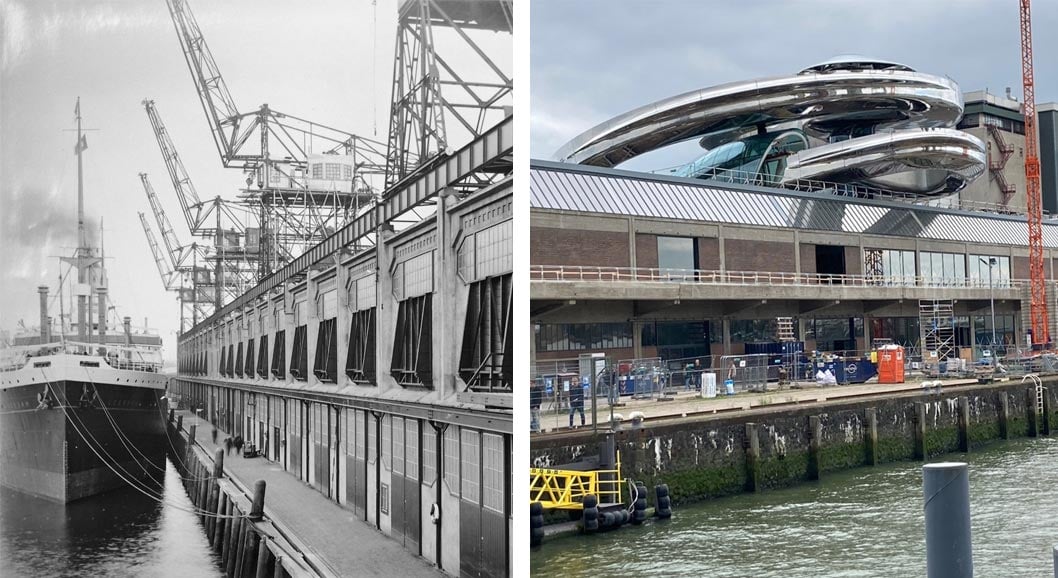
Images: MAD architects, Netherlands and Jackie Watts
2. Re-Imagination of Station Pier
MMHN remains optimistic. Fortunately, in Melbourne Ports Victoria has retained waterside heritage infrastructure (Station Pier Terminal buildings) capable – actually perfect for – housing just such an Immigration Centre as part of the cruise terminal. A reminder that MMHN continues to advocate for the reimagination of the Station Pier Precinct. The Ports Victoria website states: “Station Pier is closed to public access until further notice”. The opportunity we have in relation to Station Pier surely cannot be squandered indefinitely.
See: MMHN Opportunity 7 Station Pier
3. RAN review for King’s visit
Leaving aside republican sentiments, maritime enthusiasts in Melbourne, can justifiably feel regret, tinged with envy, at what seems to be a diminishing RAN presence in Melbourne these days. King Charles observed a Royal Australian Navy Fleet Review and Australian Defence Force fly-over along Sydney Harbour on 22nd October 2024.
You may wish to see it: https://www.youtube.com/watch?v=2JBGSpxCEr
4. What could happen with Central Pier?
You will be aware Central Pier in Victoria Harbour is currently being demolished. On the 14th of November, MMHN Board Member, Jamie Gillingham, will discuss the form and feasibility of the MMHN proposal that Central Pier be replaced by a large floating pontoon/pier.
The project will be constructed off-site without nuisance to residents and provides a perfect, environmentally sustainable base for a Maritime Experience Centre (MEC) surrounded by a promenade and a maritime garden overlooking the harbour at its tip. The model is the Brooke St Pier in Hobart designed by Jim Gandy. Jamie’s presentation will discuss the merits of the MMHN proposal, its feasibility, and the solution it provides to the need for appropriate ‘permanent activation’ in Docklands Precinct.
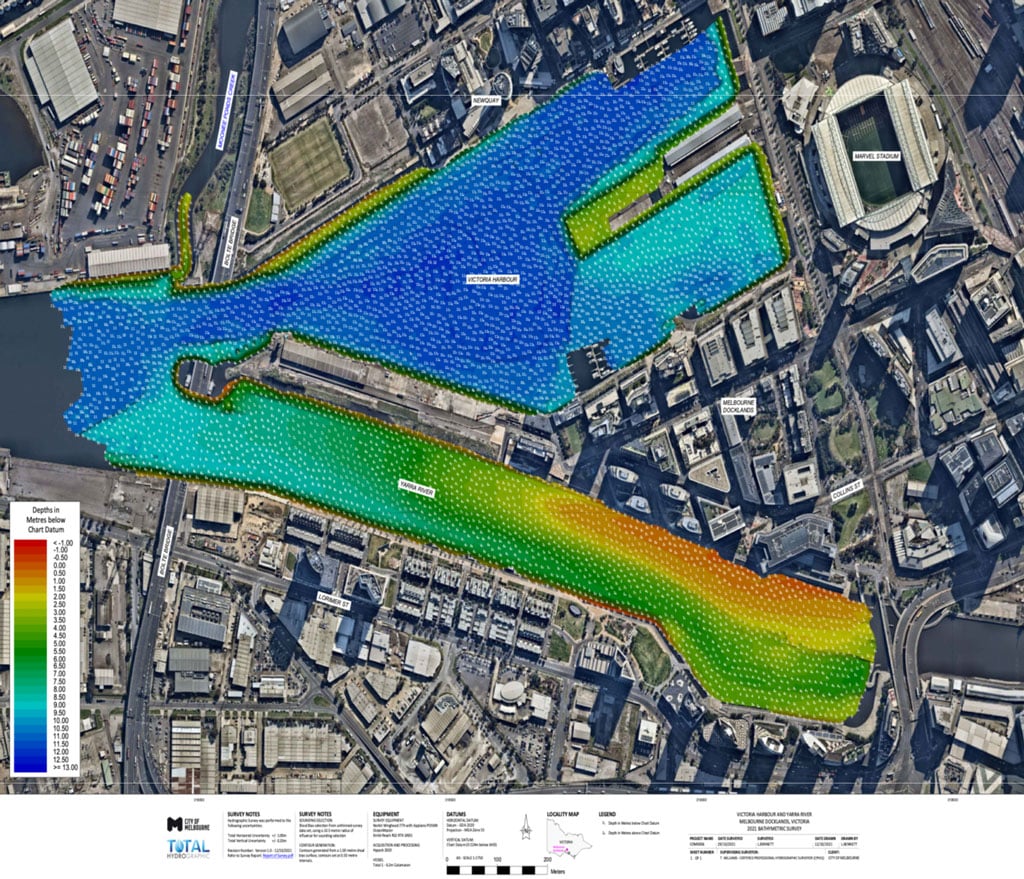
Image: Victoria Harbour Depth chart – Waterways Branch
Invitation : What could happen with Central Pier?
When: 5pm on Thursday, 14th November
Where: City of Melbourne Waterways Branch Lounge, 1st floor (near the corner of New Quay, lift and stairs available)
RSVP: 10th of November, please email info@mmhn.org.au
5. 2024 Melbourne Boat Show – Maritime Heritage
In the aquatic heart of Docklands Precinct, the 2024 Melbourne Boat Show proudly featured maritime heritage. The recreational boating sector is immensely popular in Victoria with 39,000 people attending, despite the weather! Great news for 100+ exhibitors PLUS this year, thanks to MMHN Member and CEO Boating Industry Association (Vic) Steve Walker, the Boat Show provided a special opportunity to showcase our maritime heritage as well as the unique maritime status of the Docklands Precinct. Along the wharves of Victoria Esplanade, and on Victoria Harbour itself, the public had valuable access to information and conversations about the 17 Maritime Museums of Victoria dotted around Victoria’s coast; about our stunning lighthouses; and about the Wooden Boats Association. The public had the rare opportunity to climb aboard several vessels in Melbourne’s Heritage fleet: the ST Wattle, the Alma Doepel, the Enterprize, and the Grower. Finally, in brilliant sunshine, the 3rd Annual MMHN & OSSA Children’s Art Exhibition concluded, where young maritime artists of Docklands Primary School were presented with maritime art awards on centre stage. It was a memorable weekend for many on Victoria Harbour.
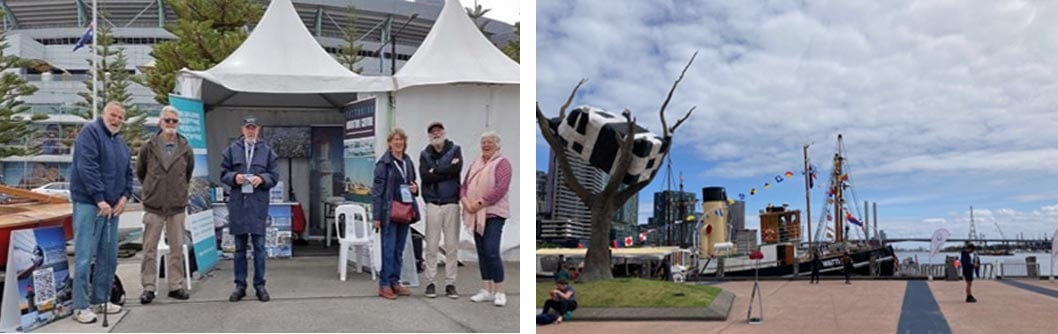
Images: MMV and Heritage Fleet Harbour Esplanade – MMHN
6. Mexican Navy Visit: more inspiration
Launched in 1982, this spectacular steel-hulled, three-masted Mexican Navy ship, Cuauhtémoc, has docked in Station Pier and was – miraculously – open to the public. Named after the last Aztec emperor and warrior, the 90.5 m barque boasted multiple giant flags, Mexican music, a friendly crew, and gloriously polished wood and brass. The vessel is the Mexican Navy’s instructional tall ship for 4th year cadets at the Heroic Naval Military School. She and her 261-member crew are a diplomatic symbol of Mexico abroad. This cruise features the largest number of female personnel in its history, with 53 women out of a total crew of 261 members. This visit was part of 7-month, 25,000 nautical mile trip, visiting 13 ports.
It is clear from the alacrity with which the public flocked to see this absolutely gorgeous sailing vessel that there is pent-up demand to connect with Melbourne’s maritime heritage.
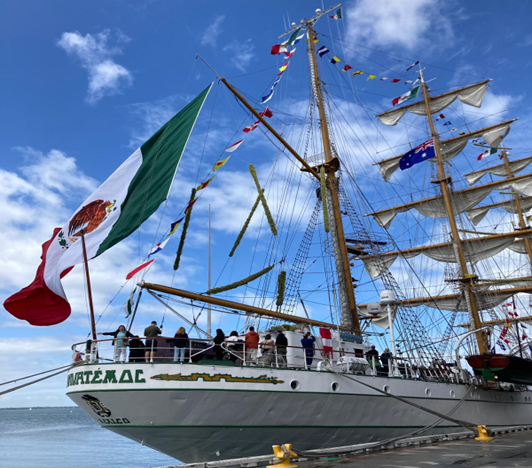
Image: MMHN, Station Pier. Open Day on the Mexican Navy ship Cuauhtémoc
7. Marvellous to see people enjoying Station Pier – Ports Victoria
Public access to Station Pier triggered by the Cuauhtémoc visit and enabled by Ports Victoria was very welcome indeed. Clearly many, many people in Melbourne loved this opportunity to have fun and, albeit briefly, reclaim their pier. What a delight to see the crowds throng on Station Pier – a rare sight these days! A reminder that in days gone by, Station Pier was a marvellous social asset enjoyed by the people of Melbourne. Historic images abound of crowds enjoying Station Pier – joyful welcomes and poignant departure scenes, people strolling along the pier taking in the sweeping views along the coast and over the bay, anglers, birds, shipping. Quoting the Ports Victoria website: “Historically, Station Pier has been Victoria’s welcoming point for generations of new arrivals and what it has become, not only is the worst cruise terminal in the developed world, but the ‘off-limits’ to us all”. Sadly, in recent years, prohibitive restrictions have been imposed and Station Pier no longer feels like ‘the people’s pier’. Ever optimistic, MMHN hopes that before too long, public access to Station Pier will increase. Meanwhile, MMHN will continue to advocate for just such an outcome. Melbourne deserves it.
See: MMHN Opportunity 7 Station Pier
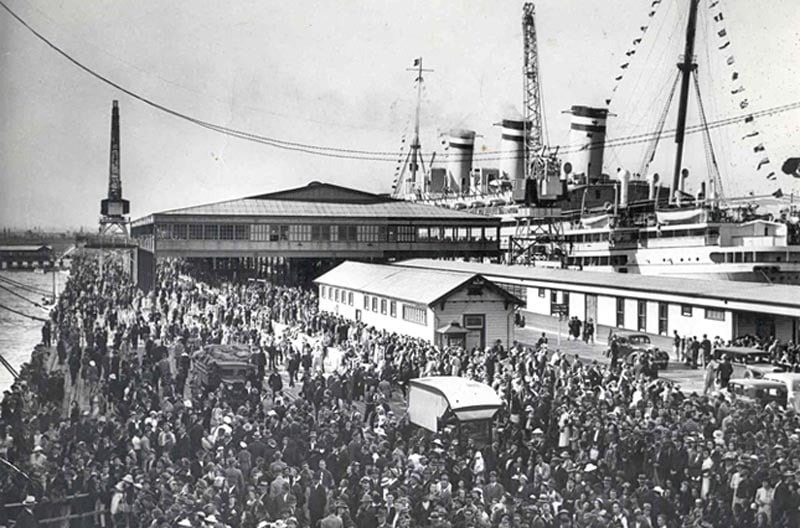
Image: Station Pier 1938, Collections – Victorian Ports Corporation
8. Maritime Art Matters
MMHN is delighted to have embarked, together with OSSA, on a collaboration with the Australian Society of Maritime Artists at the historic Victorian Artists Society Gallery in East Melbourne between October 25 – November 4, 2024.
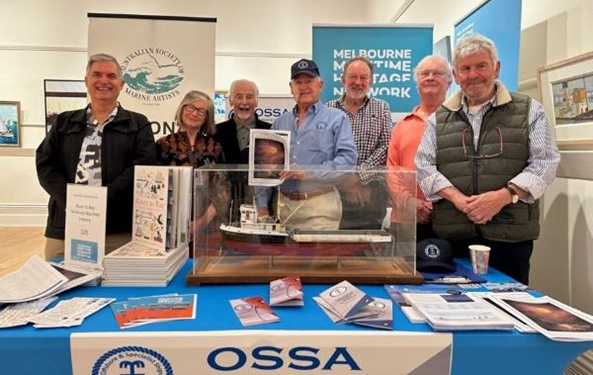
Image: OSSA & MMHN folks at the opening event of this joint exhibition
9. Marine Services – Bolte West Precinct
MMHN is pleased to report progress by the City of Melbourne on the long-awaited and desperately needed Marine Services on the Yarra in Bolte West Precinct, adjacent to and under Bolte Bridge. Planning notices are on display at 208 Lorimer St. The absence of such a depot has been a glaring deficit in Docklands Precinct from the outset which is why MMHN list it as a major objective.
See an outline of our proposal on the MMHN website:
MMHN Opportunity 4 Marine Service Depot
For details of the documents, see: https://www.melbourne.vic.gov.au/planning-permit-register-search-results?appid=398168
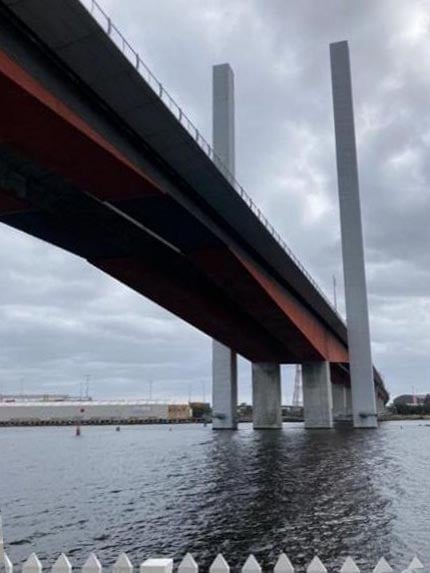
Image: Approximate location of the proposed facility at Bolte West Precinct – MMHN
10. Amazon Wreck News – Astounding!
MMHN reports exciting news from The Amazon Project at Inverloch beach on the 16th of October:
“The first day of Spring was the start of an exceptionally eventful month for the Amazon shipwreck. 1st September was the start of the big swells revealing as much of the Amazon shipwreck we have seen in the past. There was little indication of what was to come over the next few weeks. The swell was so high that the treacherous, unrelenting waves were smashing onto the coast providing no access to the foreshore. In fact, the foreshore was disappearing and retreating. The Amazon wreckage was swept 60 metres to the east where it settled but over the next few weeks, in the bed of the eastern outlet of Wreck Creek it ‘slid’ a further 7 metres where it is now partially imbedded.”
Cyclonic conditions battered the Inverloch Surf Beach eroding everything in the path of the huge swell. Our friends at Heritage Victoria, maritime archaeologists Danielle and Liam were on the scene at 5.30am on 2/9/2024 to make the most of the low tide and to undertake photogrammetry on the Amazon shipwreck site. It is estimated that this view of the wreck may not have been seen for at least 75 years!
See: https://www.heritage.vic.gov.au/about-us/news/news-stories/an-amazon-shipwreck-piece-exposed
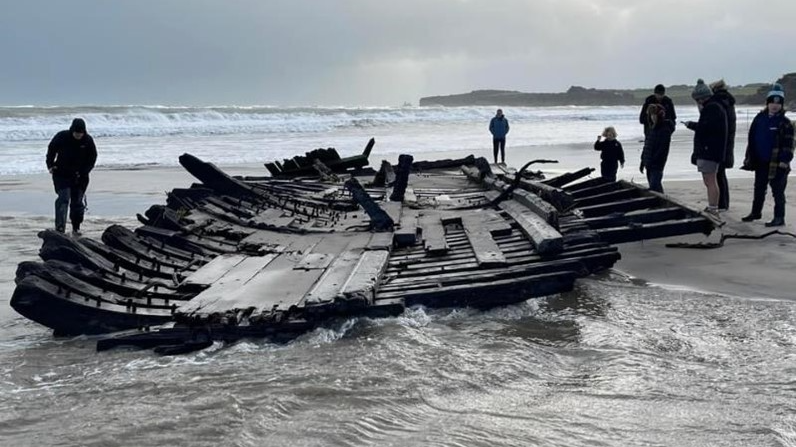
Image: Amazon wreck at Inverloch, Heritage Victoria
11. Tasmanian Ferries: Good news and less so
Tasmania takes ferry services seriously, why not Melbourne?
Tasmania is sensibly acting to reduce traffic congestion to and from Hobart during peak traffic periods, as well as creating more choices of travel for events and better places along the river. A new Bellerive ferry terminal is to be built as part of the $20 Million transport masterplan for Hobart’s Derwent River ferries. The upgrade to the terminal will serve 500 passengers daily. Since the trial for this service commenced in 2021, more than 380,000 trips have been made. The Tasmanian government has allocated $19 Million for ferry services over the next four years. As it plans, designs and manages the public transport service contracts with the ferry service operators, terminals are also planned for Lindisfarne Bay, Sandy Bay and Wilkinson’s Point.
See: The Urban Developer – Tasmania Bellerive ferry terminal
Spirits Ferries debacle
Acutely disappointing and costly news for those involved in the construction of the two larger vessels to boost tourism for Tasmania. They won’t fit on the port. The current infrastructure cannot accommodate them, and completion of the new infrastructure is two years away. In the meantime, the plan is that they be deployed elsewhere. On the 25th October, the ABC described the situation as a “farcical position where the brand new Spirit of Tasmania ferries it purchased may end up being hand-me-downs by the time they reach the state’s shores”. For more than 7 years, the state government has been on a mission to replace the existing Spirit of Tasmania ships with two new ones and build a berth for them to dock in Tasmania. The whole way through, the only thing Tasmanians have been able to trust with the project is that whatever can go wrong, will.
One factor beyond anyone’s control was the collapse of German shipbuilder FSG. That said, sorting adequate berthing in advance of their completion seems a manageable, basic task. Regrettably, work on building that berth hadn’t even started and was to be completed by August 2024. Instead, the government has released a new “realistic” time frame of February 2027, exactly two and a half years after that original completion date. The new $850 million ferries are likely to be leased to a private operator elsewhere.
Existing ferries do not have enough capacity for freight or vehicles. This ferry saga on the Derwent has been described as a “diabolical failure” and involves two high level resignations.
For more, see: ABC News – New Spirit ferries may be secondhand by the time they arrive
Also: AFR – Tasmania ferry failures ‘farcical and embarrassing’
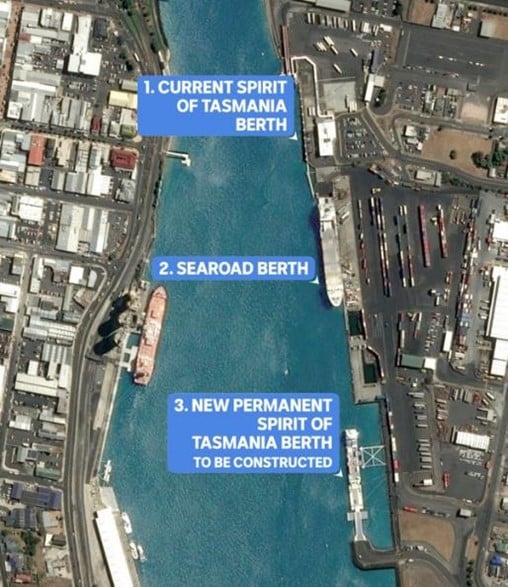
Image: Berths. ABC News: Magie Khamen
12. Defence Precincts – Henderson Shipyard in WA, and Osborne in SA
The Federal Government will establish a consolidated Defence Precinct at Western Australia’s Henderson shipyard to underpin billions of dollars of investment in defence capability in WA and generate much local employment. This builds on the strategic partnership between Defence and Austal Limited at Henderson and represents a major milestone on the AUKUS pathway. On the 16th of October, the Minister for Defence, Richard Marles, told The ABC “Australia’s future nuclear submarines will be built in South Australia at the Osborne shipyard, while WA is now confirmed as the maintenance hub, next to the submarines’ base. But Minister Marles said it was not a competition between South Australia and WA and the workforce of both states was needed to build the new industry”.
MMHN notes with regret lost maritime heritage assets and lost capability. Prior to this new direction, the federal government actually sold naval ship building operations in Melbourne and Sydney. See below for more on these initiatives.
Henderson, WA: Announcement – New Defence Precinct at Henderson
See also: ABC News – New AUKUS Submarine Servicing Base
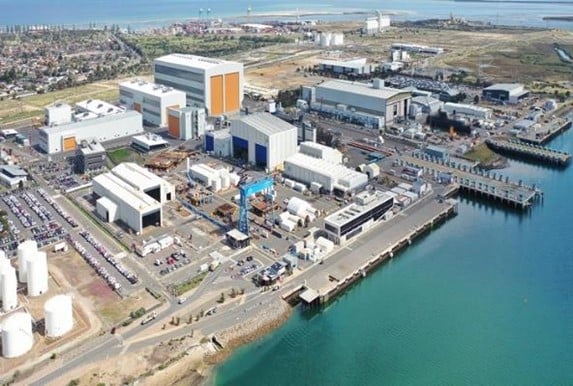
Image: New Defence Precinct at Henderson
13. 50th Anniversary of the Maritime Museum of Tasmania
MMHN gratefully acknowledges the Federation of Australian Historical Societies for alerting us to this significant event via the FAHS Newsletter (October, 2024). The director of the people involved in the maritime industries with an interest in matters maritime formed the Ship Lovers’ Society of Tasmania. Probably Tasmania’s first historical society, and one of the earliest groups in Australia with a specific interest in maritime heritage. A principal objective of the Society was “the study, collection and preservation of maritime records, pictures, books, souvenirs and models”. Its collection grew rapidly and in 1936, the Society held the Tasmanian Nautical Exhibition at the Hobart Town Hall. Yet the Society objective (to develop a dedicated maritime gallery at the museum) took decades to emerge. In 1955, the Society lobbied the Tasmanian Government to develop a folk museum at the historic Battery Point property ‘Narryna’ and in 1957 the Van Diemen’s Land Memorial Folk Museum opened for business, with an entire exhibition room dedicated to the Society’s collection of Hobart’s maritime history. Eventually in 1999, with the support of Hobart City Council, the former Carnegie Library became the Museum’s home.
MMHN notes that the FAHS was established in 1977, has 8 constituent members (one in each state and territory), and is the national peak body representing the interests of around 1,000 historical societies and about 100,000 members throughout Australia. The FAHS logo says it all: “Because history matters”.
See: https://www.history.org.au/
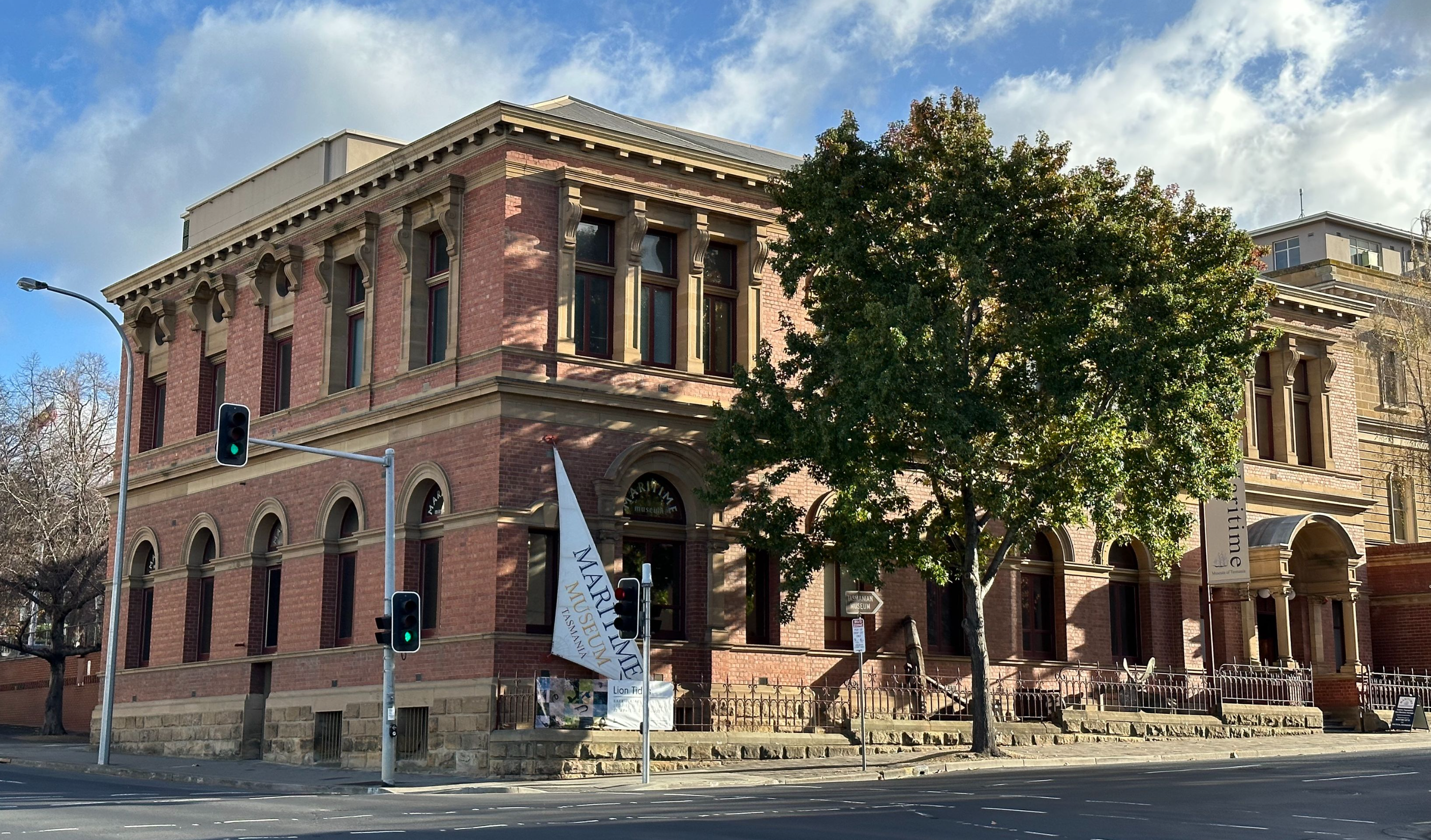
Image: The Maritime Museum of Tasmania, Wikipedia
14. Tasmanian Maritime Heritage Network
This is an informal group of more than 30 museums, collections, corporate sector representatives, heritage organisations and heritage sites across Tasmania. It aims to promote and protect Tasmania’s rich maritime heritage. Network members are custodians, both within and beyond Tasmania, for maritime heritage material that may otherwise be lost to the community.
See: https://www.maritimetas.org/
15. Precarious Balance – Ships, dredging and flooding
The Yarra estuary, like many around the globe, is not shaped as it once was. Nor is it the habitat it once was. Melbourne was once a Birrarung/Yarra estuary that meandered in from Port Phillip Bay. A rocky shelf protected it and the sweet water upstream from tidal surges. Beginning in 1835, the river was ‘shaped’ (quite quickly and relentlessly) to enable burgeoning maritime trade, a practise which ultimately generated immense prosperity for the region. Its wharf infrastructure was adapted for turning circles, pier length, bridges, and dredging. And Port Phillip Bay too was shaped as newer, longer piers were designed, as well as breakwaters, systematic channel dredging, etc.
A recent article reported on the variations of this pattern of port improvement (AKA interference) which occurred in estuaries and river systems the world over. New York Harbor, San Francisco Bay, and Miami’s Biscayne Bay are areas just like Melbourne where rivers meet the sea and 80-90% of the natural habitat has been built over.
“Dredging and filling in the early 1900s to create navigation channels and harbors in Biscayne Bay resulted in over twenty human-made spoil islands and two partially filled natural mangrove islands.”
Larger and larger cargo vessels require deeper channels and constant dredging. There may be dire, unpredictable consequences – flooding and storm surges. In the US, the result has been the environmental collapse of estuary habitats and the loss of buffer zones that helped protect cities from storm surge and sea-level rise. Rapid urbanization and associated coastal development over the last 100 years have severely altered natural habitats. But the damage of such environmental changes is not confined to what is visible on land. The water tells the story: deep dredge holes, associated spoil placement and chronic elevated turbidity levels. High turbidity is usually undesirable given that it correlates with the re-suspension of unconsolidated bay mud, spoils island shorelines and reduces the amount of light penetrating the water column, limiting productivity of bottom vegetation and phytoplankton. When the edges of dredge banks and un-vegetated bottom sediments are eroded, the passage of storm surges and flooding can become much more severe.
See: The Conversation – Coastal cities have a hidden vulnerability
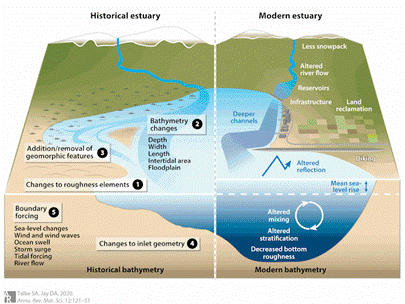
Image: Side by side, illustrations show how dredging and ‘estuary urbanization’ alter the water flow in estuaries. Talke, S.A., and Jay, D.A, Annual Reviews of Marine Science, 2020.
16. Extended Marine Reserves – Excellent news
Mike Foley of The Age reports good news:
“Half Australia’s oceans to be protected in win for seals, penguins”. The Federal Government have announced that the marine reserve around Heard Island and McDonald Islands in Australia’s Antarctic Territory will quadruple in size. This move follows an independent scientific review, commissioned by the government last year when it announced a near-tripling of the marine park around Macquarie Island. That decision was praised by conservation groups for restricting the area that can be fished and at the time the government was urged to do the same with Heard Island and McDonald Islands. These little-known Australian islands which teem with emperor penguins and elephant seals, and have the country’s only two active volcanoes, will be protected with an additional 300,000 square kilometres of marine park.
See: The Age – Half of Australian Oceans to-be-protected in win for seals and penguins
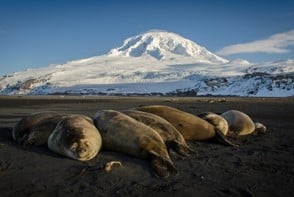
Image: Southern elephant seals chilling out in front of Heard Island’s volcano, Big Ben. Credit: Matt Curnock
17. Experiential Learning – Voyage on the Cutty Sark
This is an informal group of more than 30 museums, collections, corporate sector representatives, heritage organisations and heritage sites across Tasmania. It aims to promote and protect Tasmania’s rich maritime heritage. Network members are custodians, both within and beyond Tasmania, for maritime heritage material that may otherwise be lost to the community.
See: https://www.maritimetas.org/
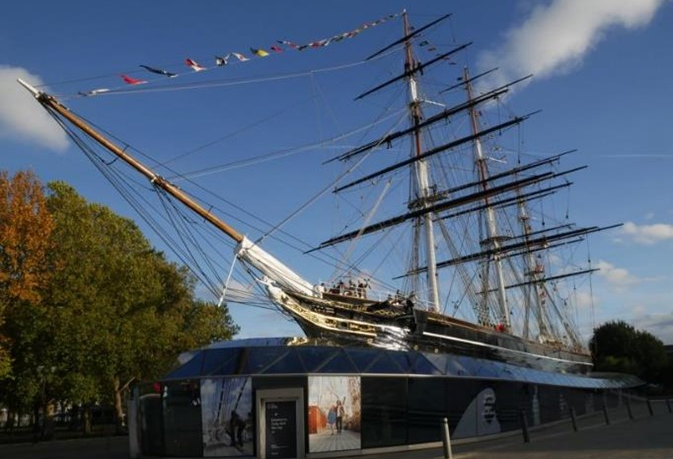
Image: Cutty Sark, Greenwich Museum
18. New Zealand navy ship runs aground, sinks off Samoa!
MMHN can but imagine the angst associated with this incident at sea on the 6th October. HMNZ Manawanui ran aground on a reef and sank off the coast of Samoa while actually conducting a reef survey. Fortunately, all 75 crew and passengers were rescued. Video and photos published by local media showed the vessel listing heavily and giving off plumes of thick grey smoke. It later capsized and was below the surface by 9am local time on Sunday. HMNZ Manawanui cost the New Zealand government $NZ103 million ($93 million) in 2018 when it was commissioned. The cause of the incident is not yet known.
Update: Samoan officials confirmed oil is leaking from three locations, and residual oil was from the service tanks of the vessel, where the engine room is. Navy divers are assessing the situation.
See: ABC News – Navy ship runs aground off Samoa
Also: NZ Herald – HMNZs Manawanui
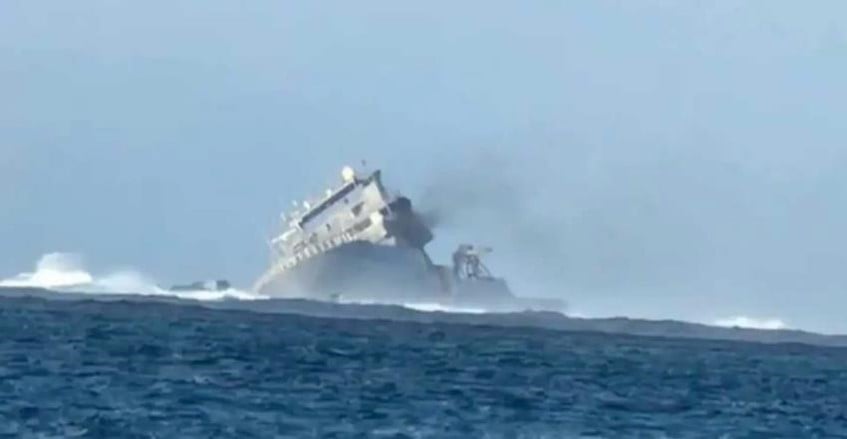
Image: HMNZS Manawanui with smoke coming from it before it capsized on Sunday. Photo / Profile Boats
19. Gippsland Offshore Wind – November information Opportunities
Offshore wind developers, Star of the South (aka Southerly10), will hold meetings on projects proposed in Gippsland during November. It is an opportunity to hear about project plans, meet locals already working in the industry, view maps, share your ideas and give feedback. Government agencies VicGrid and Offshore Wind Energy Victoria will also be there to answer questions about Victoria’s transmission and energy plans. You can find out more about the events here.https://storage.mlcdn.com/account_image/382920/1Q3jFobZ6x87zag8GiWNaWa2pktM9qg0UKGpM8bL.png
Seaspray: Friday 8 November, 4:30–6:30 pm, Seaspray Surf Life Saving Club
Foster: Wednesday 13 November, 3–6 pm, Manna Gum Community House
Traralgon: Thursday 14 November, 4–6 pm, Gippsland Performing Arts Centre, Meeting room 1+2
Yarram: Saturday 23 November, 8:30am – 3:30pm, Yarram Agricultural Show.

20. Global impact of Maritime Union Action
Just as the ocean itself is interconnected, so too is maritime trade. A US dock workers’ strike, reaching from New York to Texas, threw global supply chains into disarray. About 50,000 members of the International Longshoremen’s Association (ILA) have walked off the job on the East Coast and Gulf Coast ports after failing to reach an agreement with port owners over a new pay contract. This is the union’s first strike since 1977, and it has effectively crippled nearly 50 per cent of US trade through the affected ports. The ABC journalist, Daniel Ziffer, reports: “Global supply chains have been so frequently strained in the past five years, it has led to different countries reassessing their reliance on them. First was the hammer-hit of the COVID-19 pandemic. Since then there have been issues with pirates, the drying and narrowing of the Panama Canal, and even a stuck ship [Evergreen]”.
The head of international freight and logistics for the Freight & Trade Alliance which represents 500 Australian companies involved in freight forwarding, the customs broking community, import and export also weighed in.
“‘It’s hard to put a dollar figure on it, but it will be quite substantial,’ he said, pointing to estimates of the daily cost to the US economy being about $US5 billion (about $7.26 billion) for each day the strikes continued. Australia does about 5-10 per cent of our trade with the US. It’s our second-largest trading partner outside of China.”
So, the impacts will be quite severe, but not so severe as if somebody like China were to go on strike, for instance. “Mr Jensen expects the impact to be ‘less than COVID’ but similar to the impact of the Red Sea pirate issue. Most ships work in global loops, like a long-haul version of a commuter train, servicing a set string of ports. Disruptions such as the strike affect their ability to move, and that shifts trade. It pulls the vessels out of rotation. That’s going to mean more vessels, more urgency on US-bound goods. The carriers will be able to increase rates and the shipping lines will obviously service the routes that they feel the rate is the heaviest”.
See: ABC News – Dockworker strike could increase global shipping costs
21. Seaworks to open new gallery space
Seaworks Foundation will soon open a new gallery space for travelling and temporary exhibitions. The gallery will be located in the mezzanine area of the main shed at Seaworks, known as The Loft. The transformation of The Loft into an exhibition space has commenced and is expected to be completed before the end of the year. Other development plans underway at Seaworks include the repair of Workshops Pier which will be funded by a $6 million State Government grant, and ambitions for further site activation enabled by an extended lease from Seaworks’ landlord, Parks Victoria.
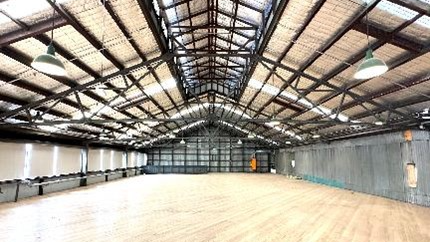
Image: Seaworks
22. Vale Trevor Huggard AM
MMHN joins the very many maritime heritage and sailing enthusiasts saddened at the death of Trevor Huggard. We acknowledge Trevor’s vision, his legacy, knowledge, courage, sense of adventure, and dedication to the public good. Good things happened around Trevor. A former Lord Mayor of Melbourne, Trevor was a man of action as well as a leader. Trevor led the establishment of the Melbourne to Osaka Yacht Race and establishment of Seaworks Maritime Precinct in Williamstown. MMHN is grateful for the fascinating account of Trevor’s impressive contribution to life in Melbourne and on the ocean the excellent account published by the Ocean Sailing Club of Victoria.
See: https://www.orcv.org.au/club-blog/5627-vale-trevor-huggard-am
We commenced with inspiration about Rotterdam and now we sadly conclude with the inspirational life of a maritime enthusiast.
Until next time,
Jackie
Dr Jackie Watts OAM
Chair,
Melbourne Maritime Heritage Network