

Greetings all
Where to start! Having just returned from representing MMHN at the 2024 International Congress of Maritime Museums (ICMM) in Rotterdam and Amsterdam, I am overwhelmed by this maritime heritage ‘tsunami’ of world’s best practice in relation to preservation, exhibition, ocean literacy, the Blue Economy, and decolonisation – myriad current global maritime industry issues. Yet, I am also buoyed and optimistic to find that the MMHN ‘approach’ and the MMHN ‘agenda’ in Melbourne compares so favourably with organisations elsewhere, many of which enjoy centuries of maritime tradition, an abundance of maritime assets, and secure government support! I have much to share with you in due course, commencing with:
Invitation: MMHN Presentation on 2024 ICMM Conference
When: Wednesday 9th October at 5.30pm
Where: 239 A’Beckett St, Melbourne CBD
An informal PowerPoint presentation on the short paper, entitled: “Capturing the past to inform the future”, and a discussion on issues arising from the conference. Worldwide, it seems that, regardless of assets, infrastructure or funding, many museums are dealing with emerging issues and struggling for relevance. You may wish to see the entire program.
See: https://icmm-maritime.org/congress-2024-programme/
(Note: All are welcome to attend the MMHN 2023/24 AGM which will be held prior to the presentation at 4.30pm).
Contents
1. Welcome Announcement at the ICMM Conference
2. Australian Society of Marine Artists (ASMA)
3. 62nd Melbourne Boat Show 2024
4. Young Maritime Perspective – Art Exhibition
5. Unusual Maritime Infrastructure: Save the Beaconsfield Reservoir Action Group’s (SBRAG)
6. Ocean Liner Design
7. Wind Power – Then and Now
8. Banana Alley – Melbourne Maritime Infrastructure on Northbank
9. Betina Wooden Boat Museum, Croatia
10. Hardanger Maritime Centre, Norway
11. Australian Maritime Security
12. AUKUS Recent Summary
13. Station Pier: Progress?
14. Rotterdam Harbour – FENIX Migration Museum
15. Patrick Terminals Melbourne
1. Welcome Announcement at the ICMM Conference
The Australian National Maritime Museum (ANMM) has been chosen by the ICMM Committee to host the next ICMM Conference scheduled for late in 2026. Since its establishment 50 years ago, ICMM has nearly 150 members in 36 countries (as of 2022). All ICMM member museums may submit a bid to host an ICMM conference, but until 2026, ICMM events had been confined to Northern Hemisphere institutions. We shall see whether ‘tyranny of distance’ will impact on participation numbers in the 2026 conference. However, the 2026 event will be a marvellous opportunity for all maritime stakeholders around Australia (and others in our hemisphere) to confer. Australian stakeholders have two years to plan what we might share with other global maritime museums. What do we do? What matters, from our perspective? An international ICMM sub-committee curates the program. You may wish to see the ICMM website.
See: https://icmm-maritime.org
2. Australian Society of Marine Artists (ASMA)
MMHN noted with regret that in 2024 the Mission to Seafarers has decided not to host its annual Maritime Art Exhibition/Competition and Sale – significant loss to maritime enthusiasts. In recognition that this important event, which enables public access to maritime art which must not be lost, MMHN and OSSA have joined forces to support the Australian Society of Marine Artists (ASMA) at their forthcoming National Exhibition. The Australian Society of Marine Artists is a group of diverse artists and others interested in marine and maritime art – painters, lithographers, printmakers, sculptors, model-makers, historians and students. It is a national organisation, with a broad and inclusive definition to allow for a rich mixture of expertise, mediums and interests.
MMHN strongly recommends you see this excellent video about AMSA:
https://marineartistsaustralia.com.au
Maritime art and maritime heritage are inextricably entwined – the oceans, ships, trade routes, seafarers, sea life, ports, etc. Throughout history, maritime art has visually represented the maritime world for us all. It delights, informs and instructs, and gives pleasure to many of us by capturing the everchanging maritime environment – the movement, the colour, and the light. A high level of artistic skill and understanding is required to convey the unique complexity found in maritime art, which is what makes the theme so impressive. October offers two excellent opportunities to take a close up look at what has made maritime art so appealing over time. In May 2024, AMSA held a ‘paint out’ event, in which several artists met on North Wharf, Docklands to capture what they saw. You will be stunned at their vision and skill.
Their work is still available to view here: https://marineartistsaustralia.com.au/2024/05/07/alma-doepel-paint-out/
Invitation: ASMA National Exhibition
National Exhibition of the Australian Society of Marine Artists (ASMA)
When: Sunday 27th October from 2pm
Where: The Victorian Artists Society Gallery, 430 Albert St, East Melbourne
3. 62nd Melbourne Boat Show 2024
MMHN is delighted to find that Boating Industry Association (Victoria) has increased its engagement with maritime heritage organisations in Victoria in 2024. In addition to fishing boats, cruising yachts, ski boats, jet skis, marine tech, fishing and much more, the Melbourne Boat Show 2024 (MBS) will prominently feature maritime history and culture. This increased focus will include heritage fleet vessels and exhibits from members of Maritime Museums Victoria (MMV) and related maritime heritage groups and collections. Given the expanding participation in the MBS by both exhibitors and the public, having a greater maritime heritage presence is very promising in terms of raising public awareness. Further, thanks to two MMHN Board Members, Steve Walker and Michael O’Brien, another new element in the MBS program will assist in raising public awareness of maritime heritage; a large outdoor screen will project a continuous program of maritime heritage and maritime industry footage for visitors to enjoy.
MMHN recommends that you visit the 4-day event.
Thursday 17th October, 3pm – 6pm
Friday 18th October, 10am – 6pm
Saturday 19th October, 10am – 6pm
Sunday 20th October, 10am – 4pm
See: https://www.melbourneinternationalboatshow.com.au

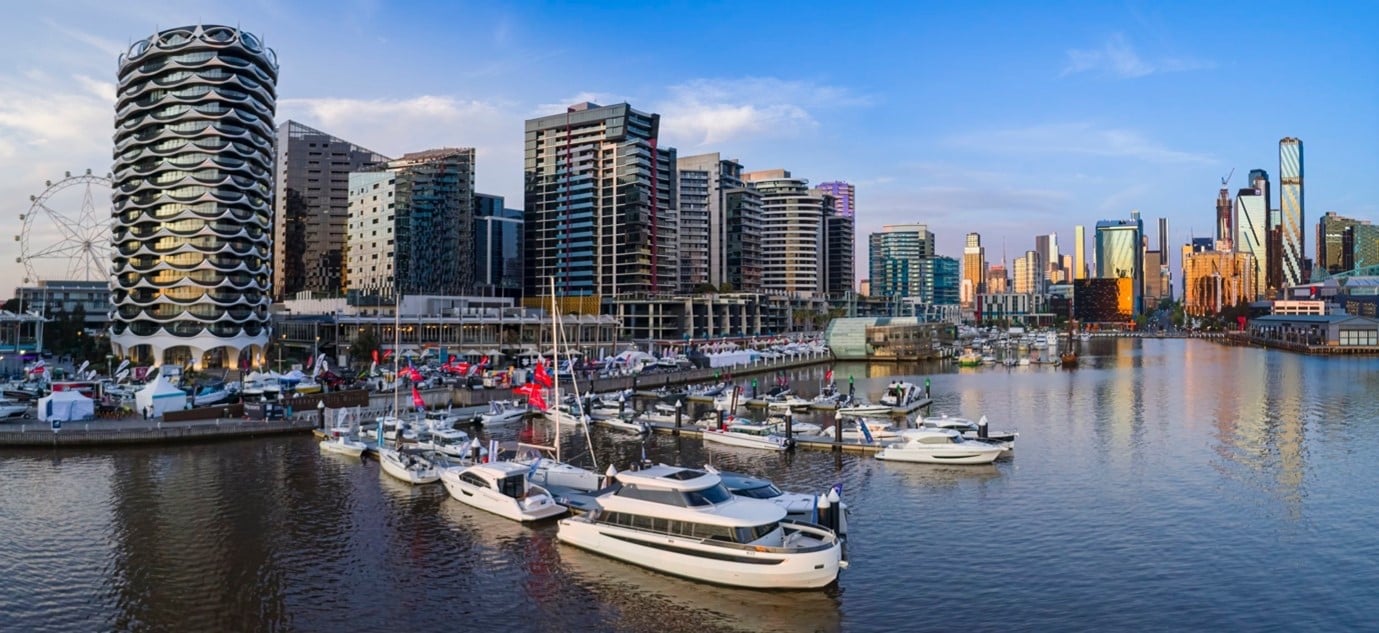
Image: MBS
4. Young Maritime Perspective – Art Exhibition
MMHN recognises the need to devise strategies to raise maritime awareness in young people so that they may come to understand the significance of living in an island nation which is reliant on the maritime environment. Maritime art, we hope, may be the first step towards ‘ocean literacy’ and an understanding of the Blue Economy which will, of course, shape their future.
The 3rd MMHN/OSSA Children’s Maritime Art Exhibition builds on the past two successful years in which local Docklands students have been tasked with creating, over term break, maritime art on subjects which reflect their unique waterfront location. Hopefully this initiative will spread. To this end, MMHN has prepared project materials to engage other schools located around Victoria near MMV locations in hosting their own Children’s Maritime Art Exhibitions.
Invitation: MMHN/OSSA Children’s Maritime Art Exhibition
An invitation to the annual MMHN/OSSA Children’s Maritime Art Exhibition
When: Exhibition starting from Tuesday 15th October
Where: The Magnet Galleries at The District Centre, Docklands
Also, if you find yourself at the Melbourne Boat Show on Sunday 20th October at 3pm, you may enjoy attending the awards presentation, showcasing ‘notable’ art works selected by a professional maritime artist at Centre Stage on New Quay.
5. Unusual Maritime Infrastructure: Save the Beaconsfield Reservoir Action Group’s (SBRAG)
A powerful force we trust, driving the due recognition of maritime heritage in Victoria necessary to counter and overcome the amnesia evident in the public realm and in all levels of government. See current example below.
Maritime heritage infrastructure takes many forms. MMHN commends the valiant community efforts of the ‘Save the Beaconsfield Reservoir Action Group’ (SBRAG) to save water infrastructure which was specifically constructed to sustain the Cerberus Naval Base, which itself has existed to defend against perceived naval threats to Victoria since 1903. Although the base was strategically situated on Western Port, no potable water was available at this location and, initially, water was brought in by ship. Obviously, a sub-optimal solution! Consequently, the Federal and State governments of the day agreed on the necessity of establishing a more reliable water source. This came in the form of a complex water infrastructure scheme to channel water to Cerberus Base from what became Beaconsfield Reservoir. The project was called the Mornington Peninsula Water Supply Scheme (MPWSS). The scheme supplied the naval base while also enabling the expansion of farming in the region and later the urban development of the entire Mornington Peninsular. Over time, demand for water increased, leading to expanded water catchment systems, including dams. Arguing that the maritime heritage significance of the MPWSS is unique and irrefutably significant, SBRAG have applied for the scheme to be listed on the Heritage Register. Regrettably, the responsible State agency, Melbourne Water (MW), appears to have no interest in maritime heritage, nor in the well documented significance of the MPWSS. Without consultation, as a cost-saving measure, MW commenced draining the reservoir, ignoring the dire heritage consequences for the dam wall and the existing MPWSS infrastructure. Heritage Council rejected the SBRAG application for heritage listing, favouring MW. Quite a blow. Disappointed but adamant that water management issues and not maritime heritage preservation had determined this refusal, SBRAG commenced the onerous application to trigger a review of the decision. They claim, and rightly so, that evidence of unique maritime heritage significance is irrefutable. Over many months, MMHN has been asked to lend support. After a long period of uncertainty, SBRAG was successful! A review of the refusal will take place on the 25th of November. SBRAG is now preparing to argue its case live before the Heritage Council. In essence, the matter hinges on the Heritage Council accepting the unique significance of the remaining MPWSS infrastructure in the naval heritage of Victoria.
MMHN takes the view that heritage is often about the stories captured by maritime infrastructure, and this unique MPWSS story has merit.
6. Ocean Liner Design
MMNN commends Mike Brady for this marvellous contribution to maritime heritage. We recommend that you have a close look at Mike’s website which reveals the “Stories Behind History’s greatest Machines”.
Consider sharing your recollections of any of these liners by emailing info@mmhn.org.au.
See: https://www.linerdesigns.com
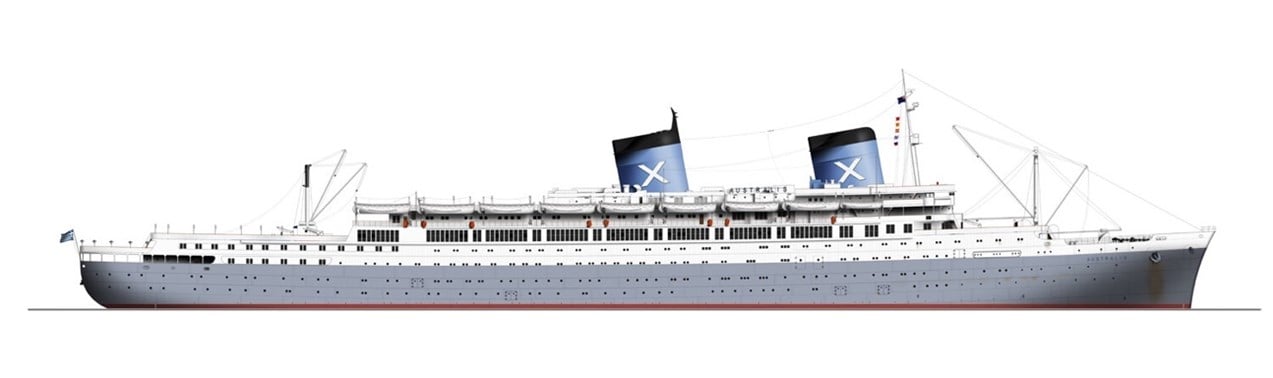
Image: Liners like Australis have attained an almost mythical status. Illustration completed in 2018 by Michael C Brady, Oceanliner Design.
7. Wind Power – Then and Now
MMHN has previously reported on modern cargo vessels adopting cost effective and environmentally beneficial new sails to supplement conventional engines. The UN’s International Maritime Organization (IMO) finally committed to quitting carbon “by or around 2050”. Danial Meyerowitz reports, “The still operational fleet of wind-powered cargo vessel is sometimes overlooked. These heritage wooden schooners and as well as newly designed sailing ships have formed a loose global alliance that’s attracting venture capital”.
The maritime industry has agreed to quit carbon by 2050, but this vintage fleet is proving that, for some cargo, emissions free shipping is available now. And while giant cargo carriers are attempting to revisit sail power, their tiny brethren never deserted tides and trade winds. Cleaner fuels will contribute to greener sailing, but the surest way to reach the IMO target – and minimise looming carbon taxes – is to find the best wind solution. For example, the brigantine Tres Hombres is an 80-year-old wooden boat carrying cargo the traditional way – by wind alone. Tres Hombres makes the 9,000km trip without a fuel tank. The life of the brigantine began in 1943, but by 2007 it was in a wreck-like condition. Three friends from Delft in the Netherlands reclaimed her, and with the diligence and dedication of many volunteers over the span of 2 years, she was completely restored. She now conducts long distance ocean transportation, exclusively powered by the wind.
See: https://fairtransport.eu/en/our-fleet/tres-hombres/
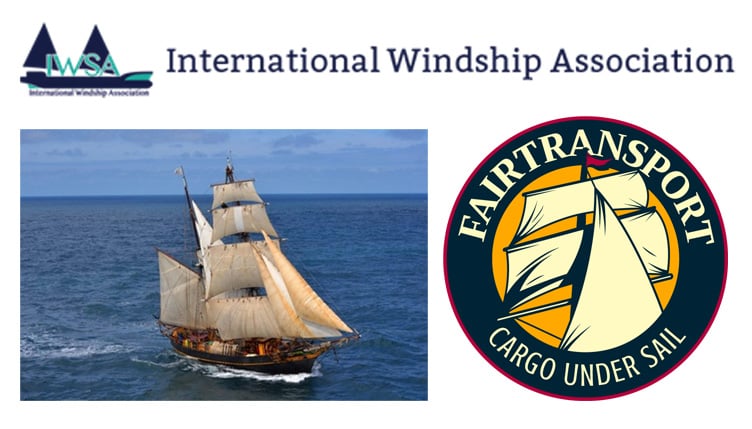
Images: Fairtransport website
8. Banana Alley – Melbourne Maritime Infrastructure on Northbank
As the port city of Melbourne boomed, “a railway viaduct was built to link Flinders Street Station with Spencer Street Station. The arched vaults under the railway line, originally known as the Viaduct Buildings, were handily placed between the river wharves and the now lost Western Market, making them the ideal location to store produce.”
“Bananas, in particular, were stored here. The fruit was picked and transported green, but exposed to ethylene gas in the vaults to bring it to perfect ripeness.”
“Unloaded at Queen’s Wharf, the bananas came with spiders, insects, snakes and rodents concealed within the bunches. No doubt some of these unpleasant denizens lingered on when vaults were abandoned in the 1930s after the construction of the Spencer Street Bridge prevented ships from reaching the nearby wharf.”
“The vaults were divided into 33 separate spaces, with the first tenants being recorded in 1893.”
These vaults remain visible elements in the extensive riverport infrastructure which grew up along the Northbank.
Find out more: https://meandmybigmouth.com.au/milk-dock-markets-banana-alley/
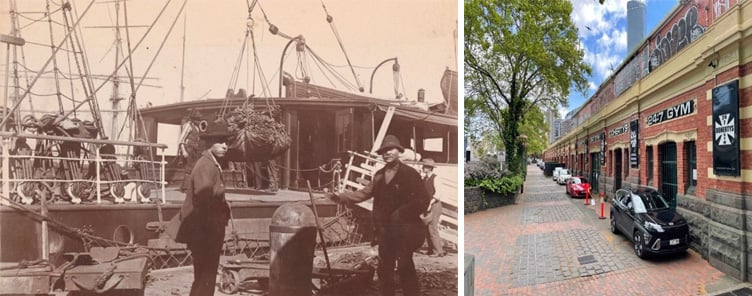
Images: 1. Onloading green bananas. 2. Northbank, post-Greenline.
Source: https://meandmybigmouth.com.au/milk-dock-markets-banana-alley/
MMHN has long advocated that a ‘Northbank Trail’ already exists but has been subsumed in the hype around the costly and contested Greenline Project. With a new City of Melbourne council election looming, both projects seem to have questionable futures. MMHN already has the accurate historical research which could bring to life the rich maritime stories of Melbourne as a booming 19th century river port. And it would require minimal capital works expenditure, simply regular cleaning, graffiti removal, pavement paint and ramps, informational signage, etc. All that is needed is City of Melbourne commitment. No matter who is elected Lord Mayor of Melbourne in October, MMHN is optimistic that they and their new councillors will see that the Northbank Trail has the potential to be an important asset in our maritime city.
9. Betina Wooden Boat Museum, Croatia
Many maritime enthusiasts find wooden boats and wooden boat building utterly beguiling. MMHN has two wonderful boat museums for you this month.
MMHN Board Member Michael O’Brien shares:
Betina Museum of Wooden Shipbuilding won a European Heritage Award in 2019. It is located in the Croatian village of Betina, one of the very special places to be found along the Dalmatian coast, on the island of Murter. Betina is a small historical village of around 800 inhabitants and is basically oriented around tourism, fishing, agriculture and craftsmanship. Among all, Betina has an outstanding reputation and is specifically known for its long tradition in wooden shipbuilding and is famous for its excellent shipbuilders. Betina nowadays is one of few remaining centres of small wooden shipbuilding on the Croatian Adriatic. There are many types of ships being built in Betina, from small boat kaić (4m long) to big cargo ships (27m long). The Museum is intent on sharing knowledge between the older generations of shipbuilders, visitors, locals, and future shipbuilders.
See their website for more information: https://www.mbdb.hr/en/betina-museum-of-wooden-shipbuilding/

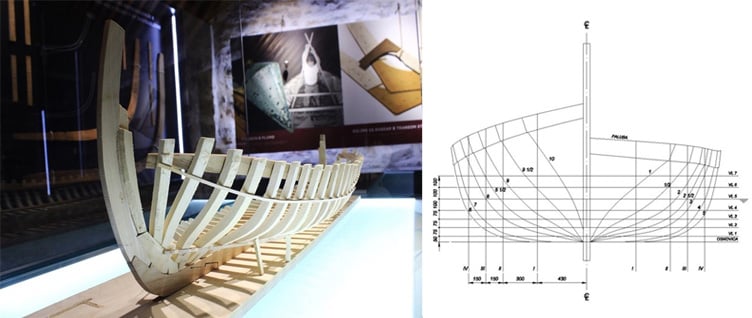
Images: Betina Museum website
10. Hardanger Maritime Centre, Norway
MMHN Chair, Jackie Watts, recently visited these marvellous premises in Norheimsund, which won a European Heritage Award in 2023. For centuries, Hardanger has been a key boat-building place and it is still producing traditional wooden boats today. The centre itself commenced as a youth social project around restoring the Sloop SJ Mathilde – which involved an estimated 50,000 hours of labour! The centre today is part of the Hardanger-Voss Museum, and the complex has 40 professional workers – one of the largest dedicated boat restoration centres in Northern Europe. It has its own Smithy, ropemaking line, and small and larger boat workshops.
See: https://fartoyvern.no/en/restoration/
See also: https://fartoyvern.no/en/mathilde/

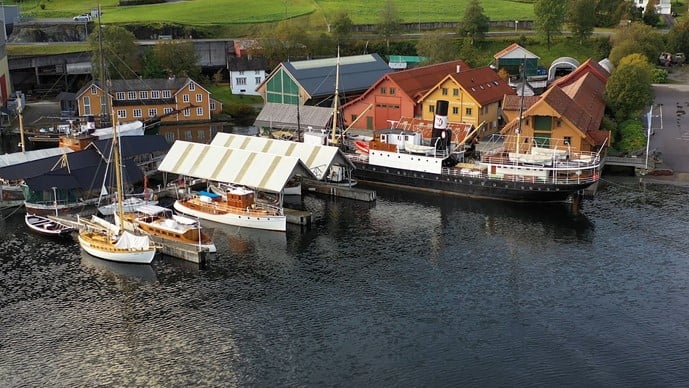
Image: Hardanger Maritime Centre website.
11. Australian Maritime Security
Two matters to keep front of mind. Australia has an immense coastline and has the 3rd largest Exclusive Economic Zone (EEZ) in the world. We have 8222 islands and 40% of Antarctica. Our national security is inextricably entwined with the ocean. The oceans surrounding us are indeed vast physical barriers but also, as the media reports with increasing regularity, oceans are highly contested areas of national concern. The Australian Institute of International Affairs recently convened an Australian Maritime Security Forum which unpacked issues including areas of focus, foreign policy, maritime regions, implications of our security allyship with the US, and our largest trading partner, China, now often engaging in strategic maritime competition in our region. International norms and laws in these waters are coming under increasing pressure. The major question being, how should Australia navigate these turbulent waters and safeguard its maritime security amidst evolving regional and global pressures? Established in New South Wales in 1924 and in Victoria in 1925 as branches of London’s Royal Institute of International Affairs, the Australian Institute of International Affairs (AIIA) is an independent, non-partisan, non-profit organisation devoted to the promotion and discussion of international affairs and global issues (often under the Chatham House Rule).
See: https://aiiavic.glueup.com

12. AUKUS Recent Summary
Professor John Blaxland of the Strategic & Defence Studies Centre, Australian National University, writes in The Conversation on the 15th of September:
“Three years have passed since the United States, Australia and United Kingdom announced on September 15 2021 that they would enter into a security partnership called AUKUS. A major part of the deal involved the US and UK helping Australia acquire nuclear-propulsion submarines. This decision by the Morrison government controversially entailed backing out of a A$90 billion deal with a French company to purchase 12 submarines. In recent months, the AUKUS deal has generated a fair amount of criticism from former Prime Ministers Paul Keating and Malcolm Turnbull, former Foreign Minister Gareth Evans, and some in the media. Critics have focused on five main arguments about AUKUS:
- The pact enhances the prospects of war with China
- Australia doesn’t need nuclear-propulsion submarines
- The deal makes our neighbours in South-East Asia uneasy
- The pact drags us back to our Anglosphere past, tying us closely to the US and UK
- The forecast cost of the submarines (between A$268 and $368 billion) is unconscionably high.”
Professor Blaxland argues that these 5 claims are all based on assertions that miss the point. MMHN suggests that you take a look for yourself.
See: https://theconversation.com/australia-cant-afford-an-aukus-about-face
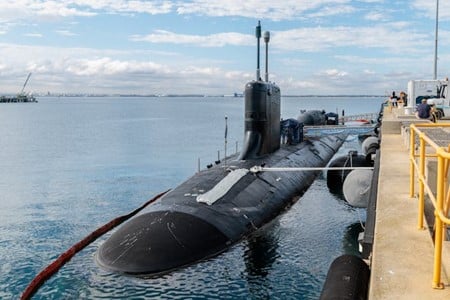
Image: A Virginia-class nuclear-powered attack submarine at HMAS Stirling Naval Base in Western Australia in August 2023. Source: The Conversation, Richard Wainwright/AAP.
13. Station Pier: Progress?
MMHN Member, Mark Sims, alerted MMHN to the following recent Facebook announcement about Station Pier. Regrettably, there is no new news. However, it does point out that the State government simply must address the long-standing, appalling reputational risk and, of course, the economic waste that this heritage-listed maritime infrastructure constitutes.
MMHN poses the question: Is this announcement convincing at all? Is it cause for optimism?
“We are planning for Station Pier’s future: to preserve the pier’s heritage, while meeting the growing demands of the cruise shipping industry. $70 million has been dedicated to maintenance and upgrades over the next four years, so for safety and security, access to the pier is paused whilst works are being undertaken. The Victorian Cruise Shipping Strategy work has commenced, and will confirm the future needs of the pier for cruise shipping. This work is consultative, and we will engage with key local stakeholders such as to consider new opportunities for the pier and its surrounds, including greater community use.” – Melissa Horne MP.
You may wish to look at the MMHN Stated Objective No.7: Re-Imagining Station Pier, which can be accessed here.
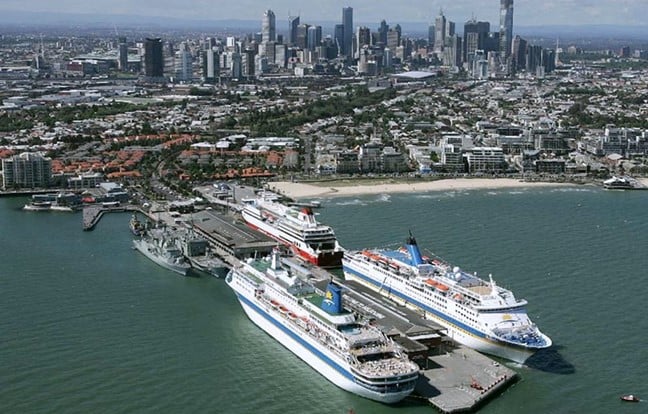
Image: MMHN website
14. Rotterdam Harbour – FENIX Migration Museum
By way of comparison, MMHN invites you to consider the inspirational repurposing project underway in the Port City of Rotterdam, which is obviously savvy and serious about optimising the economic potential of its now redundant port infrastructure.
“FENIX, a major new museum inspired by stories of global migration, will open on a landmark site in Rotterdam’s City Harbour in 2025. The 16,000 sqm building, dating from 1923, was once part of the largest warehouse in the world. Located on the south bank of the River Maas in Rotterdam’s historic port district, the warehouse served as an important building for storage and shipping for the Holland-America Line, a Dutch cargo and passenger line. The Holland-America Line facilitated the journeys of millions of migrants in the 19th and 20th centuries who arrived and departed from the surrounding docks”. Parallels may be drawn between the vast, empty, cavernous spaces of Station Pier – the Ellis Island of Victoria – and the vision coming to life in Rotterdam.
See: https://fenix.nl/en/fenix-warehouse/
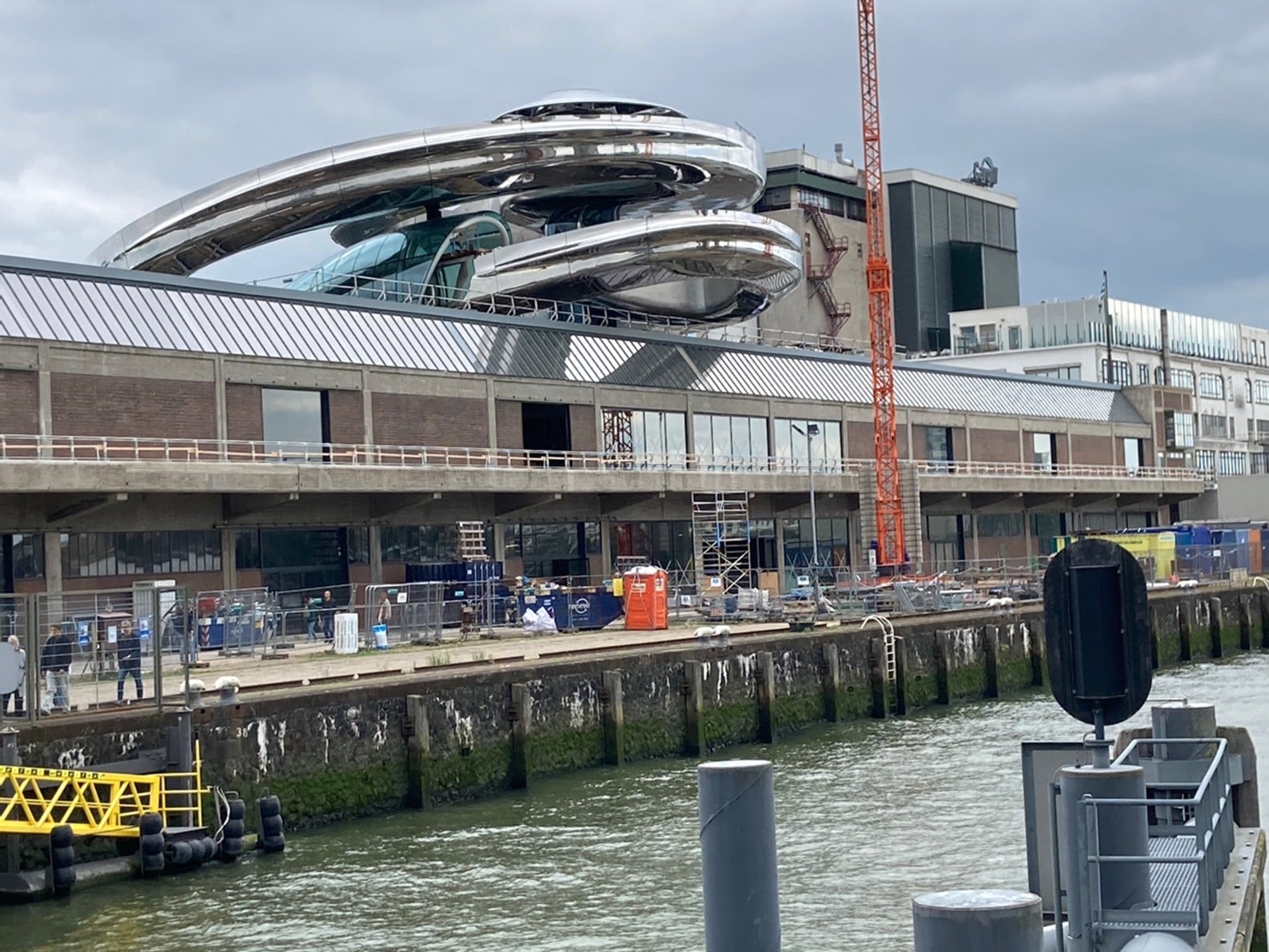
Image: Jackie Watts
15. Patrick Terminals Melbourne
We are delighted to announce that Patrick Terminals (Melbourne) are now a new MMHN Corporate Sponsorship Partner. Support such as this sustains MMHN in our efforts to gain due recognition that the maritime industry has been, and will continue to be, crucial to the future of our island nation – past present and future.
The present: Based on the independent assessment of the Australian Bureau of Infrastructure, Transport and Regional Economics (BITRE), Patrick Terminals (Melbourne) is the best-performing terminal in the Port of Melbourne. The latest BITRE report confirms that Patrick outperforms its competitors by more than ten berth moves per hour.
The past: Patrick Terminals can trace its origins back to 1919, when Capt. James Patrick, together with Mr F.W. Radford, established Patrick Steamship Co. Ltd and commenced shipping operations with the SS Timaru out of Sydney along the east coast of Australia. By 1925, it was operating as both a shipping line a stevedore, gradually expanding interstate.

Until next time,
Jackie
Dr Jackie Watts OAM
Chair,
Melbourne Maritime Heritage Network