

Greetings all
MMHN is commencing the MMHN Update this month on a sober note. The plight of seafarers continues to shame those of us who thrive in port cities around the world very much dependent on maritime trade. As you will see, the Update concludes on a more optimistic note with two invitations!
Contents
1. Seafarer Abandonment 2024 – appalling
2. Floating Piers / Pontoons
3. Seaward: Chasing Master Mariners in the Golden Age of Sail
4. Waters are warming; Coral Sea temperature at 400-year high
5. RAN Amphibious Craft and its WADER?
6. Development Victoria Missing in Action – Central Pier Waterfront Place Principles and Vision Strategy
7. Asian Maritime Transparency Initiative (AMTI)
8. Australian National Maritime Museum (ANMM)
9. Clipper Stad Amsterdam
10. Futures of Seafood: Ocean Estate User Survey
11. Heard and McDonald Islands
12. Maritime Skills OSSA Advocacy: Position Paper
13. Maritime Workforce Deficits – New Book
14. Gas Exploration: Commonwealth Waters to the South
15. Station Pier: US Naval vessel far from cutting-edge but oh so essential!
16. Sad Ship Story
17. Queensland Maritime Museum
18. Steam Tug, Forceful: What a perfect name for a tug
19. AMSA – National Compliance Plan
20. ‘All at Sea’ and possibly ‘Out of Our Depth’
21. HMAS Great Britain and Trollope – Melbourne’s first PoP culture celebrity visitor
22. World Ship Society
23. Couta Boats: Iconic wooden Australian gaff rig fishing boats
24. Invitation 1: Birrarung Riverfest
25. Invitation 2: MMHN AGM 2024
1. Seafarer Abandonment 2024 – appalling
The extent of hardship, not only inflicted on seafarers themselves but on their dependent families deprived of income in their home countries, is truly appalling. MMHN is grateful to Australian Mariners Welfare Society for this disturbing update:
2023 was the worst year ever seen for seafarer abandonment. The International Transport Forum’s (ITF) June 2024 Seafarers Report revealed that its global network of inspectors recovered $57,161,779 in unpaid wages for seafarers in 2023. The Report also confirmed record numbers of abandoned vessels (129) and abandoned seafarers (1,983). Inspectors conducted 9,530 ship inspections and handled 1,188 cases globally. Steve Trowsdale, ITF Inspectorate Coordinator, emphasized the critical role of inspectors in defending seafarers’ rights and holding exploitative shipowners accountable. The ITF has over 125 inspectors in 110 ports across 55 countries, many of whom are former seafarers or dockers. Inspectors enforce collective bargaining agreements for over 357,000 seafarers on flag of convenience vessels and are trained to identify exploitation, overwork, and signs of forced labour. They have the authority to examine wage accounts and employment contracts. Trowsdale highlighted the importance of recovering owed wages, noting that many seafarers are primary earners for their families. Under the ILO’s definition, seafarers unpaid for two months are considered abandoned, and non-payment of wages can indicate potential abandonment.
See: Fighting for rights: ITF inspectors stand strong for seafarers
2. Floating Piers / Pontoons
A reminder that MMHN has proposed the ‘solution’ to the problematic future of replacing Central Pier. Floating Piers come in many forms and suit many purposes – but not yet in Melbourne. Many of you will have noted the US Defence used a version of a floating wharf to unload in Gaza, operating as the Gaza Trident Causeway Pier. No comparisons should be drawn at all to the type of the floating pier proposed by MMHN. Off the coast of Gaza, installing such a pontoon at this location (lashed by wind, storms and tides) was described as ‘bold’. By June, the Gaza pier had been shut down three times.
The protected waters of Victoria Harbour in the Docklands Precinct propose a markedly different environment for such a pier/pontoon. A former Navy utility boat coxswain observed of the Gaza pier, “the equipment is old… and it’s all ‘Lego bricked’ together, and that platform is actually held together by line”. Interesting to note that, “the cost of the [Gaza] pier project was less than budgeted”. MMHN is aware that such pontoon constructions are remarkably inexpensive. For example, Hobart’s Brookes St Pier cost in the vicinity of $10 million. Much less than any conventional pier.
See: Gaza Military Pier
Docklands News reported on the enthusiastic response to the MMHN pier proposal, presented by the engineer/designer Jim Gandy, who shared his insights and expertise. The event, hosted at AFL House, attracted interest from many notable figures within government, including Development Victoria (DV), the City of Melbourne, and Heritage Fleet, among others. DV has responsibility over redeveloping Central Pier once the current demolition is complete in several years. Since officially opening in 2015, the Brooke Street Pier, the inspiration for the pier/pontoon proposed by MMHN, has helped transform Hobart’s waterfront.
See: Docklands News – Central Pier afloat?
3. Seaward: Chasing Master Mariners in the Golden Age of Sail
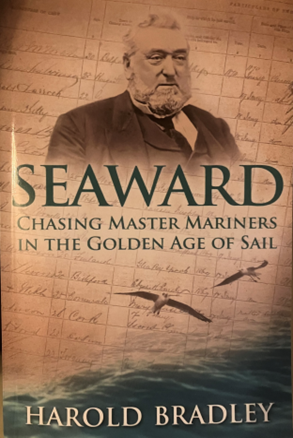
Melbourne’s maritime heritage during the Victorian gold rush years is featured in a new book, Seaward: Chasing Master Mariners in the Golden Age of Sail. The biographical and historical memoir details the lives and careers of master mariners William and John Kelly, brothers from Antrim, Northern Ireland, who sailed clipper ships from the UK to Australia, India, and the Far East. Author Harold Bradley reports that Chapters 2 and 3 deal with the clipper ships Miles Barton and Merrie England (1853-1858) on voyages to Melbourne. In 1858, the Miles Barton and the Merrie England transported over 1,000 emigrants to Victoria. The book may be accessed as a print-on-demand (POD) book with IngramSpark (an online self-publishing company) or purchase via Amazon AU, Booktopia, Fishpond, The Nile, James Bennett.
4. Waters are warming; Coral Sea temperature at 400-year high
A recent report by Dr. Benjamin Henley, Highest ocean heat in four centuries, published in the prestigious journal Nature, explains the method of calculating sea temperatures long ago. It’s a complex process but alarmingly credible.
“Researchers use this 1618–1995 reconstruction and the available 1900–2024 instrumental data to contextualize the modern trend and rank four centuries of January–March SSTAs with greater precision than was previously possible. We then assess the degree of human influence on ocean temperatures in the region.”
It involves geochemical analyses of drill core samples previously collected from the Great Barrier Reef dating back to 1618, allowing researchers to reconstruct ocean temperatures, combined with measurements taken with instruments from 1900 onwards, to create a complete record for the past 400 years! Mike Foley (Age 8/8) reports the six hottest years for sea surface temperatures on the Great Barrier Reef have all been since 2016. The Henley Report states that summer of 2024 was such an extreme reading it was literally off the chart. Marine heatwaves drove mass coral bleaching on the reef in 2016, 2017, 2020, 2022 and 2024. Seawater temperature is the most important environmental variable governing the abundance and distribution of life in our coastal seas. Reef corals, in particular, have a very narrow range of temperature tolerance which varies in relation to geography, temperature levels and duration of exposure. For example, corals at Magnetic Island in the central Great Barrier Reef can happily stand 30.5 °C for 20 days, but just 90 kilometres away at Davies Reef, the same species of corals will bleach within a day, and at Great Keppel Island in the southern Great Barrier Reef, they would be dead within a day.
See: Australian Institute of Marine Science – Sea Temperatures
See also: CBC – Great Barrier Reef waters reached 400-year highs
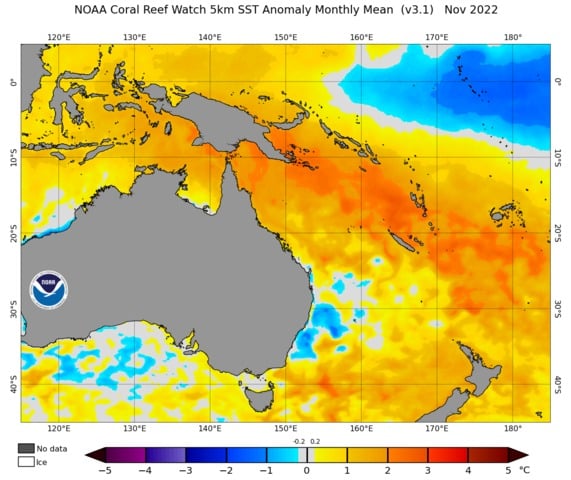
Image: Weatherzone
5. RAN Amphibious Craft and its WADER?
Nautical language always amuses – what is a WADER? The Australian Amphibious Force conducted Wet and Dry Environmental Rehearsals (WADERs) across the coast of Northern Queensland to maintain their AAF certification. Rehearsals included amphibious raids and assaults upon Cowley Beach Training Area, conducted by personnel from the HMAS Adelaide (Australian Amphibious Force HQ), as well as a beach landing force comprising of infantry, armoured vehicles, artillery, aviation and logistic elements. The WADER series will enhance the Australian Amphibious Force and the Royal Australian Navy’s joint operability and will prepare the Australian Amphibious Force for deployment later this year.
Have a look at this YouTube video: Australian Amphibious Force WADER 24
6. Development Victoria Missing in Action – Central Pier Waterfront Place Principles and Vision Strategy
This matter is of immense importance to maritime heritage in this state. Ever optimistic, MMHN looked forward to the release of this ‘Vision Strategy’ as a step towards ameliorating the protracted ugly pier demolition debacle. Not so.
Promising to “transform the heart of Docklands into a gathering place at the water’s edge where the city’s creative energy comes together in welcoming spaces”, the Central Pier Waterfront Place Principles and Vision Strategy is deeply disappointing. DV states that the “vision” reflects “feedback from community and the input from experts in tourism, heritage, place-making, sustainability and design”. MMHN took the word “Strategy” to involve action going forward? Not so.
Instead, DV has offered Docklands Community and Maritime stakeholders little more than mere description. No plans, no timelines, euphemisms, inaccuracies and a regrettable lack of detail.
See for yourself: DV – Vision for Central Pier and waterfronts
So, what did MMHN expect of such a “Vision Strategy”? Certainly, respectful accurate historical reference to the significant and unique heritage of Docklands Precinct. MMHN is pleased to note appropriate reference to Indigenous presence, which existed long before the “Blue Lake” intermittent swamp was transformed by the ambitious and successful Coode Scheme, which of course included construction of the civil engineering marvel, the Victoria Dock (later Victoria Harbour). This port infrastructure was the ‘engine room’ that drove Victoria’s prosperity. Docklands Precinct, the location of extensive wharves, stevedoring labour and a railways-based goods distribution network, enabled the transformation of Melbourne from colonial backwater to a great metropolis – the great port city that it is today. Without maritime trade, Victoria would certainly not have prospered. Central Pier was a crucial asset to Victoria Docks in our shared maritime heritage. DV does not acknowledge, and certainly underplays this reality, stating “the removal of Central Pier is a pivotal step toward its transformation as we start to consider viable opportunities for its future”. The use of the term “removal” is euphemistic. Central Pier, a heritage-listed maritime infrastructure asset, is finally being demolished after a series of earlier demolitions and decades of ineffectual maintenance and neglect by those responsible. Regrettably, such inaccuracies or misapprehensions continue in the document. “Central Pier is located on Victoria Harbour, a small and meaningful part of Melbourne that is located within the traditional lands of the Wurundjeri Woi-wurrung people and which forms a key component of Melbourne’s early maritime history”. Central Pier is, in fact, at the epicentre of Victoria Harbour which, in physical form and certainly in heritage significance, is far from “small”. Further, given the port was operational into the late 1960s, its economic importance was not limited to “Melbourne’s early maritime history”. The DV agenda appears to be to diminish or downplay what is, in fact, a unique infrastructure asset in Victoria – the Docklands Precinct and Its maritime heritage.
So, where does the DV Central Pier Waterfront Place Principles and Vision Strategy leave the many concerned stakeholders who devoted time and effort to providing DV with “input from experts in tourism, heritage, place-making, sustainability and design”? Nowhere!
Several years now into the process of Central Pier/Waterfront re-development, MMHN is dismayed to note in the DV ‘Vision Strategy’, the statement “we start to consider viable opportunities for its future”. DV may well only just “start to consider viable opportunities”, but many others in Docklands Precinct (including MMHN) have long been engaged in considering such “viable opportunities”, seriously and in great detail.
MMHN has put forward a cogent ‘Vision’—in fact, a viable solution.
See: https://mmhn.org.au/maritime-experience-centre/
In a nutshell, MMHN recognizes this an a unique opportunity for this unique location; an opportunity to celebrate all aspects of Melbourne as a maritime port city – past, present and future. Our vision is an iconic low-rise architectural and cultural ‘drawcard’ structure with shared community facilities surrounded by a promenade deck and maritime garden. This Marine Experience Centre will sit atop a floating pier/pontoon and will create permanent activation in the centre of Harbour Esplanade, with cutting-edge displays and exhibits to attract, inform and delight residents and visitors alike. MMHN wants Victoria Harbour and its maritime heritage jewel, Central Pier, to sparkle!
To conclude on a positive note; in a recent meeting with MP Colin Brookes, the Minister responsible for both Docklands Precinct and Development Victoria, MMHN received a positive response to our Docklands concerns and suggested solutions, including the proposals of the floating pier/pontoon and the Maritime Experience Centre. We live in hope, albeit impatiently!
MMHN calls on DV to produce more than a mere descriptive ‘vision’. Let’s see DV accelerate the project and act before the demolition is complete.
7. Asian Maritime Transparency Initiative (AMTI)
A fascinating – yet alarming – database comes to MMHN via the Asian Maritime Transparency Initiative.
“Five claimants occupy nearly 70 disputed reefs and islets spread across the South China Sea. They have built more than 90 outposts on these contested features, many of which have seen expansion in recent years.”
AMTI gathers satellite imagery of each outpost, along with other relevant information, and documents their current status and any changes detected in recent years. Scarborough Shoal presents an example of what is tracked by the database. An uninhabited rock west of the Philippines, the shoal has many names.
U.S. Board of Geographic Names: Scarborough Shoal
China: Huangyan Dao, 黄岩岛
Philippines: Bajo de Masinloc/Panatag Shoal
Taiwan: Huangyan Dao, 黃岩島
It is described as a contested and much monitored rock. “Scarborough Shoal is a rock in the South China Sea, approximately 120 nautical miles west of the Philippine Island of Luzon. There are no structures built on Scarborough Shoal, but the feature is effectively controlled by China, which has maintained a constant coast guard presence at the feature since 2012”.
See: https://amti.csis.org/island-tracker/
And: https://amti.csis.org/scarborough-shoal/
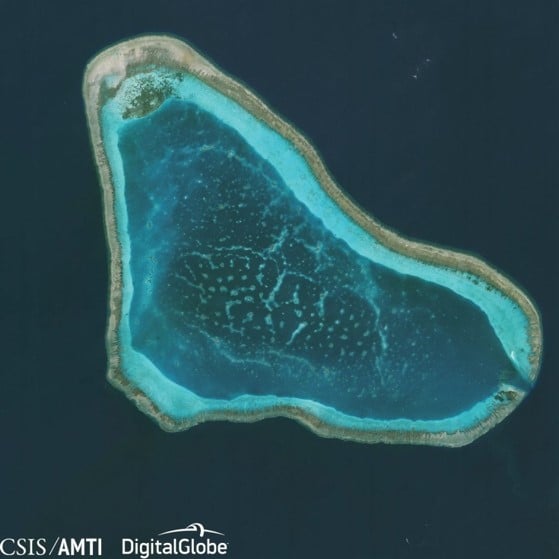
Image: AMTI
8. Australian National Maritime Museum (ANMM)
Sea sounds fun! ANMM alerts maritime enthusiasts to an opportunity to sail from Sydney to Hobart and return in late January. A highlight of the experience will be to participate in the Australian Wooden Boat Festival.
See: The Australian Wooden Boat Festival
Up to 30 paying crew member and supernumerary positions are available on each voyage, taking in the South Coast of NSW, Bass Strait and the East Coast of Tasmania. The vessel master is Mr. Anthony Longhurst, who will be supported by a professional crew. An information pack can be obtained from the ANMM website at http://www.sea.museum/sail-endeavour.
Applicants are required to confirm their physical fitness. Previous sailing experience is an advantage. Early registration of interest is recommended.
Applications close November 15, 2024.
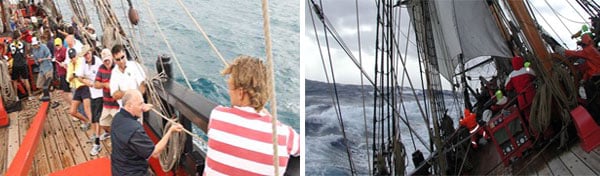
Image: ANMM
9. Clipper Stad Amsterdam
If you are tempted by this ANMM opportunity, you may wish to investigate the voyages of the Clipper Stad Amsterdam. Noting that the advertised route in Australia seems to be limited to Brisbane and Sydney, MMHN contacted this company to raise awareness of Melbourne as a destination port. Per Wikipedia, “the Stad Amsterdam (City of Amsterdam) is a three-masted clipper built in Amsterdam in 2000 at the Damen Shipyard designed by Gerard Dijkstra modelled on but not a replica of, the mid-19th frigate Amsterdam –the hull is made of steel. She is a very fast ship, with 15 knots being a normal speed. She won the 2001 Cutty Sark Tall Ships’ Race”.
See: https://www.stadamsterdam.com/en/
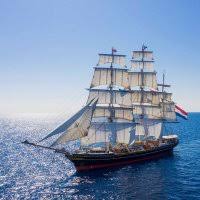
Image: Wikipedia
10. Futures of Seafood: Ocean Estate User Survey
In case the term ‘Ocean Uses Estate’ is new to you, the ‘Estate’ includes energy, Shipping and Ports, Government and Regulators, Defence and Security, Research representatives and all maritime enthusiasts. “This survey will explore the current and future uses of the ocean estate along with strategies to support sustainable and equitable access and the management of ocean resources. By identifying trends, forecasting changes, and understanding cumulative impacts, we seek to support a resilient and thriving ‘Ocean Estate’”.
MMHN agrees with the survey organisers that “participation is crucial in shaping a better understanding of Australia’s current and future blue economy”.
See: Seafood Industry Australia
Complete the survey here.

11. Heard and McDonald Islands
Heard and McDonald Islands are in the Southern Ocean, 4,000 kilometres south-west of the Australian mainland and 1,700 kilometres north of Antarctica. They exist in one of the most pristine parts of the world, are virtually untouched by human activity and are both UNESCO World Heritage sites. Currently, 17 per cent of the waters around Heard and McDonald Islands have been designated a sanctuary zone that is closed to the public. The ABC journalist, Melissa Clarke, reported (5/7) that the existing marine park, that includes the subantarctic Heard and McDonald Islands, is set for a massive expansion—an extra 300,000 square kilometres of ocean. In effect, this will quadruple the extent of the current protected area, providing a haven for penguins, seals, whales and albatross, as well as protecting important breeding and feeding grounds for sea life and bird life.
See the full article: ABC News – Antarctica Marine Park Expansion
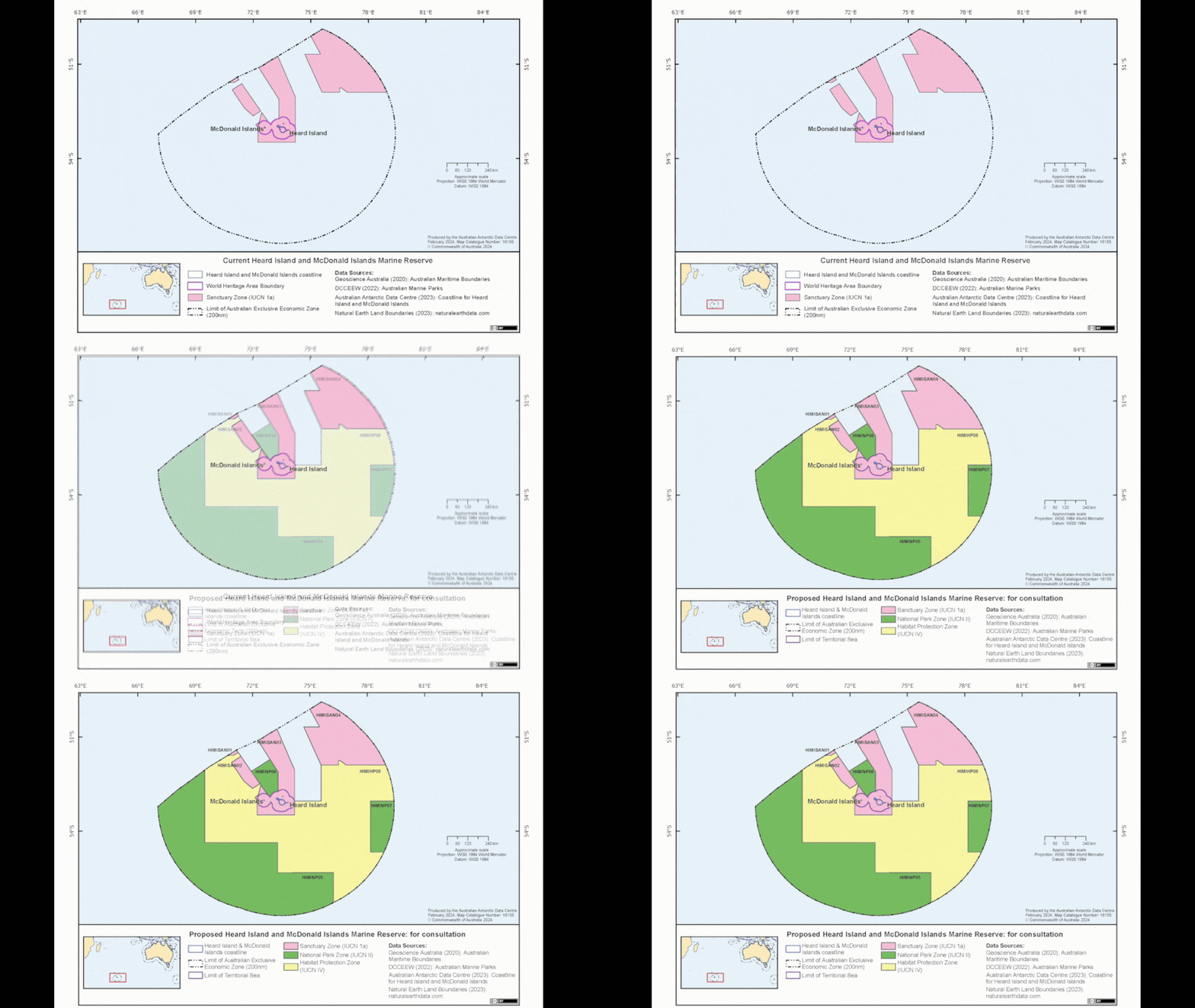
Image: These maps show the current protected zones, as well as the proposed new protected areas. Supplied: Australian Antarctic Division.
12. Maritime Skills OSSA Advocacy: Position Paper
Pleasing indeed to see actual seafaring practitioners putting forward solutions to what is a real threat to this nation. MMHN recommends this excellent OSSA paper highlighting the severe problems the Australian Maritime Industry has with shortage of seafarers, capability to train, and our national maritime resilience.
The unions (AIMPE, AMOU and MUA), together with the major workplace organisations (AREEA and MIAL), have collaborated to raise these issues and to suggest solutions, with the call for immediate action. The presentation was attended by AMSA, MIAL, RAN and OSSA, as well as Federal and State Ministers and bureaucrats.
See: AREEA – INPEX Maritime Workforce Position Paper
13. Maritime Workforce Deficits – New Book
MMHN recommends that you have a look at this interesting text, entitled Port Economics, Management and Policy. It is a comprehensive analysis of the contemporary port industry; how ports are organized to serve the global economy and support regional and local development. It examines many seaport topics, including shipping and international trade, and port terminals, governance, competition and policy.
See: https://porteconomicsmanagement.org/
14. Gas Exploration: Commonwealth Waters to the South
ABC journalist, Melissa Clarke, reported (24/7), “the federal government opens waters off the Victorian, South Australia, and Tasmanian coasts for new gas exploration possibly leading to new offshore gas wells designed to supplement the east-coast energy market”. Esso and Beach Energy are expected to take up the exploration permits for the Otway Basin, which extends from south-west South Australia to north-west Tasmania, and the adjoining Sorrell Basin to the west of King Island and Tasmania. The energy market operator and the competition watchdog have warned of energy shortages within 3-4 years if new gas supplies are not found. Environment groups warn the result will be fossil fuels consumption beyond 2050. Permits to explore waters between Victoria and Tasmania have been approved by the federal government. Australian Conservation Foundation Chief Executive, Kelly O’Shanassy, said “saying this gas is for domestic use is no excuse when more than 80 per cent of the gas extracted in Australia is exported, a portion of which could stay in Australia and be used to manage an orderly transition to clean energy”.
A reminder that despite Australia being one of the world’s largest producers of liquid natural gas (LNG), most gas extracted is contracted for export.
See: ABC News – Government Approves Gas Exploration Permits
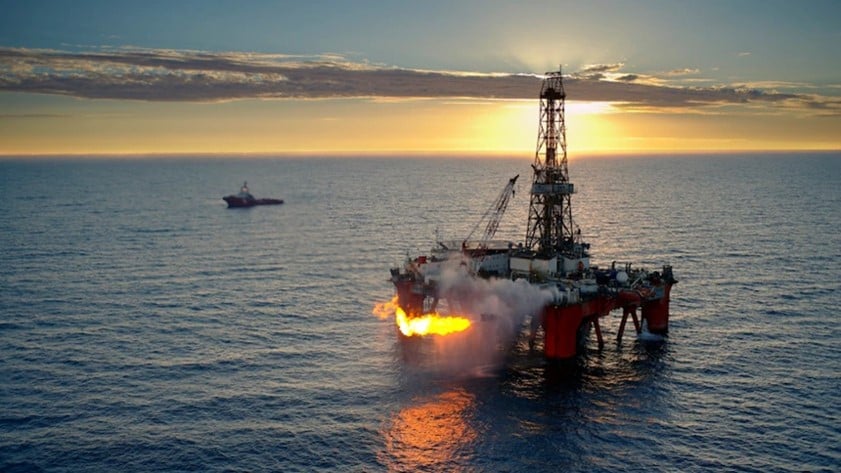
Image: ABC News
15. Station Pier: US Naval vessel far from cutting-edge but oh so essential!
Given the long and illustrious history of Navy vessels berthing at Station Pier, MMHN welcomes the US Navy submarine tender USS Emory S. Land (AS 39), berthing on outer west, Station Pier. Whilst the USS Emory S. Land is regrettably not an RAN vessel, we sincerely thank MMHN member, Janet Bolitho of Port Places, for this interesting ship-spotting and enjoyable research:
“Launched in 1977 and ‘it looks old’ because it is! Nevertheless, an impressive asset. The tender was, and continues to, enable deployed Guided Missile and Fast Attack submarines in the 5th and 7th. Fleet areas of responsibility providing food, electricity, water, consumables, spare parts, medical, dental, disbursing, mail, legal services, ordnance, and intermediate level maintenance and repairs to surface combatants and ships1.It has an integrated crew of sailors and civilian mariners under the administrative control of Commander Submarine Force, U.S. Pacific Fleet, Pearl Harbor, Hawaii, and operational control of Commander, Submarine Group 7, Yokosuka, Japan.30 Royal Australian Navy officers and sailors have spent 5 months on the tender in Guam, integrating with US sailors and building knowledge, skills, and experience in how the US conducts nuclear-powered submarine maintenance.”
Continuing, Janet writes, “on a grey, cold, windy afternoon, the Station Pier precinct was deserted. Only hardy fishermen were out. This lone ship at the deserted pier was such a contrast to the scene in Port Melbourne in August 1908”.
Janet reports that, at the time, “Port Melbourne was in a fever of anticipation for the arrival of 16 vessels of the American fleet on a goodwill mission around the world. President Roosevelt deployed the US Atlantic Fleet to the Pacific to show that the United States had arrived as a world power. Sixteen white battleships with gold trim sailed up the Bay on Saturday morning on 31 August. The Bay was smooth as glass. Prime Minister Deakin and other members of the Federal government were on board the paddle steamer Hygeia to watch the ships arrive. At 10am, 2,000 sailors of the American Navy landed at Town Pier in Port Melbourne. Crowds lined the foreshore form Port Melbourne to Brighton. Trains came from the city every five minutes. Craft were out on the Bay to meet the fleet. From Town Pier, the sailors marched into the City of Melbourne. Festivities on a grand scale took place. The US Navy came to Australia at the invitation of Prime Minister Alfred Deakin. At that time Australia was feeling isolated and vulnerable in the Indo Pacific, not confident in the protection offered by the British Navy. Deakin had initiated the invitation to US President Theodore Roosevelt, even though the move was resisted by both the British Admiralty and the Foreign Office. ‘He wished to send a clear message to Whitehall that Australians were unhappy with Britain’s apparent strategic neglect’. The visit of the Great White Fleet, as it came to be known, was the start of Australia’s defence relationship with the United States.”
“It was also the Peter Dean of the Lowy Institute describes AUKUS ‘not as collective defence treaty but rather a technology pact built off a security partnership. It is about the co-development and delivery of key technologies from nuclear submarines to enhanced innovation in key sectors such as quantum computing, AI, and cyber’. While Port Melbourne’s piers are no longer a focus of naval activity, the visit of USS Emory S. Land is a local reminder of Australia’s involvement in AUKUS and our defence relationship with the United States.”
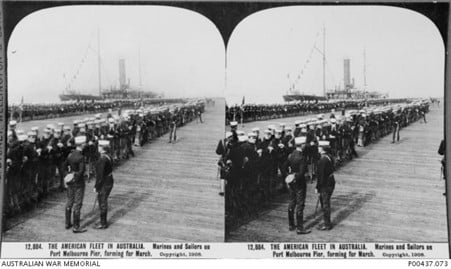
Image: AWM
16. Sad Ship Story
MMHM Board Member, Michael O’Brien, draws our attention to a lovely but poignant YouTube account of an event involving the vessel Falls of Clyde. The video, titled ‘Hawaii Plans for Removal, Likely Scrapping, of 145 Year Old Historic Sailing Ship’, describes the last surviving iron-hulled, four-masted, full-rigged ship, and the only remaining sail-driven oil tanker. She was designated a U.S. National Historic Landmark in 1989 but was deregistered in 2024 due to her condition. Hawaii is seeking proposals to scrap the ship. An awkward name, but a splendid vessel. You may wish to find out more about ‘Friends of Falls of Clyde’, so the link is provided below.
Watch on YouTube: Falls of Clyde
See: http://www.friendsoffallsofclyde.org
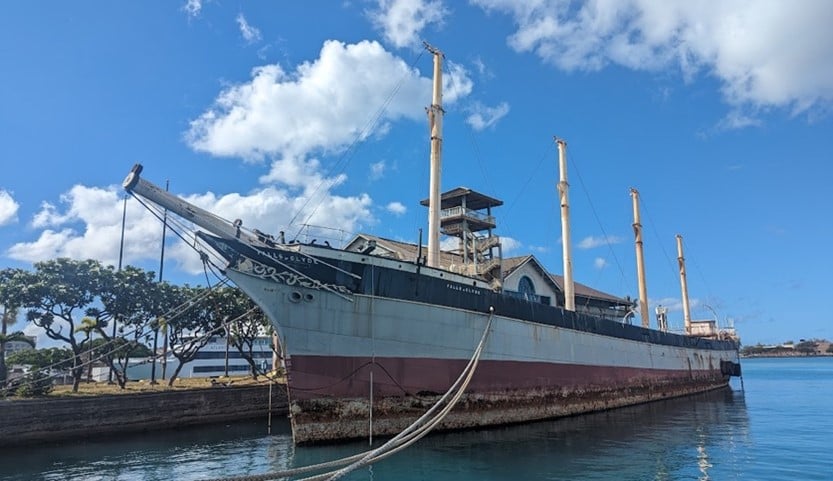
Image: Friends of the Falls of Clyde
17. Queensland Maritime Museum
Be quick or you may miss it. MMHN Chair, Jackie Watts, visited the Queensland Maritime Museum recently. Housed in a former Brisbane Expo Pavilion on the riverbank, this quite extensive collection is located adjacent to a dry dock (in which sits the famous HMAS Diamantina). Designated a ‘Queensland Icon’, the RAN River Frigate was commissioned in 1945 and remains one of the last World War II River Class frigates in the world. Designed in the UK, this River Class Frigate, was built in Australia along with seven sister ships: Barcoo, Barwon, Burdekin, Gascoyne, Hawksbury, Lachlan, and Macquarie.
Technically advanced, “the frigates were equipped with radar, high frequency direction finding and good radio communications… [including] The Type 271 surface search radar”, one of the most significant scientific and technological developments of WWII. Initially, the power requirements and bulk meant that only the largest warships could be fitted with radar. But Australian expertise kicked in!
Australian physicist Dr Mark Oliphant, then working in Britain, secured a development contract from the Admiralty. In early 1940, together with physicists John Randall and Henry Boot, Oliphant designed the cavity magnetron which became one of Britain’s most closely guarded wartime secrets. “With its cavity magnetron the Type 271 radar had range and bearing discrimination small enough to detect small objects such as surfaced submarines and, in good weather, submarine periscopes. The power requirement was reduced and the aerial smaller, making this type of radar ideal for smaller warships like Diamantina tasked with protecting convoys and anti-submarine warfare.”
Beyond the vessel itself, HMAS Diamantina is of national importance, having served in New Guinea waters late in WWII. The final surrender Japanese forces on both Nauru and Ocean Islands were signed on board.
Jackie found the dry dock sadly neglected. No surprise, given the museum receives ZERO government support. In conversations with Jackie, the team of museum volunteers shared worrisome news for all maritime enthusiasts. The site is the shared responsibility of Brisbane Council and the State Government’s South Bank 30 Year Master Plan, adopted last year. So, in effect, ten months remain on the lease of the current site. What will become of the dry dock, in which the Diamantina sits, is the question. No plans for removal have yet been discussed. Cross your fingers and stay tuned.
One final thought: If you are an MMHN member and are planning a visit to the Queensland Maritime Museum, the entry fee is waived. However, given the museum receives ZERO government funding, you may wish to help. Information on how to do so can be found here.
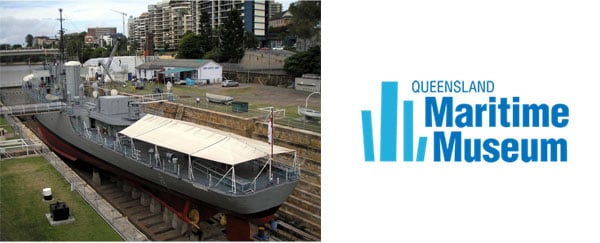
Image: Queensland Maritime Museum
18. Steam Tug, Forceful: What a perfect name for a tug
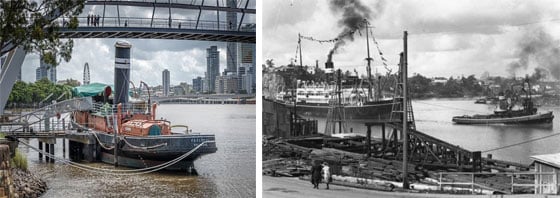
Stating the obvious, maintenance costs are always high around heritage vessels. Almost $1 Million in repairs and maintenance has been spent on this tug, aptly named Forceful. The ABC reported in February 2023 that, “Brisbane River’s heritage tugboat Forceful was destined to be dismantled, recycled as maintenance costs bite”. The Forceful, built by Alexander Stephen & Sons Ltd in Glasgow, launched in late 1925. “The vessel arrived in Brisbane in March 1926 and operated for the most part in the Brisbane River for four decades”. After several years on display below the Queensland Maritime Museum in the Brisbane River, the tug was relocated to a shipyard (hope was not lost!). Unfortunately, this move proved to be the beginning of the end, and the tug was scrapped in January 2024.
See: ABC News – Historic Tug Boat Scrapped
Images: Queensland Maritime Museum
19. AMSA – National Compliance Plan
AMSA have now released the updated National Compliance Plan, designed to give our regulated maritime industries and compliance partners insight into the compliance areas AMSA will focus its efforts on for 2024–25. To access the plan, see: http://www.amsa.gov.au/national-compliance-plan-2024-25.
By way of background, the AMSA Board is appointed by the Federal Minister for Infrastructure, Transport, Regional Development and Local Government, in this case the Hon Catherine King MP.
See: Full list of AMSA Board Members.
20. ‘All at Sea’ and possibly ‘Out of Our Depth’
Seriously amusing! At the recent fascinating lecture at Athenaeum Library, Prof. Emeritus Chris Browne, member of Rare Books Melbourne, shared gripping, and at times astonishing, tales about authors of maritime fiction. The title of the lecture, All at Sea, could not have been more accurate! Many of us were literally ‘out of our depth’ with anecdotes from 18th, 19th and 20th century authors. The audience was often astonished at the marvellous illustrations – some of which were actually by the authors themselves.
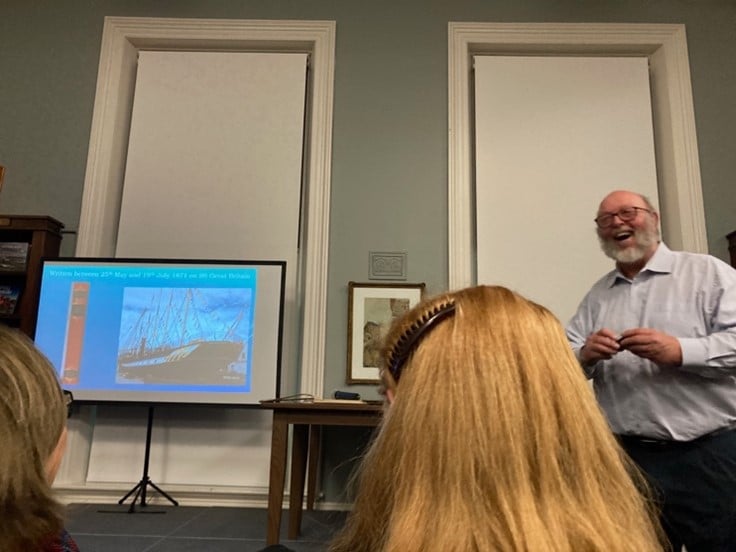
Image: Jackie Watts
21. HMAS Great Britain and Trollope – Melbourne’s first PoP culture celebrity visitor
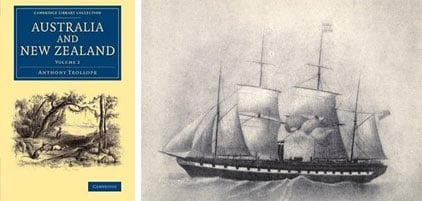
The image you see behind Chris (above) features the SS Great Britain, now a museum ship at Bristol. Formerly a steamship, the Great Britain was the larhttps://storage.mlcdn.com/account_image/382920/sPAvan26ZrGf28hXP9hbi3ydc24dq4G00vtBnTBk.jpghttps://storage.mlcdn.com/account_image/382920/sPAvan26ZrGf28hXP9hbi3ydc24dq4G00vtBnTBk.jpghttps://storage.mlcdn.com/account_image/382920/sPAvan26ZrGf28hXP9hbi3ydc24dq4G00vtBnTBk.jpghttps://storage.mlcdn.com/account_image/382920/sPAvan26ZrGf28hXP9hbi3ydc24dq4G00vtBnTBk.jpghttps://storage.mlcdn.com/account_image/382920/sPAvan26ZrGf28hXP9hbi3ydc24dq4G00vtBnTBk.jpggest passenger ship in the world from 1845 to 1853, initially designed for transatlantic service between Bristol and New York. In 1845, the vessel was the first iron steamer to cross the Atlantic Ocean in a voyage lasting fourteen days. Designed by Isambard Kingdom Brunel (1806–1859), the ship was built of iron with the innovative use of a screw propellor. In May 1871, the well-known English writer, Anthony Trollope, boarded the SS Great Britain, bound for Melbourne. Trollope was very influential in the UK, and so what Trollope had to say about Australia was widely read. And Trollope said a lot. However, despite his overwhelmingly positive words, colonial Australians were not happy.
See: Anthony Trollope
The SS Great Britain’s first voyage to Australia left Liverpool on August 21st, 1852. Over the next 25 years, it carried thousands of people from England to Australia and back and circumnavigated the world 32 times. Her “efficient steam engine to be used during unfavourable winds, which allowed the ship to run to a timetable and make the journey from Liverpool to Melbourne in about sixty days”. Trollope was possibly Melbourne’s first ‘pop culture’ visiting celebrity. A prolific, popular author of 47 novels, Trollope evidently spent a lot of time in his cabin writing Lady Anna on his voyage to Melbourne. After travelling for a year and two days touring the six Australian colonies and New Zealand, he wrote a two-volume memoir titled Australia and New Zealand (Chapman and Hall 1873). Although an overall warm and sympathetic account of his travels, the colonial press questioned the accuracy of his reporting, criticised his manners, and disparaged his facility as a writer. The 815-page Australian Section of the book twice referred to Australians as braggarts. Victoria, he said, was the worst offender and “the Melbourne blast beats all the other blowing of that proud colony”. The colonial press, which had at first welcomed (albeit cautiously) his tour, responded now in a mood of acrimony and pique.
See: The Conversation – Anthony Trollope
Also: The Trollope Society – Sixty days at sea
Images: Trollope Society
22. World Ship Society
MMHN is always delighted to receive the marvellously diverse, weird but wonderful images of vessels plying our waters—visually presenting a reminder of the continuation of maritime innovation.
See: http://www.mhav.net/wss.php
Also: World Ship Society
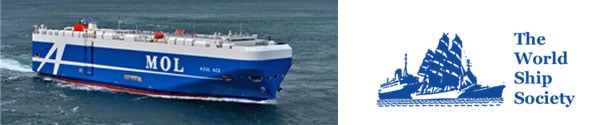
Image: Owen Fole – MOL’s Azul Ace captured departing Port Phillip Bay
23. Couta Boats: Iconic wooden Australian gaff rig fishing boats
Such a familiar name to most but a reminder of just how significant these boats are to Victorian maritime heritage. The origin of these fishing vessels lies in the southern waters of Bass Strait and the areas just outside of Port Phillip Bay in the late 1800s.
“The name is derived from the fish barracouta (Thyristies atun), a common fish found off the Victorian coastline and not to be confused with the fierce barracuda found in warmer waters. ‘Couta’ as they are called colloquially, are up to 1.2 metres long, and are caught on hooked trolling lines. A strip of rawhide was used for bait. As an abundant and inexpensive fish it was used to supply the fish and chips trade in Melbourne.”
Couta boats were designed and built locally, probably with input on arrangement, proportions and structure from fishermen and boat builders. Given that there does not seem to be any individual craft recorded that defined the characteristics, it was more likely to be a gradual process of small changes. Just two crew members were needed to man the boats, with a set of oars to use when the wind dropped. MMHN recommends you follow this in greater detail: Australian Register of Historic Vessels.
You may also wish to look at the Couta Register. Couta enthusiasts look to the past as well as the future – the history of every Couta Boat is important. Especially important is the build integrity of new boats.
Lastly, information on about Tricia O’Brien’s book on Couta boats, and a link to buy the beautiful coffee-table item, can be found here.
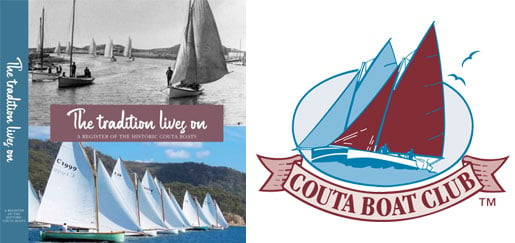
Image: Couta Boat Club
24. Invitation 1: Birrarung Riverfest
In the spirit of celebrating all of Melbourne’s extensive waterways, MMHN alerts you to a forthcoming treat – the Birrarung Riverfest – and you are all invited! Running from the 1st to the 22nd of September, see the full program here.
MMHN would like to draw your particular attention to ‘Our Birrarung: Past, Present and Future’. An afternoon of celebration and reflection with Sammy J at The Edge Theatre Fed Square, on Sunday 22nd of September.
25. Invitation 2: MMHN AGM 2024
Possibly less exciting than RiverFest (but do try to come along) and please RSVP for catering purposes.
Notice of Annual General Meeting (AGM) for FY 2023-2024
The Annual General Meeting of MMHN will be held on 9th of October at 5pm at the Royal Historical Society of Victoria (RHSV), 239 A’Beckett St, Melbourne. Attendance in person is encouraged. However, if you wish to attend the AGM via Zoom, please request this via email: info@mmhn.org.au. A Zoom link will be emailed you and will be open at 4.45 pm.
Agenda for the AGM and Presentation
1 – Welcome and apologies: confirmation of quorum
2 – Chair’s Report for FY 2023-2024 (circulated prior to the AGM meeting)
3 – Financial report for FY 2023-2024 (available at the AGM meeting)
4 – Election of MMHN Board directors:
In accordance with the Constitution, nominations for the election of Board directors are open to individual financial members of MMHN.
Nomination forms may be requested via email info@mmhn.org.au.
Completed Nominations must be emailed to info@mmhn.org.au before Thursday 26th of September.
Proxy voting may be requested via email to info@mmhn.org.au.
The names of financial members of MMHN who have nominated for election will be listed on the AGM Agenda, distributed at the AGM. In accordance with the Constitution, the following current directors will stand down and offer themselves for re-election: Martin Dixon, Jamie Gillingham and Steve Walker.
MMHN reports that one casual vacancy occurred during the year, which was filled by Kevin Keenan, who is now required to stand down and re-nominate for election.
5 – Any other business brought forward, in accordance with the Constitution
6 – General questions to the Board
2024 AGM Presentation
MMHN is delighted, once again, to collaborate with the Royal Historical Society of Victoria in inviting RHSV members to hear Dr. Jackie Watts OAM share insights into her participation in the 2024 International Congress of Maritime Museums, held in Rotterdam and Antwerp, at 6pm after the AGM.
Until next time,
Jackie
Dr Jackie Watts OAM
Chair,
Melbourne Maritime Heritage Network